Archive for the ‘Uncategorized’ Category

#week2

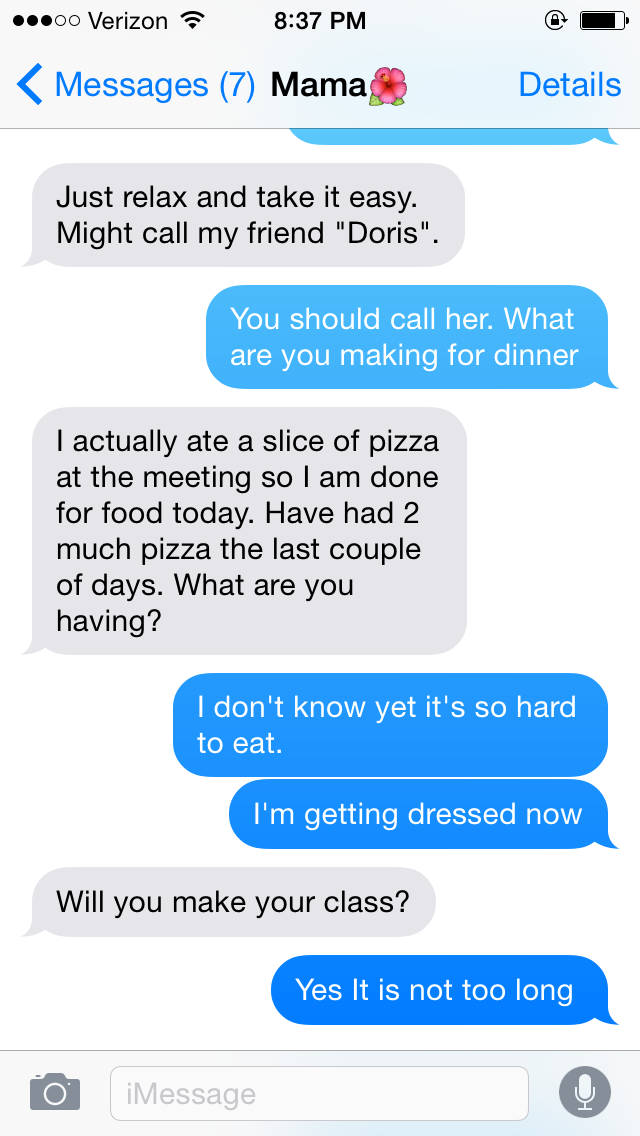
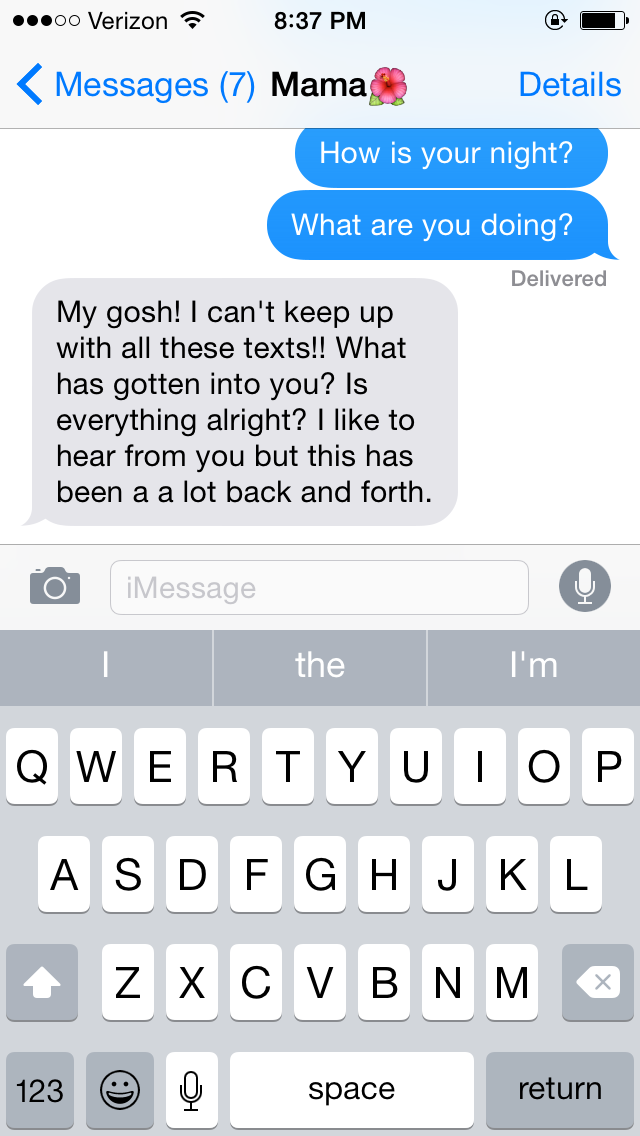
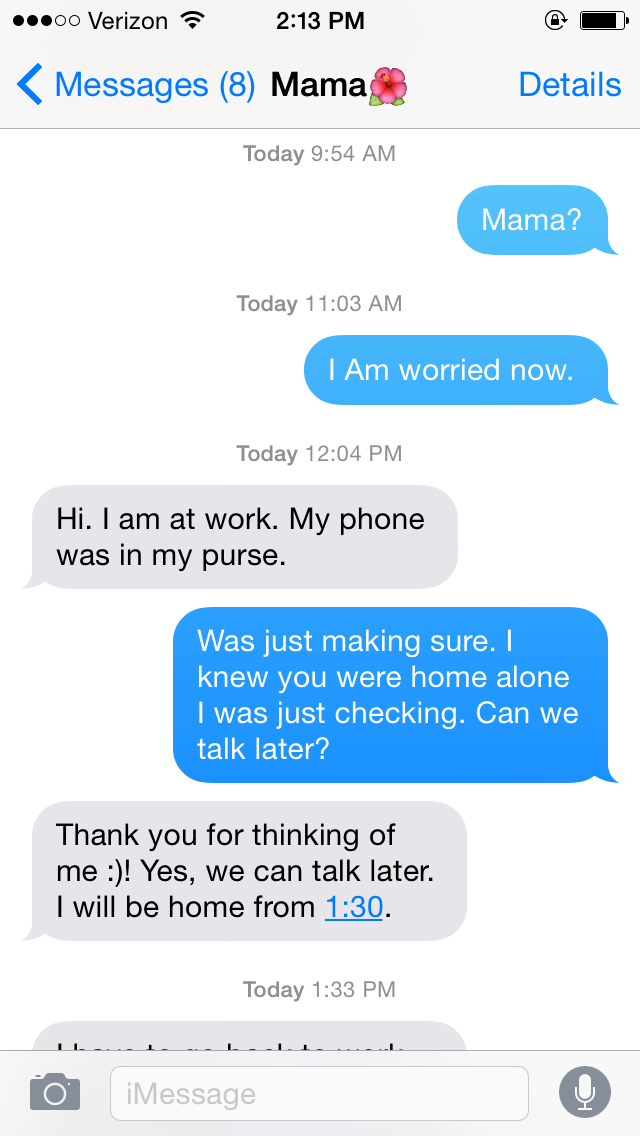
For this tech-mediated breaching assignment, I chose to experiment with a breach that was listed under one of the inspirational ideas. In this breach, I texted my mother an absurd amount of times over the course of one day until I felt like she started to get annoyed. We usually speak a couple times a day, so the amount that I ended up speaking to her grew rapidly. I wanted to try and break the social norm of texting etiquette.

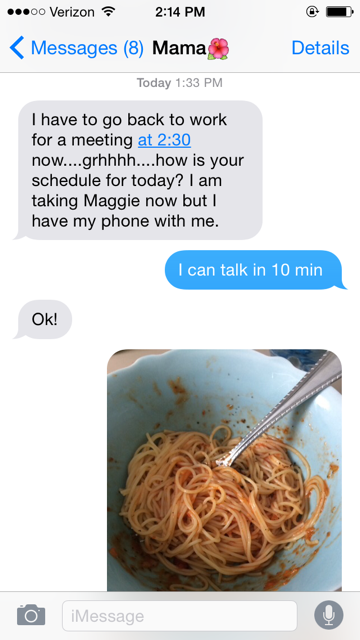
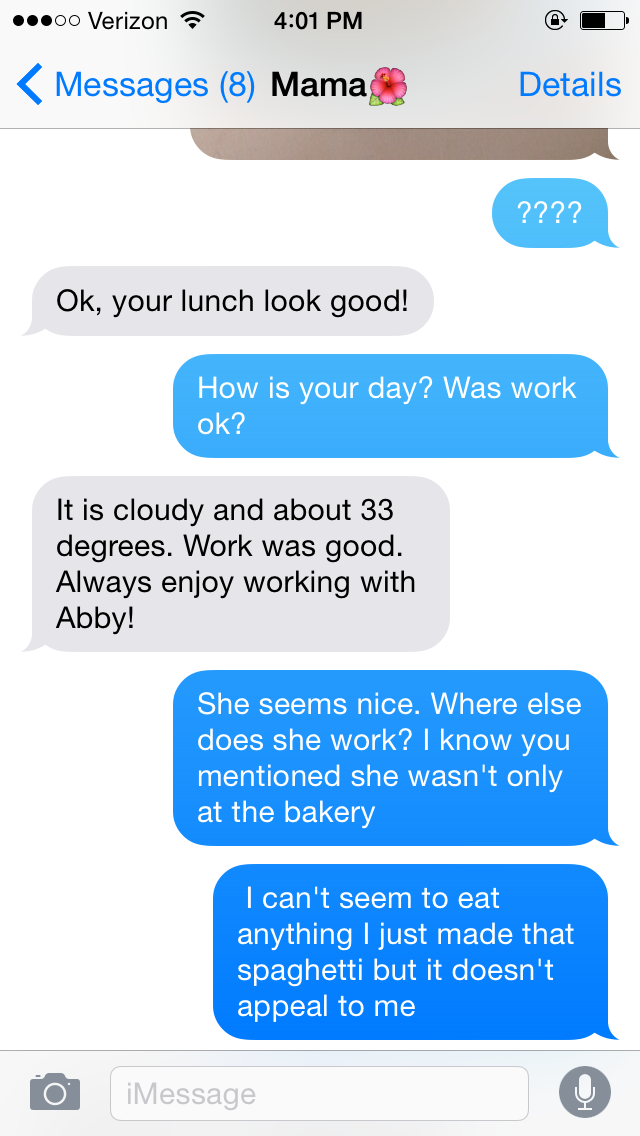
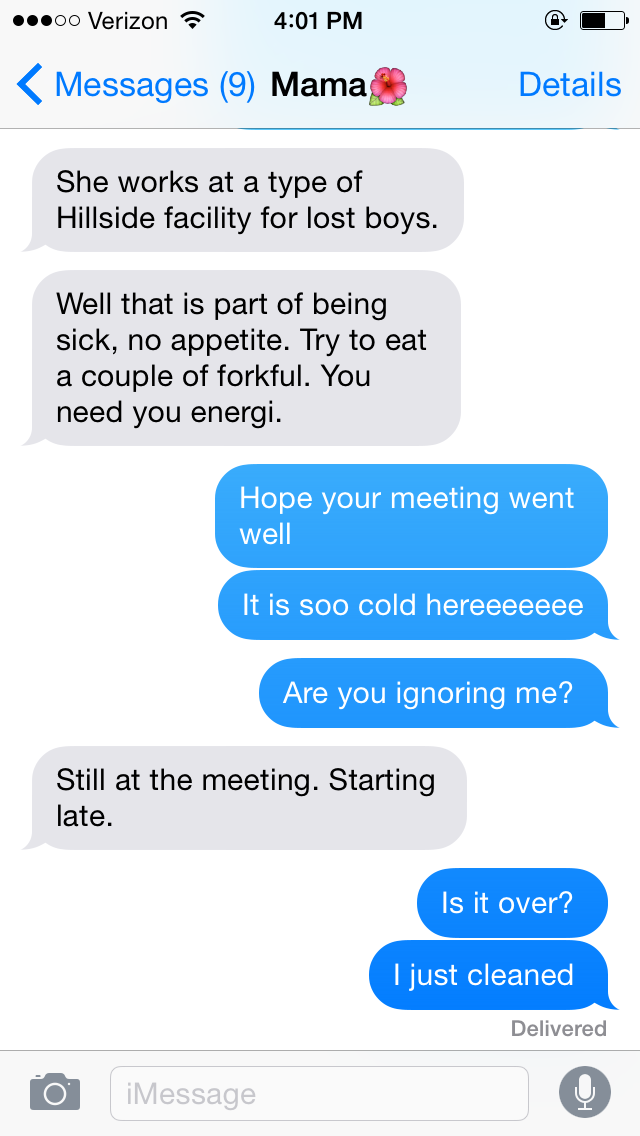
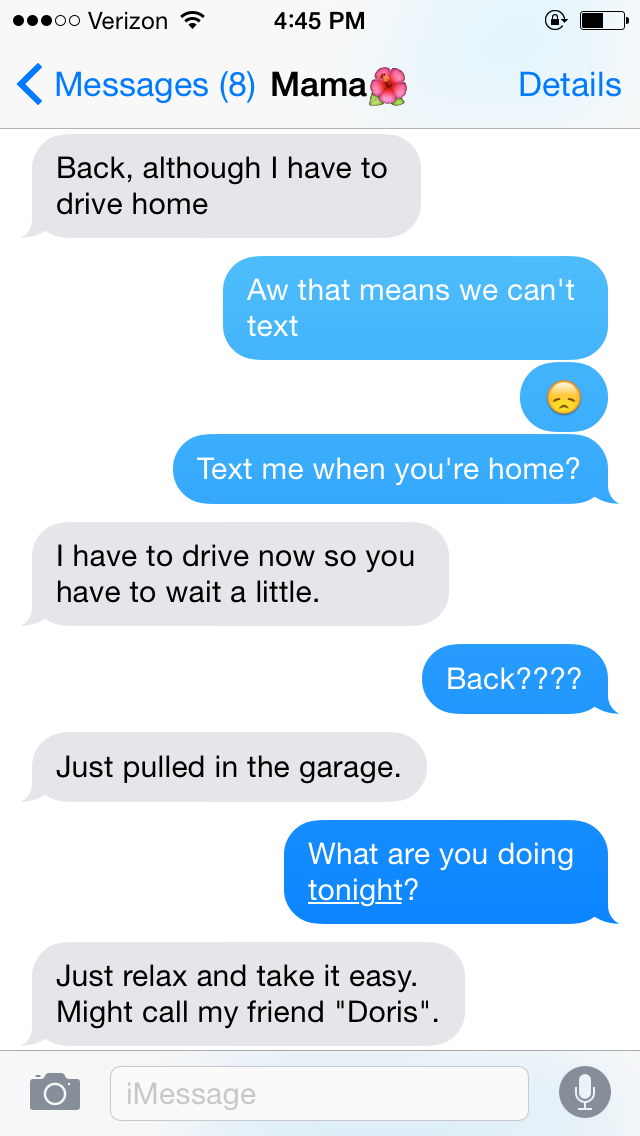
Below are screenshots of our conversation:

IMG_6602 IMG_6603 IMG_6605 IMG_6606 IMG_6607 IMG_6610 IMG_6611


The initial reactions I was getting were not quite what I expected. She answered nicely to all of my questions and did not seem to get annoyed or question my responses. It is very unlikely that I text her as much as I did this day, but she did not seem to mind. (Maybe she just enjoyed talking to me??)

Eventually, she thought something might be wrong and asked if everything was okay because she could not keep up with all of the texts. If I were to do this experiment again, I would message someone who I do not know that well, and I think the results would be drastically different because there would be more of a level of expectation.

After looking back at this breach, I do not know if I consider it to necessarily represent an artistic practice like the webcam piece done by Addie Wagenknecht does. I would like to experiment again with this assignment and see what I come up with that could be more creative.


“I got two grams for 40$!” – Social Media Breaching

TwoGramsFortyBucksSocialHack


I choose to bend the rules of the “TXT space”/Relationship between parents and children.

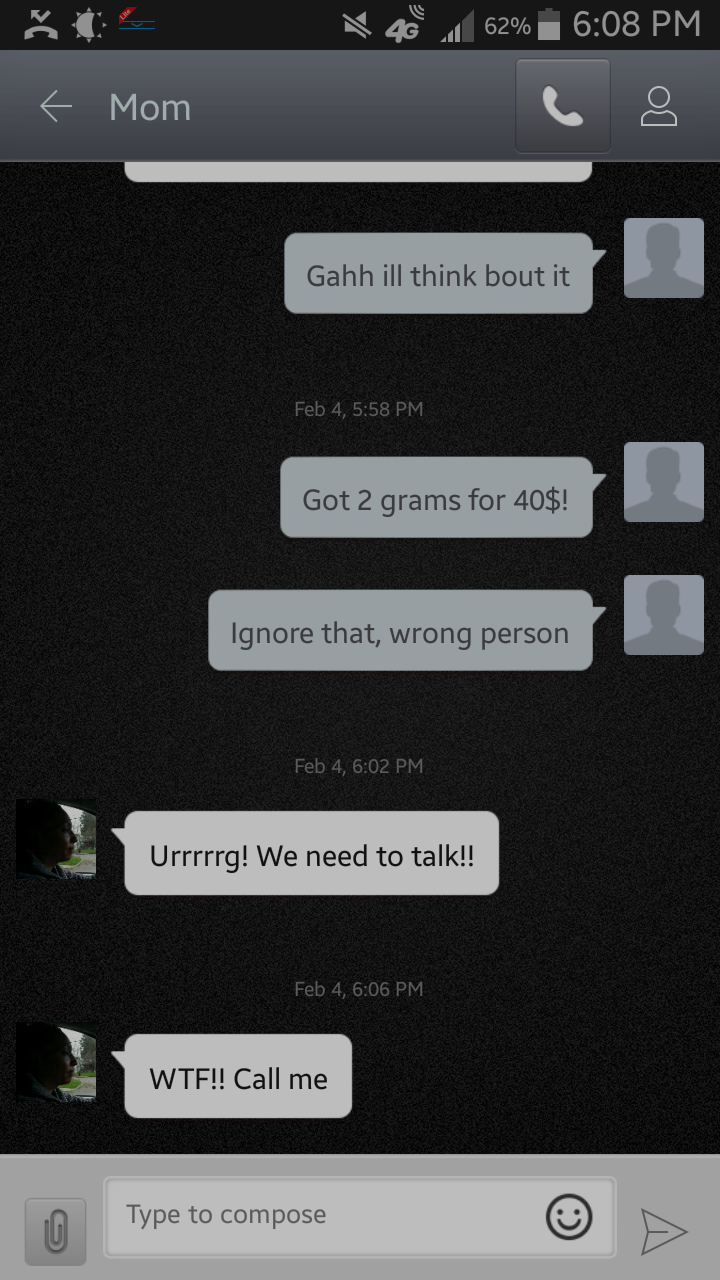
As you can see above, I sent my mother a text saying “Got 2 grams for 40$!”, then “Ignore that, wrong person”. She quickly replied with a text, and a call, which I purposely didn’t answer. She sent another text shortly after that. I waited about 15 minutes and decided to call her and tell her the truth so she didn’t order an assassination. I tried to explain what had just happened, but she was hesitant to believe. She told me she “Just about had a heart attack….Was about to come to Purchase and kick your butt!”. Obviously, she was quite upset about the whole ordeal.

I found this whole experience exiting! For some reason, I felt like I was in trouble even though I knew I was innocent, which I thought was interesting. I was eager to see how my mother would handle the whole ordeal, her performance was as expected. This experiment breached the usual relationship you might have with a parent. Most children don’t share that they have bought an illegal substance to their parents. This was interesting to say the least! I still have some adrenaline running in my system.

Social Media Breach – Predictive Text Tweets

For my social media breach this week, I initially knew that I wanted to use Twitter as my medium. It seemed like the best candidate because of the fact that, unlike other forms of social media, it allows the least amount of content to be released at a time. Facebook and Tumblr arguably allow the most, images, long blocks of text, links, embedded videos, etc. Instagram allows picture and video sharing. But Twitter is mainly used only for short bursts of text, which is limiting in itself. This limiting factor seemed intriguing to me.

Something else that intrigued me was the interaction of bots with social media. The automation and lack of control over the posts is chilling and strange, considering we expect genuineness in most social facets. But the fact that we use the invention of the internet to socialize and still find computers and automation around us influenced my breach.

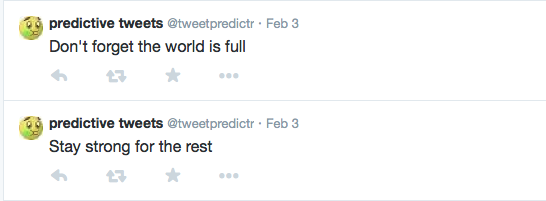
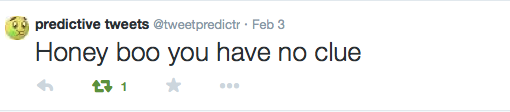
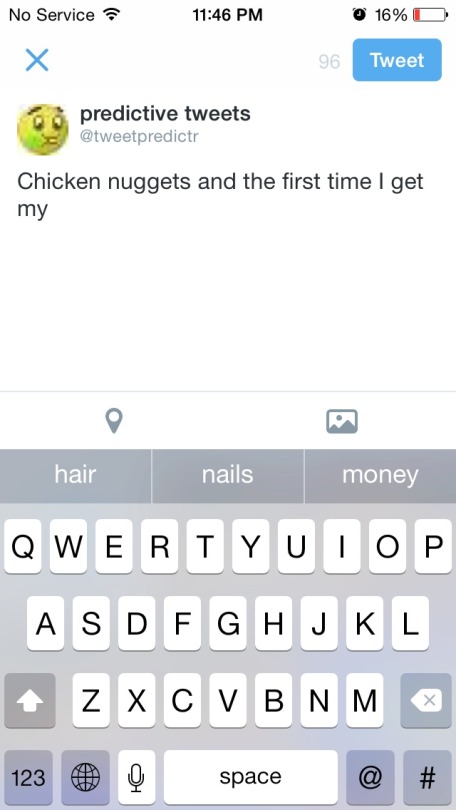
For my breach, I decided to start a twitter account and create tweets using Apple’s predictive text feature. The text based content that Twitter allows and automated content from Twitter bots were both inspirations for the account. It is not completely automated, of course. Part of my involvement in the breach is curation. Sometimes I allow the first word to be decided by the predictive text, but I also start it at times. I also curate what word is going to come next, as I am given three choices. The end product is sort of a collaboration between me and the technology; it gives me the content and I present it.

Screen Shot 2015-02-04 at 5.09.31 PM Screen Shot 2015-02-04 at 5.09.43 PM

Some of the results were poetic, while others were funny and strange. I had something to do with that, due to the fact that the word choices relied on me. But the choices that the iPhone gave me were also strange by themselves at times. I also experimented by only choosing the first or second options given to me, forming an abstract sentence only informed by it’s own doing. In this case, I am allowing the technology to speak completely, giving it a platform.


The project also reminded me of “Technorealism and the Accident of Art” from Rosa Menkman’s book The Glitch Moment(um). By transforming the use of a feature introduced to aid, art is created through accident and glitch. In forcing this process through another method, we are able to create art in this form.

tumblr_nj9pkv9IrY1qefqfjo1_540

This can be considered a breach for several reasons. Twitter is a platform for people to share their thoughts in about 120 characters or less, shared unwittingly with automated robots that tweet content. This account is a bridge between content composed by technology and the content being curated by a real person. It is also a breach of communication, weaving together nonsensical phrases and sentences because it is what the technology assumes we are going to say. It is an attempt of technology trying to predict and know us better than we do ourselves.

Screen Shot 2015-02-04 at 5.09.37 PM
This account is an ongoing project. Follow at https://twitter.com/tweetpredictr

Reference:

Menkman, R.

The glitch moment(um)

In-text: (Menkman, 2011)

Bibliography: Menkman, R. (2011). The glitch moment(um). Amsterdam: Institute of Network Cultures.

Assessment 1: Exercise 2: Over Sharing

screenshotcollage_BIG

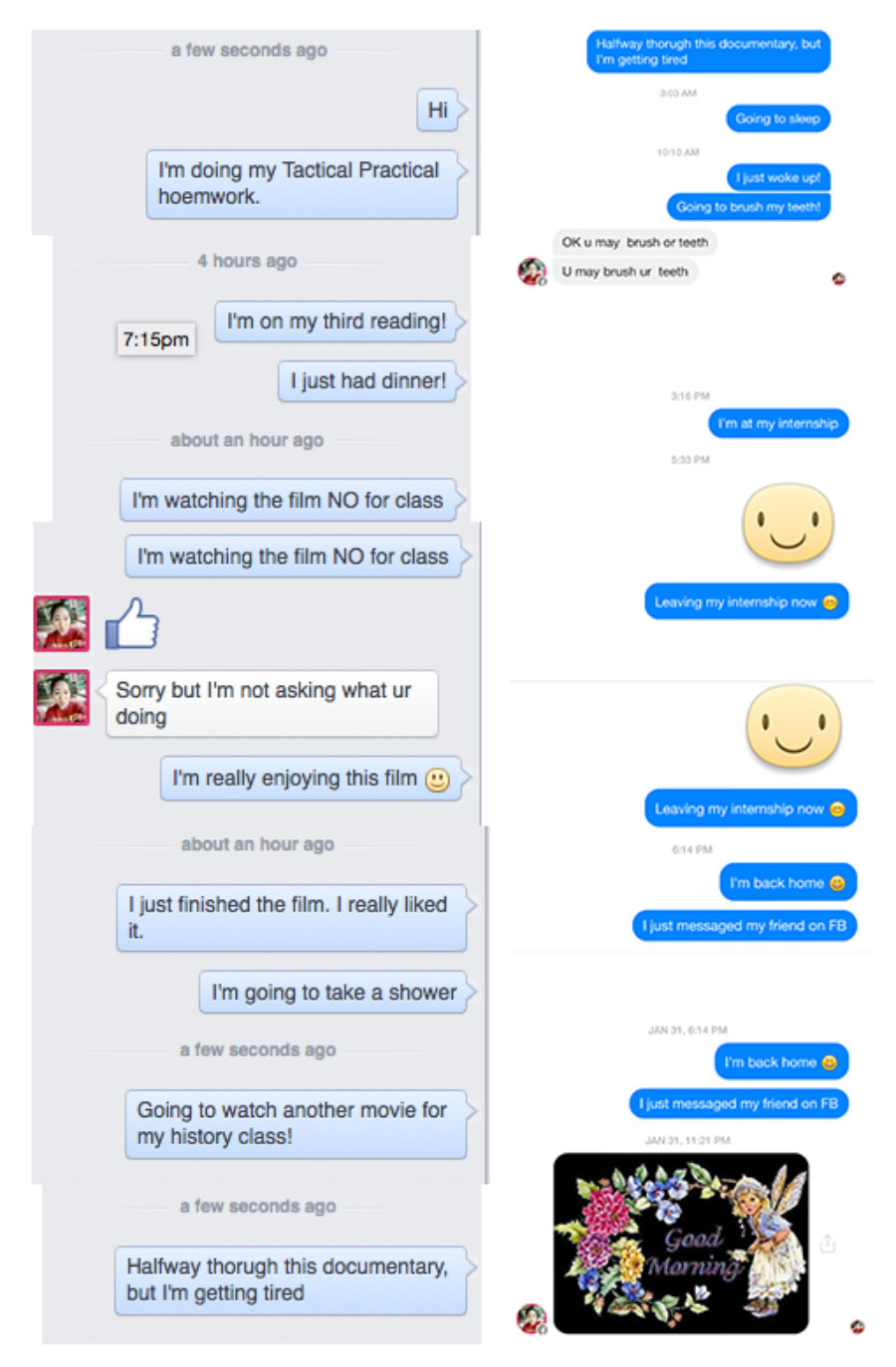
For my glitch social network experiment I decided to take on one of breaches described from socialmediacollective.org. The glitch I decided to do was the oversharer. For 24 hours I was to message someone everything I was doing. For this project to get the best results it had to be someone who I hardly knew or didn’t know at all. Luckily for me I had received a friend request on Friday from this woman from the Philippines who I had never met in my life. I then decided to message her a majority of what I did from 5pm on Friday to around 6pm on Saturday night. I let this woman know everything I was doing.
The results I got from this experiment were just a few replies. When I started to send the messages to her she initially didn’t reply to any of them. After sending five messages she then replied with a thumbs up and said, “ Sorry but I’m not asking what ur doing.” I didn’t reply to that with an answer and I continued to share with her what I was doing at that moment. She didn’t respond to me again until I told he I was brushing my teeth. She then replied by saying “Okay U may brush ur teeth.” I then let her know that I was at my internship, then leaving my internship and then said that I was back home. At that point the 24-hour period was up and I had no intention of messaging her again. Then to my surprise on Sunday morning she replied to me with a Good Morning picture.
I classify this as breaking the space in which messaging on social media is typically pertained to. People normally use the messaging system to talk and get to know someone. It’s designed to be a space for conversation online. If someone were to actually let the others know what they were doing on Facebook all day they would most likely just leave a post and maybe tag some friends if they really wanted them to see it. I used this space as if I was posting. I was taking the actions of what one normally does when sharing some information, but instead I shared almost everything I was doing in a space normally used for conversations.
This exercise has made me realize that there are certain social guidelines we follow when using parts of social networks. A social network like Facebook has many ways of using it. The messaging area of the social network is to get to know someone or keep in touch with those you already talk to on a daily basis. It’s meant for having a conversation privately and not constantly telling the other person what you are doing. I think direct messaging has a type of experience attached to whoever uses it and using it for reasons other than messaging seems weird and unwelcome.
By looking at the first chapter of Clay Shirky’s Here Comes Everybody, this exercise helped me realize how our social interactions are determined by the ways in which they work. This reading helped me comprehend the usage of our online social experiences, while also thinking about the ways in which these situations can be used in other ways.

Exercise 1 (Assignment 1)

For this experiment, I decided to go to public places and pretend to cry.  This created a stirring of reactions from people.  Some stared in concern and other walked past just trying to ignore me.  I attempted to take a video recording of it but I couldn’t capture it well, so I will do my best to describe my experience.

One example was going into a Starbucks and started to cry.  Just small tears at first but eventually escalated to covering my face and trying to not loudly sob.  Most people just looked at me, probably wondering why I was sitting crying in public.  Others would casually look the other direction.  A few people asked if I was okay, which I responded saying I was fine and not to worry about it, and we both moved on with our day.

The next place I went was a bathroom.  I started by looking in the mirror and wiping tears off my face.  I did this for a little while.  No one really approached me.  In this setting, most people did ask me if I was okay and I responded with the same thing that I was fine.  Though instead of just moving on, in the bathroom setting more people showed a lot more sympathy toward me, asking follow up questions to make sure I was really okay.  It was a pretty different experience overall.

The next one I did was not a place but I walked around campus crying to myself.  I was crying obviously enough to bring attention to myself.  Pretty much everyone looked away.  There was maybe one person (who is a friend of mine) who stopped me to ask if I was okay.  While walking outside most people are walking because they have some place to be, and because it is cold no one is really looking to stop and have a little chat with a stranger they don’t know.  It was a very different experience than the other two places I went to.

All in all this experiment for me was enlightening for me because it showed that social interactions with strangers is challenging when just approaching someone, but throwing a curve ball at them is just as challenging if not more.  It also made me more aware of my surroundings by bringing to light the struggles in social interactions that people have every day, not just during a breach.  It definitely showed that people breach social rules every day without even knowing it.

#week1

The Catcalling Experiment

Alissa and I worked together for this social breaching experiment. We decided to “catcall” males to try to make them uncomfortable after the experiences we have both had. We wanted to do a breaching experiment that focused on switching gender roles because we are both interested in studying these norms.

The work was performance based and reminds me of other performance pieces by artists who also experiment with these themes in their work.

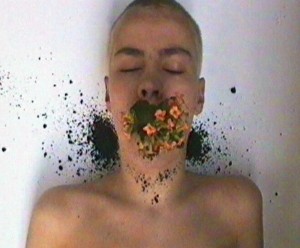
Ene-Liis Semper is an artist whom I know from seeing her video at the Museum of Fine Arts in Boston. It was titled Oasis and presents herself acting as the ground of the Earth.  In other words, the film is an aerial view of her mouth and her partner feeds soil and a flower into the opening and then plants a flower. She wanted to explore stereotypical femininity and “women’s work,” which can be explained as gardening. Her piece results in presenting an “extreme display of forced femininity.” While the work Alissa and I created was the complete switching of gender roles, I still believe that they tread the same water and are important in exploring the prevalent issues in modern day society.
ene-liis_semper_oasis1

Another artist that I respond to strongly is Marina Abramovic. I bring her up because I think vulnerability is a constant theme in her work, and I felt like the catcalling breach embodied vulnerability. Rhythm 0 is a performance based piece by Abramovic that really focuses on these particular themes. In this art work, she stands naked in a gallery space and provides a table of random objects that the audience is allowed to use on her in any way they please. The objects range from a handgun, to a rose thorn, to lipstick. The audience can touch her body, harm her body, and use her in a way that creates a truly uncomfortable experience. Below is an image and further explanation of her piece to get a better sense of her work.

http://www.whatevo.com/post/An-artists-interesting-social-experiment-DB34608A900CE7B3

The video of the catcalling experiment is below:

https://www.youtube.com/watch?v=03T9n66P9wE&feature=youtu.be

Alissa and I both felt very uncomfortable doing this exercise and it was hard to imagine that people are okay with doing this on a daily basis. We got disturbed looks from many of the men we catcalled which proved our point. However, what was interesting to us was that for one of the scenes in which we speak outwardly to a male and his friend, they later came back to sit next to us and eat their lunch. We were taken aback by this action, and after discussing it after, we decided we would not have gone to eat next to two males who were speaking out to us. It is then important to consider gender roles and how different genders act in certain situations.

What I thought was interesting was how this breach differed from the technology mediated breach. There is something very different about “breaking the rules” with no barrier, meaning a mobile device or computer. Without these objects in between the target and the instigator, it creates a very forward, vulnerable experience. The tech mediated breach didn’t require any face to face contact. There was a level of safety and comfort in being able to hide behind these machines rather than standing in the open, showing our faces and speaking to these men.

Catcalling on the streets of a city in comparison to making comments on someone’s photo online is interesting to discuss here. The two differ completely and the outcomes are different as well. Online, there is a sense of safety as mentioned before, but it also allows the one targeted to ignore what has been said, or “delete it.” On the streets, the person being targeted can still ignore, but it is much more direct and you cannot backspace the situation. It has been done and you simply cannot erase that.

A good example to bring up that relates to these ideas is the plot of the article Here Comes Everybody by Clay Shirky. The article explains a situation in which a man tries to get his friend’s phone back for her. He does this by starting a site on the Internet. He even talks to the person who stole the phone through the online platform. This is very different than going to the person’s house and confronting them face to face.

Overall, I think social breaching experiments are important to explore and I think it is healthy to break social norms and see the reactions of the public. Without these exercises, we will always be living in the confines of a society without ever breaking down the walls and seeing how we can change things for the better.

Social Breaching: Uncomfortable hair touching

Social breaching experiment focusing on conversation etiquette.

Results:

I was given the task of touching peoples hair during social interactions. This breaches the normal social etiquette that happens when two people are engaged in conversation. Most subjects became uncomfortable, fidgety, anxious, backed away, or exhibited some sort of negative physical behavior. The people I was interacting with previously knew me, I’m sure the results would be drastically exaggerated with random subjects. I didn’t engage with random people since this experiment involved touching.


Being A Parrot – Social Experiment

After generating ideas for a small experiment to challenge or bend some social norms. I decided to somewhat play around the concept of reputation. How can I apply it in a way that would cause someone to feel a bit insecure or maybe annoyed over something that doesn’t occur on a daily basis for someone? I like to call this little experiment: “Being A Parrot.” Like most parrots, they tend to repeat whatever an individual has said before. They would mimic someone’s voice in real-time or repeating a word or phrase from a previous conversation. Like recalling a memory.

For this experiment, I was meant to have one friendly conversation with one friend, to illustrate an owner and his or her pet parrot. But, minutes later a bunch of my other friends came along, forming a circle, and joining the conversation. I was contemplating whether a large group of people would improve or hurt my experiment. So I just went along with the ride.

[soundcloud url=”https://api.soundcloud.com/tracks/188400568″ params=”color=ff5500&auto_play=false&hide_related=false&show_comments=true&show_user=true&show_reposts=false” width=”100%” height=”166″ iframe=”true” /]

According to the short audio piece, this was the best result I’ve gotten from the experiment. It recorded a glimpse or a simple picture of how this “Parrot” experiment went. The piece sounded like a normal conversation among friends; the subject was mainly about websites and how some of my friends designed their sites for a class, but, when I butted in like a parrot it changed the flow of the conversation. I started repeating whatever last word or phrases some of my friends were saying. At the back of the mind, it felt more of a game than an organized experiment. But, at the middle of the piece, I captured a good snippet of how the outcome of the experiment had turned out. When one friend was trying to “unify his website,” I repeated the word “unify.” There was a pause and a couple of giggles that seemed to throw off my friend. While the rest of us found it funny, my friend who was talking about his website, didn’t find it funny at all. That’s why he responded, “Oh come on!” causing him to lose his train of thought for a minute before continuing his story.

Overall, I would have liked to make this experiment more uniformed and organized. Besides having multiple amount of people talking constantly without any breaks, it would have gone smoothly. I would have liked to record a video to illustrate a better sense of the experiment, but, it would have ended too soon over how some of my friends might have found out they were being recorded. So I ended up, tucking my phone inside my jacket’s pocket the whole time while recording. Well, most of them didn’t notice.


Conversation Glitch

For my social glitch exercise I decided to focus on conversations. So I used the conversations I had with my family, and took different parts of the conversations extremely literal.
For example, during the week I had a conversation about the ‘Naked Juice’ brand with my brother, and I said the reason why this brand was so expensive was that they needed the extra money to ‘get clothes’. Fulfilling the objective of this project was quite challenging because I had to carefully analyze each thing a family member said to me and pick and choose which part of the sentence to breach.

Of course I intended to make a video documenting this experience, because it was really enjoyable to do, but unfortunately my family doesn’t like to be filmed.
So I turned one of the events into a comic!
comic2

Social Breach – New Identity

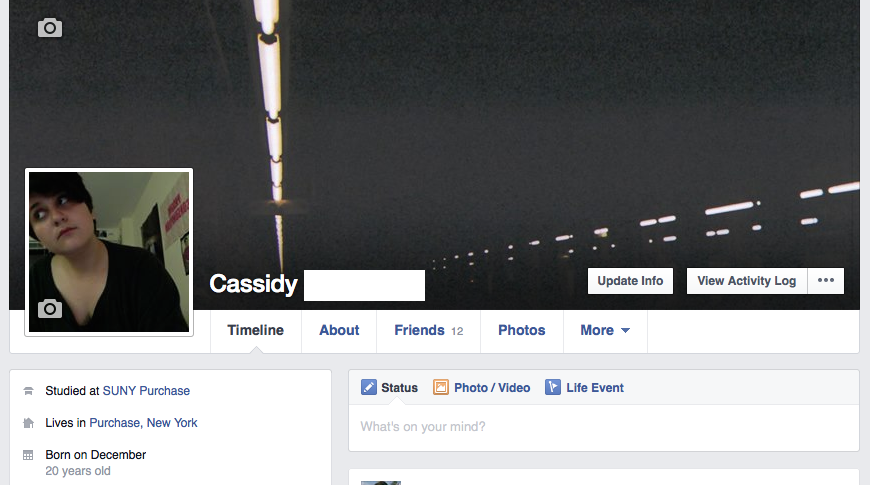
For my breaching experiment, I decided to make a Facebook profile of my roommate, Cassidy. I wanted to see how an unsolicited duplicate of someone’s person on the internet would affect our reactions outside the internet. This profile would offer as the catalyst for social interactions in person that I will discuss later.

I used some pictures they took on my computer when they didn’t have one of their own (including the profile picture). They were at work, so I figured this would be the best time to implement this experiment.

Screen Shot 2015-01-27 at 3.37.40 PM

First, after adding basic information like birthday and school, I started to add several of our closest friends. A few of them added the profile without any problems, possibly because of the status I made saying that they had remade the profile, which is a common occurrence among our friends. With the accessibility of starting new on social media, it seemed to come without surprise.

Screen Shot 2015-01-27 at 4.01.20 PM

After about 10 minutes or so of editing and curating, there started to be some push back. One of our closest friends named Rachel, posted on the profile’s wall, simply with an angry emoticon face. Another friend of ours asked who it really was. I answered as best I could, reiterating that I was indeed my roommate.

About 30 minutes into it, it seemed the charade was up once my actual roommate friended the profile and started commenting on the profile picture I had uploaded. Finally, my roommate returned from work, telling me how confused they were and slightly upset. The main reason was the fact that the profile had feminine pronouns, and my roommate identifies as gender neutral. This was a small detail I overlooked that I was trying to change on my computer.

This was possibly the main reason that they found out, as they glimpsed at my screen. “I thought so!” They exclaimed, also telling me that a couple of our friends messaged them on Facebook in confusion. The charade was up very shortly, due to how quickly we were able to communicate among our friends, and the fact that we live together.
I asked if they wanted me to delete it and Cassidy simply responded by saying “Continue using cute pictures of me. If you use shitty pictures, I’m reporting you.” It seemed that they thought it was now funny and urged me to keep using it as them, no longer creeped out or scared by it. The profile sat for a bit before the charade started to seep into the world beyond the internet.

While having dinner with friends, the profile had spread quite a bit and started to become a source of discussion among us. Why would someone want to adopt the identity of my roommate? But more importantly, who was doing this? When fingers started to be pointed, my roommate also acted like they didn’t know. That surprised me initially and I denied any involvement.

This lead to our friends turning on each other and accusing each other of making this fake profile for no real reason beyond some real joke. They warned that they would find out who it really was, pointing fingers at others still. It was interesting to see our friends start to question each other and how this small occurrence on one social realm, changed their reactions and perceptions in a different one.