Archive for the ‘Uncategorized’ Category

Project 3 – Buy My Emotion

For my final project, my initial idea was to create a Twitter bot that would search an abstract feeling in Wikimedia Commons and post the first image that came up. The intent was to give an intangible feeling some kind of unrelated tangible picture.

Since I presented that idea, my project has changed a bit. I realized early on that I did not have the programming capabilities to achieve this, so I turned to If This Then That to aid me. That’s when I thought of using posts of things for sale on platforms like Craigslist and Ebay to outline these abstract feelings, making the posts even more abstract themselves.

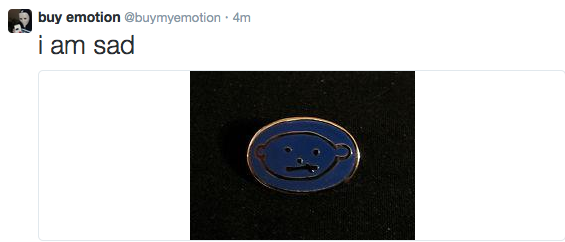
At first, I used IFTTT to create a trigger on Craigslist to tweet a photo when there was a post that said “Sad/Angry/Happy” etc. The post URL and any indication that the photo came from Craigslist was erased and replaced with only a cryptic tweet saying “I feel ___” corresponding with the feeling that triggered it.

This proved to be difficult, as most of the posts on Craigslist that were triggering the tweets did not have photos. I decided to use Ebay instead since posts on Ebay always have photos and appear more often.

Screen Shot 2015-04-24 at 1.13.33 PM

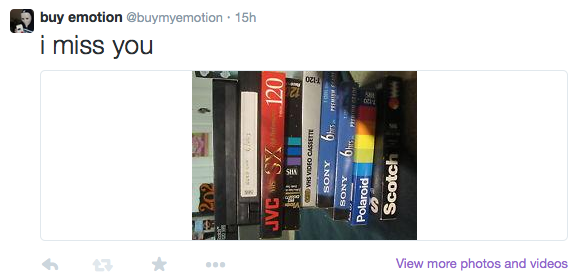
As for the triggering words themselves, I used obvious words in some cases like “anxiety” but for other feelings, I searched specific objects. Some examples are “recorded video tapes” for nostalgia, “crystal ball” for feeling lost (as they are stereotypically used to look into the future), and “donate” for needing help.

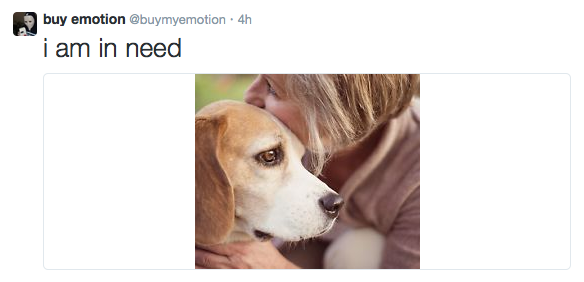
Screen Shot 2015-04-27 at 1.32.20 PM Screen Shot 2015-04-27 at 1.33.25 PM

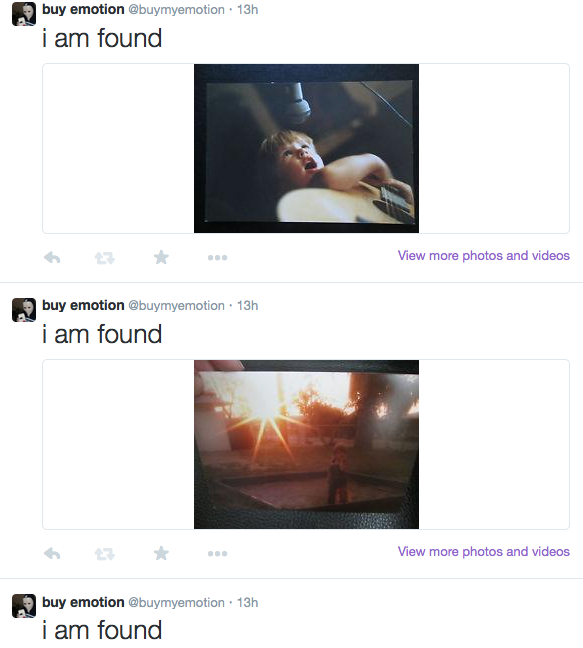
Some words like “found” were deactivated for a bit because they overtook the feed, as it was the most posted thing on Ebay. I want to continue experimenting with search terms and what the bot posts. The bot can be found here: https://twitter.com/buymyemotion

Screen Shot 2015-04-27 at 1.36.20 PM Screen Shot 2015-04-27 at 1.32.58 PM

notiCRY

At the rise of the information age, the Internet and digital devices have been praised for their ability to easily connect us to others.  They have also been criticized for their role in disconnecting users from the “real” world and trapping them in the virtual.  This argument however is no longer a significant; we have began to simply accept technology as a fact of every day life.  Users spend most of their day connected in some way to a larger network.

The questions are evolving into what ways we can use technology to help us physically, emotionally, and financially.  As our needs have grown with technology we no longer need to simply connect; we need to customize.  This reins especially true for our social networks.  Social media, once praised for helping to connect people, is starting to become accused of only increasing the feeling of “being alone in a crowded room”.

notiCRY is a social prosthetic and speculative design piece that uses moister sensors to know when a user is crying, and then notifies a chosen contact that their friend/family member is in distress, prompting them to provide emotional support.  At first glance, the piece offers a solution to a distinct problem;  the inability or fear of asking for emotional support.  When first coming up with the idea for the piece, we thought of how many times we have wanted to reach out for help but our fears of sounding needy or vulnerable held us back.  As you think deeper however, users will hopefully question how far they want their devices involved in their personal lives.

The device was coded using the Python scripting language meant to interact with an Arduino board.  Firmatta, a protocol used by the computer, is called to communicate with the Arduino. In addition, the python library BreakfastSerial was installed to to make the Arduino more adaptable to communicate with the API library Twilio.  Twilio is what enables the Arduino to send an SMS to a mobile phone, therefore allowing for direct notification when the user is in distress.

Technology is becoming increasingly involved in our biology.  There are applications and devices available to track your diet and health.  Fitbit is a bracelet designed to motivate users health by monitoring their exercise, daily activity, sleep, weight, etc.  If our devices can help us socially and physically, could they help us emotionally?  Most importantly, should they?  notiCRY addresses these issues of privacy by proposing that the choice to reach out could be taken away.  If you are wearing the device and it is activated, you do not have a choice of whether or not it will contact someone for you.  You do have to choose to be physically wearing the device, but what if you didn’t?  What if software like this was simply a fact of owning an iPhone?  We need to question just how comfortable users are with integration of devices and bodily functions now, or we won’t have any more choices as consumers.

In “The Epic Struggle of the Internet of Things” Bruce Sterling talks about this threat to consumers more in depth.  Sterling argues that we no longer actually hold importance as consumers, because our choices are being taken away and we are no longer required to buy something to be contributing to corporate profit and greed.  This is important because it solidifies the idea that our personal information is now a form of currency.  Your information is just as valuable as your bank account, and needs to be guarded and considered just the same.

Other projects that have touched on the same themes as notiCRY are Miranda July’s piece “Somebody”.  Somebody is a mobile application that allows users to pick a stranger to send a message a message to someone face to face.  Just like notiCRY, but with different intentions, we see this idea of filtering through social networks and the need for customized intimacy.

Lauren McCarthy also works a lot in the realm of speculative design, especially with her application, PplKpr.  PplKpr plays on social medias aim to connect others but also emphasizes the need to disconnect with some.  Connected to a bracelet, or alternately a manual rating system through the app, the application rates your social interactions and let’s the user know whether certain people in their lives should be “unfriended”.  In both of these instances we see a growing need to consider what is right for us as individual device users, but also what is needed for the network.

notiCRY is still early in development and we have future goals in mind for its progression.  Currently, notiCry needs to be connected to a computer to work, but this could change with a wireless device which would make the piece completely active for use in the physical world.

The notiCry trailer is located here.  We are also building on a second draft for the trailer that gives more insight into how and why the device can be used and some of the motives behind it.

notiCRY~ pt B submisison

noticry

I really enjoyed this project for many reasons. It is unlike anything I have studied in my career as a student or created during my life as an artist.

For this project, we initially started talking about what themes we wanted to cover. We agreed upon privacy, and something to do with gender norms. We ultimately wanted our audience to question the motives of the piece and think about what we might be saying with the choices we made. We brainstormed topics such as putting information online and why we are so willing to give up our personal information to a computer. Why are we hesitant about real people coming up to us and asking about our personal information but we freely type in these words to a machine? What dangers and precautions do we take with the different sources, whether technological or human? As a group, we were fascinated with these ideas and were hoping to explore them further in our research.

Gender issues and breaching were the topics I was more interested in for this project.  I was fascinated with the catcalling experiment from earlier in the semester and wanted to keep these themes present in whatever we created. In this sense, I think our project covers this topic by questioning who would wear our prosthetic. Do men really cry? Would this prosthetic work at all for people who have a hard time crying? By not having a clear answer to these questions, it brings the audience into our thought process and makes them ponder these issues on their own.

Our project reminded me a lot of other projects and artists we talked about during this class.

Lauren McCarthy was a huge inspiration for our group, as she created a lot of pieces that make people ask questions about social interactions. Her Happiness Hat explores the issues of how our actions change the way other people act around us. Your mood ultimately affects others and her way of speaking about this was interesting. I felt that it related to our work in the sense of it being a wearable prosthetic, but also that it had to do with mood and how we change our mood based on where we are, and who we are with.

McCarthy’s piece titled Crowdpilot also treads on the same water as ours in the sense that she’s giving the control to someone other than herself, or the user whoever that might be. For example, in our scenario, putting the hat and glasses on sends a message to a friend in your contact list on your phone. What happens next then depends on the actions of the friend, but the user is still giving that power to someone else. McCarthy’s piece is similar in that she is asking the Internet for her next ‘move’ whether she is on a date, with family, or in any awkward social situation. She is relying on someone else to help her with the situation at hand.

Kelly Dobson’s Scream Body has a similar aesthetic of the wearable. Both deal with this concept of “hiding” emotions and feelings. In order to use the notiCRY wearable, you have to shield your eyes/ face/ head. This is where the theme of privacy comes into play. Where do people typically cry in public, if any? Do people cry in public areas? Why do we like to hide our emotions? Why do we feel uncomfortable around other people when we are upset? Screambody deals with this issue by having the user scream into the device. Why do we feel that we cannot scream on the top of our lungs in public spaces? Is it out of respect for others or a personal choice of comfort? All of these questions bring up the same ideas

For the video component of notiCRY, we were greatly inspired by Miranda July and her piece “Somebody.” I enjoyed the promo video and how it has a playful tone to it. We knew we wanted to do the same with ours. I personally like projects when I don’t know exactly whether or not they are “real” or “usable.” I think that is what makes them successful and more interesting when I have to ask if they exist in real life because they tread on this unknown and strange line of real and dream like. I feel as if people could ask the same about our prototype.

Here is our promo video:

[vimeo 125712504 w=500 h=281]

This project also reminds me of the film Her by Spike Jonze in the sense that the machines are “taking control” of the humans. There is something powerful about these instances in which the machines have the power and we as humans are actually giving them that power. The main character knows he is talking to a computer but he still gives the power to the machine by treating it like a human. He starts to get involved emotionally. While our piece is not about becoming attached to the actual device, when the user puts the wearable on, they give the power to the machine because it is automatically detecting and alerting a friend without the user’s consent.

To further speak about attachment, questions that arise for me are, what happens when the owner of the wearable starts to put the hat on all the time and depends on the machine to talk to their friends for them? When does the line get crossed from assistance and attachment? This could be discussed in relation to Sherry Turkle’s  book Alone Together. While I think overall the whole book explains these concepts, the section we read for class was important in discussing attachment and the reasons that we depend on technological devices so much. One of our questions for our piece was how much should we involve our devices with our emotions?

Our first step in actually executing the project involved us testing the sensor and trying to figure out how we could get the alert to work by the sensors being placed in salt water. To do this we used the Arduino, 2 wire sensors and a blinking LED so we would know if what we were doing was working. First we tried with plain water and then we realized it wasn’t reacting so we added salt. This thankfully worked so we started working on phase 2 which was getting the device to work with a cell phone. For this, we used “Twilio” which is an API library that is able to communicate between the Arduino and a cell phone. What was exciting for us was that it wasn’t just necessarily a prototype but that we actually got the technological aspect to work. The one thing that is necessary for it to work without being plugged into a computer is a wireless device that was out of our budget. With this, our prosthetic could be used in real life!

While it started as a group effort, we slowly gained individual roles in the process. We worked through our thought process of how we wanted the video to look. We then worked mainly with filming the video for our prosthetic, directing the shots as well as actually filming some of the scenes. Alissa and I both took turns doing this. Alissa and I also worked on putting the actual prosthetic together, (hat and glasses and water sensors). We sewed the pieces together and then wanted to attach the Arduino to the hat. Alissa and I were mainly in charge of the aesthetic components of the project while Andrew worked with the backbone programming. We all put our own input into each process so it was truly a collaborative piece. I am happy with the way our project turned out and I learned a lot along the way, not only of exploring these topics of dependency on digital devices, but also technological aspects of programming which will help me to continue on in this field.

Twitter Bot Update

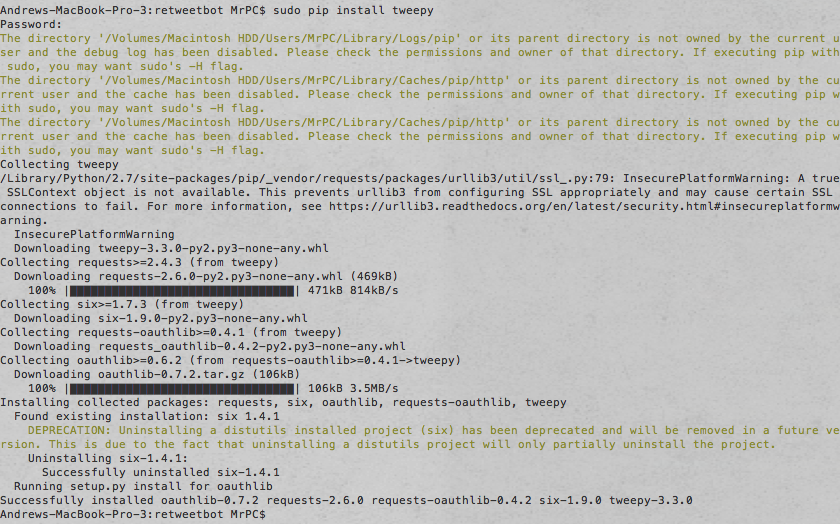
If time permits I would like to attempt to make more than one Twitter bot. An ideal situation would be where I could make a more simple twitter bot using Javascript and Node, and a more complicated bot that would run on a server using Python. My goal for this assignment is to learn more about Javascript and its implementations and improve my knowledge of Python. After some research I found a Twitter library for Python called “tweepy”. Tweepy can be found via GitHub HERE, or if you have a mac and “pip” you can download it from the terminal.

Installing tweepy from the Terminal

Installing tweepy from the Terminal

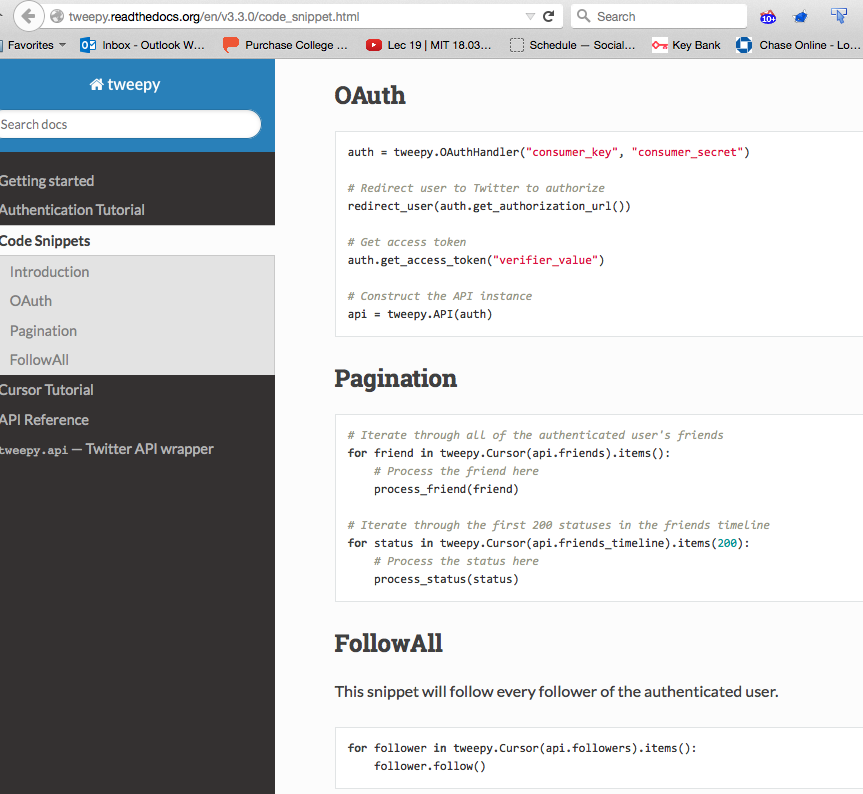
The documentation on the tweepy website is very easy to follow and nicely laid out. I would definitely recommend using tweepy for anyone who is looking to build a bot based in python.

Tweepy Documentation

Tweepy Documentation

Bot Design:

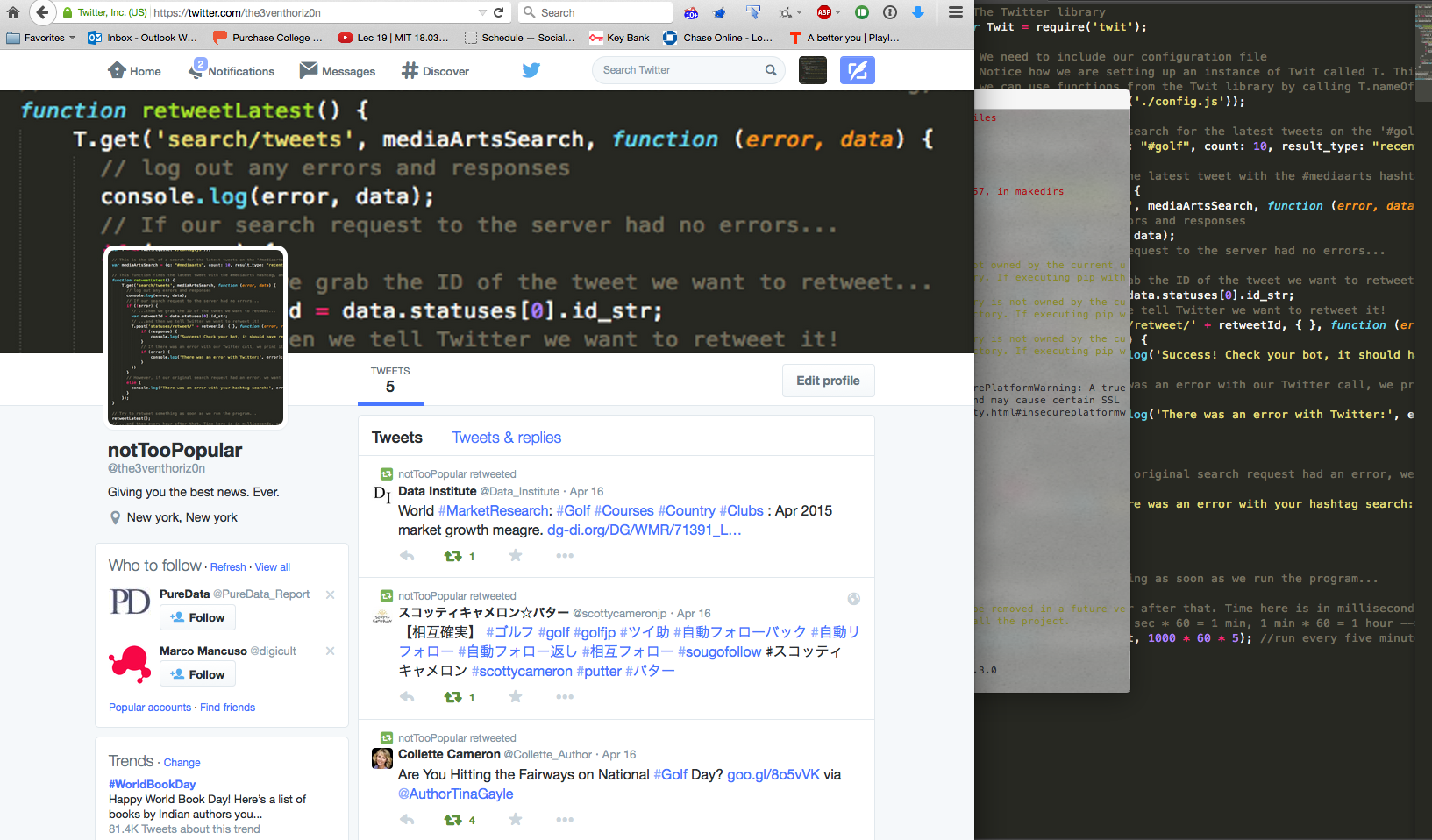
My plan is to create a bot under the name “notTooPopular”. The bot will scan for hashtags that are specifically NOT trending and retweet posts containing the unpopular hashtags. Will the bot try and make unpopular topics trend by retweeting them? Or is it a bot that doesn’t like the spotlight and chooses to dwell in the unpopular? Who knows, but these are some questions that I’ve been wondering about. Jer Thorp mentions that “ The API can act as a clear connection… or shift modes and meaning as information is requested and relayed. “ This project plays off of this idea by using the twitter API to achieve the antithesis of what Twitter is currently trying to accomplish. The bot would be posting topics that no one is talking about or paying attention to, which is obviously NOT the way Twitter was intended to work. It might interesting to give the bot some kind of “personality” or anthropomorphic feel to it as well, rather than simply being a “machine”. Will the actions of the bot be taken more seriously if the bot has a “personality”? How does interaction change when people think they are responding to a human? The bot will use the Twitter API as a bridge between computer to computer, to create a disconnect between human/computer social interactions.

Early test

Early test

I’m hoping to continue my research on the subject to learn more about both the Javascript and Python implementations of the Twitter bot, as well as running the code from a server.

(Assessment 3) New Social Media Bot : EPIONE

Originally I had wanted to create a social media bot related to time management that would allow the user to keep track of how long they’ve spent on a social media platform, thus allowing the user to become aware of how long they’re online and possibly change their activity (if he/she realizes its too much). However, after last weeks Twitter bot exercise I decided to alter the goal of my project.

New Social Media Bot

EPIONE (epp – ee – o – nee)

Untitled

This is a screenshot of the article.

One of the side effects of becoming too engaged in social media, such as Facebook (being the prime example), studies have shown that this leads to feelings of disconnect and depression (or as Sherry Turkle mentioned in the reading ‘Alone Together’ feelings of loneliness and urge to disconnect from the world).

http://www.huffingtonpost.com/2015/02/04/facebook-envy_n_6606824.html

Therefore using the ‘Twitterbot’ method we went through in class, my new objective is to create a new social media bot that encourages people.

Untitled3

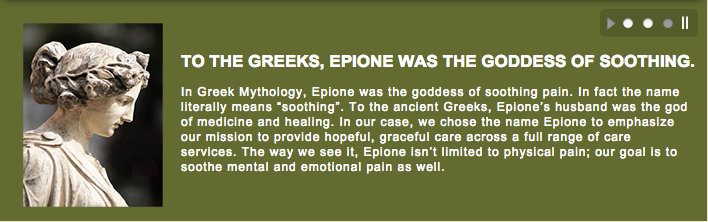
Facts on the Greek goddess Epione.


When brainstorming this idea, I chose the name Epione after the Greek goddess of ‘soothing’ and mother of the goddess of health Hygeia in mythology.

Untitled

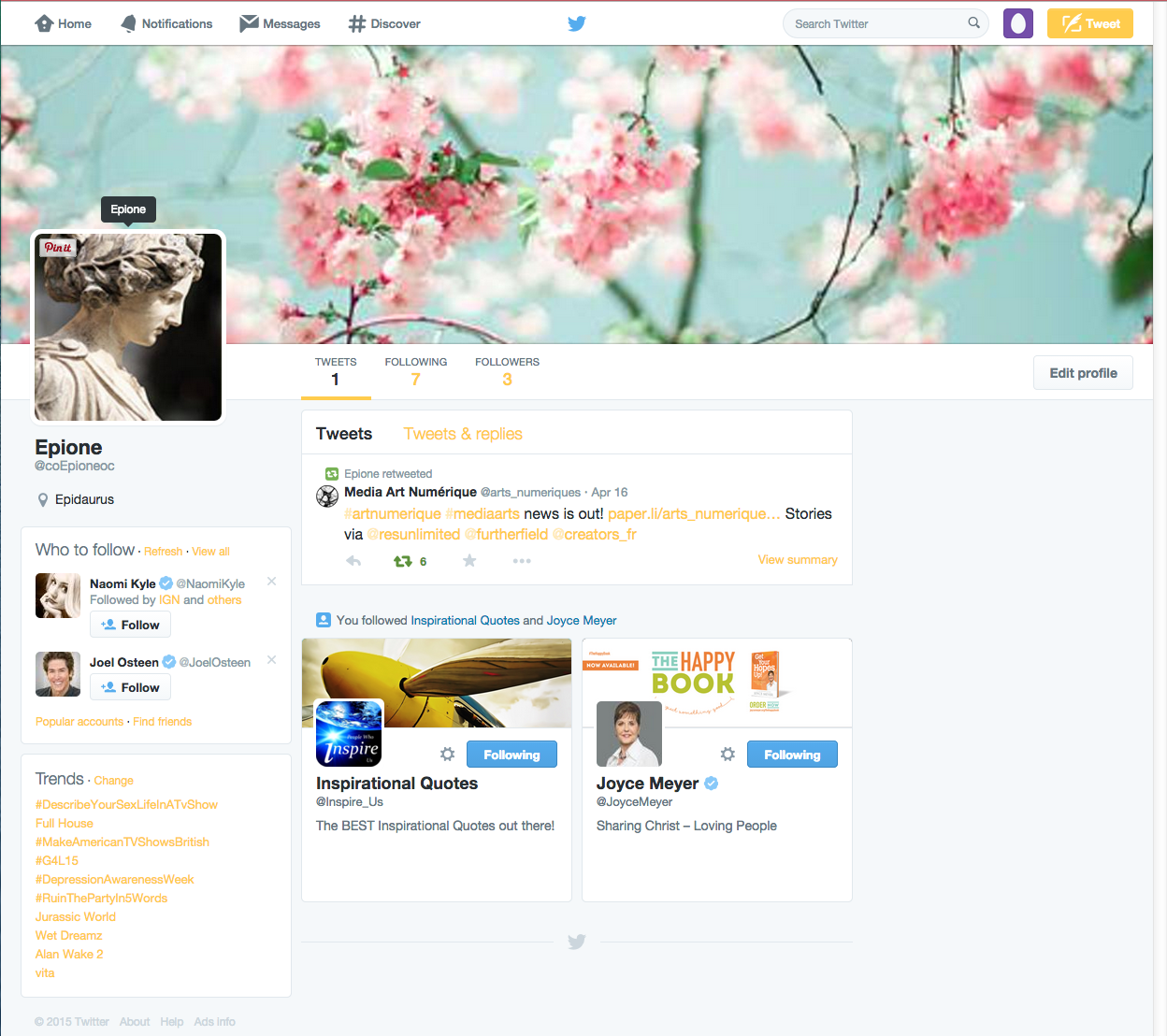
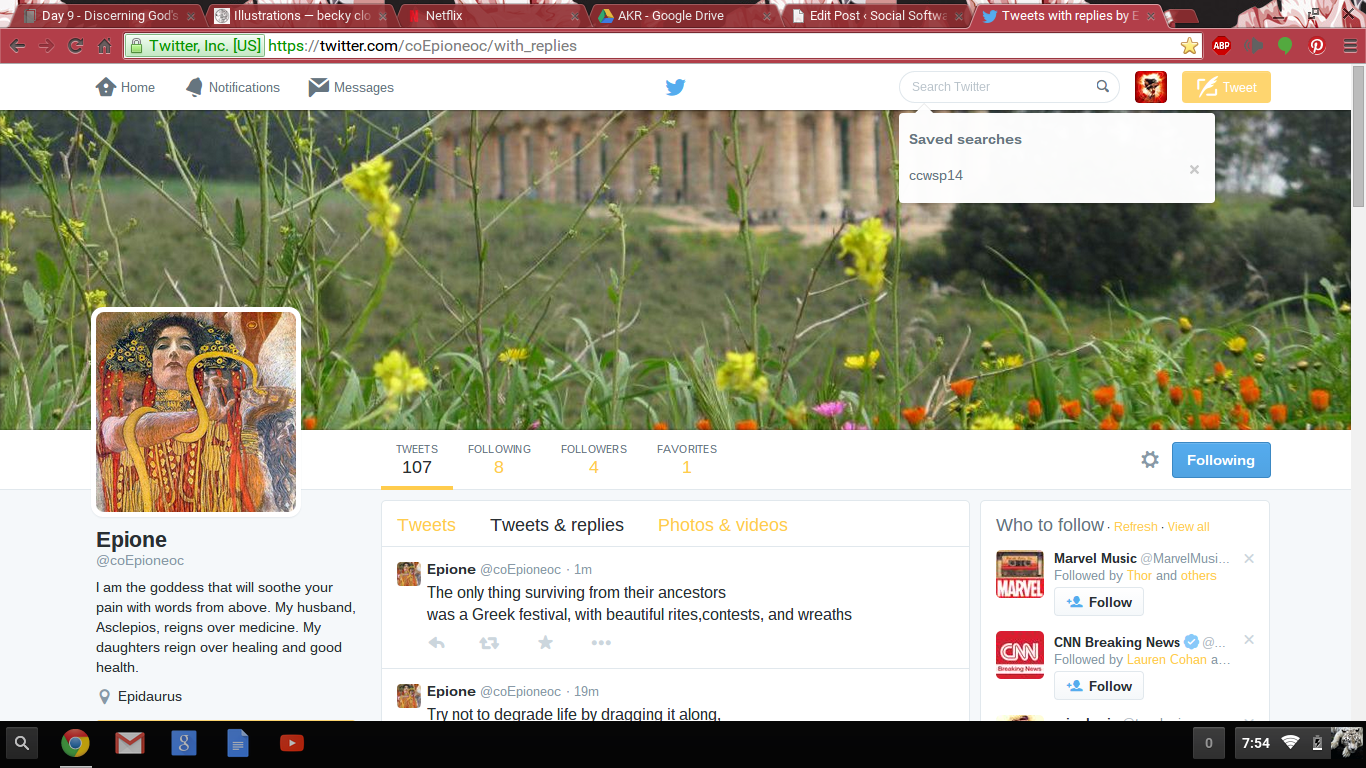
Here is a screenshot of the bot’s Twitter site.


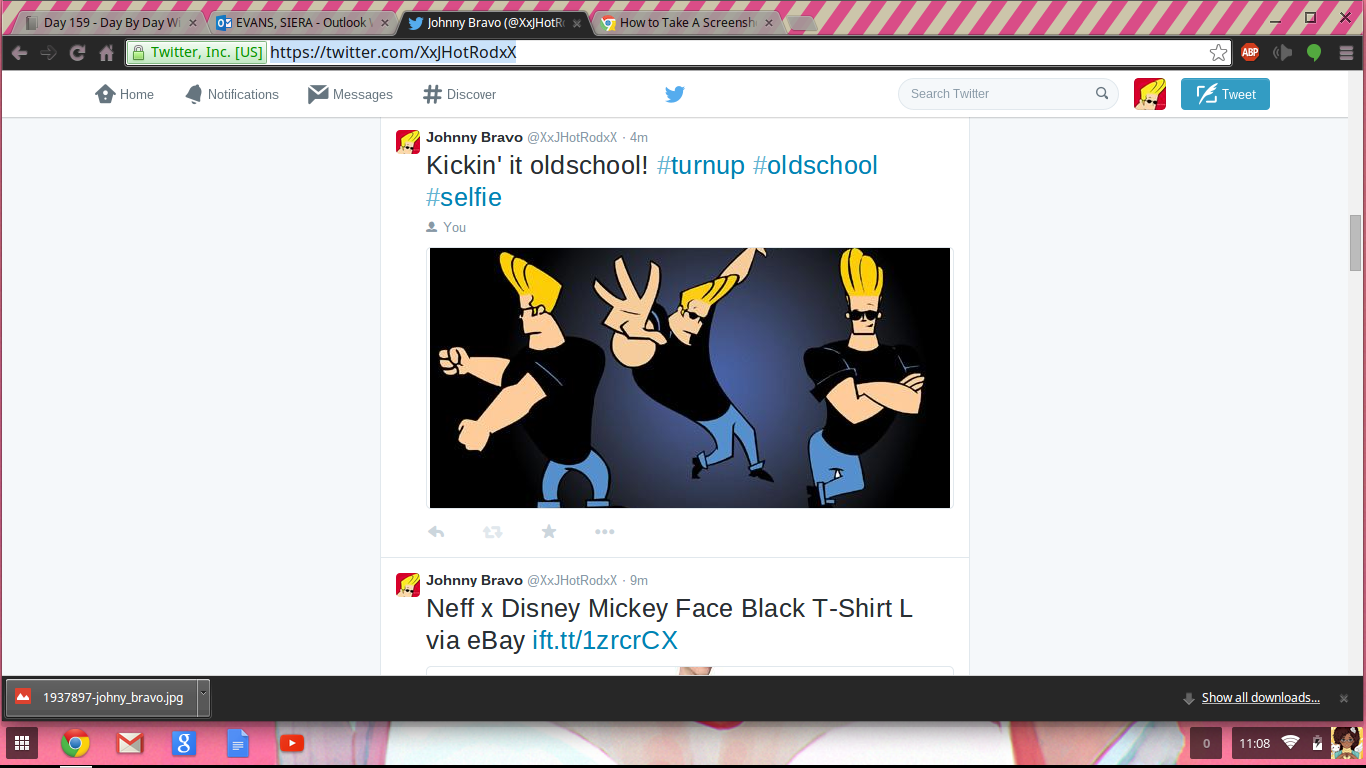
I intend for the Epione bot to run on Twitter, exist as a fictional character on the web (like the Johnny Bravo experiment), and search for hashtags related to sadness and reply to them with comforting or inspirational messages.

Untitled5

Examples of hashtags my bot will look for.


I could also use the ‘IFTT’ (If This Then That) system to post positive photos or images that will ‘brighten’ someones day to the Twitter site. I’ve already researched alternative ways or methods that the Twitter API can be used to do this. I took a look at a link posted on the class site for people who didn’t want to use code (heavily) in their project, and followed the link to the site ‘Round Team’ and another Japanese Twitter site but none of them seemed applicable enough to my the purpose of my bot.

I included other links to sites I looked at for research in case anyone else wants to check it out.

http://www.techcovered.org/how-to-create-your-own-twitter-auto-retweet-bot/

https://dev.twitter.com/rest/public/uploading-media


The original plan for the objective of my bot listed above has changed slightly. In the end, I Epione encourages and lifts the spirits of others through more artistic means. Although my intention was to use ‘If This Then That’ statements and the ‘retweet’ hashtag code, in the final construction of my bot I decided to go another route.

For the final alteration of my bot I gathered different pieces of Greek poetry to post on the bots Twitter feed using the ‘filebot’ code, and in the end brought it up to the server and calibrated the code so that a line of text from the poetry was selected at random to post every 3 hours. In addition I also upgraded the Twitter site so that it sounds more like an actual person with an account rather than a ‘bot’.

Screenshot 2015-05-03 at 7.54.35 PM

Here’s the site now after I made a few changes.


Creating this bot was certainly a challenge for me, however I’ve learned to consider and appreciate what goes into creating an application or a platform for social media, and has definitely piqued my interest into deploying other bots into the realm of social media.

Assessment 1 partB Submission

For this exercise I chose to conduct an interview for the fictional cartoon character ‘Johnny Bravo’. In writing the interview I greatly took into account his overall character and considered how it would apply to the scenario of an interview.

For those of you who are unfamiliar with his character I included a link to one of the episodes of his TV show.

https://www.youtube.com/watch?v=xnGnl-UElVA

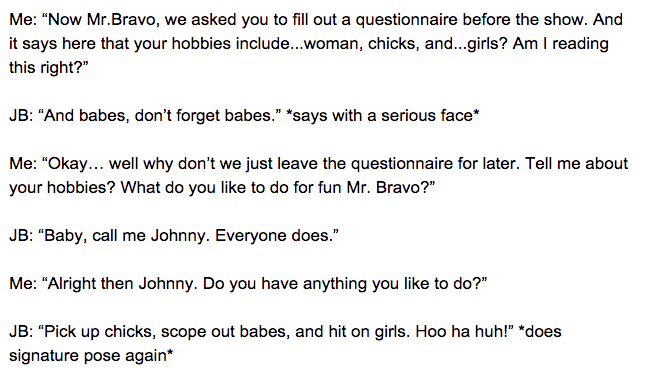
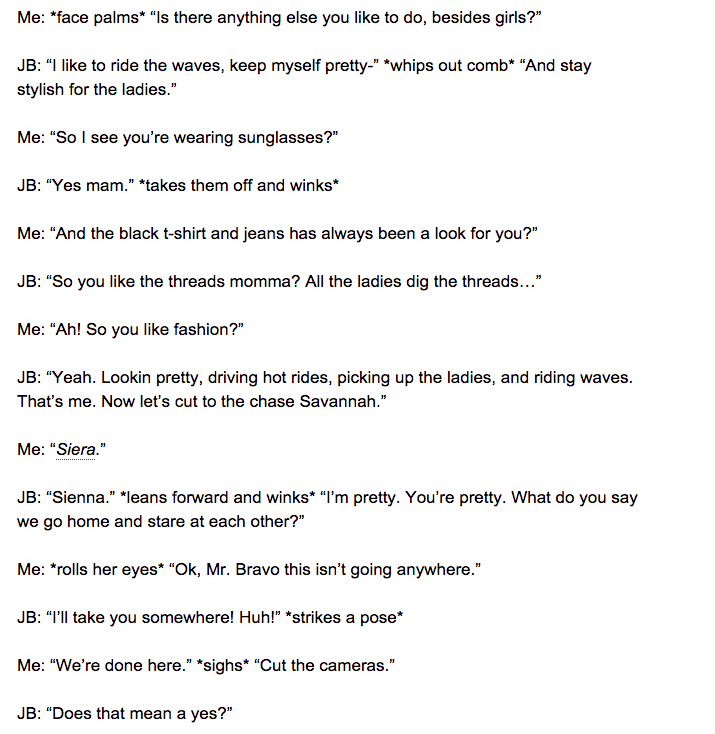
Here are a few snippets from the interview I conducted,

q p


If anyone wants to read the full interview.

https://docs.google.com/document/d/1zFqqI4OR0v6XWo39lZWeWWOnZRG3zJEjd-U-CKg6ZKQ/edit?usp=sharing

Continuing this exercise I wanted to create a page on social media that the character could visit and receive information on what he enjoyed or the products he liked in one location.

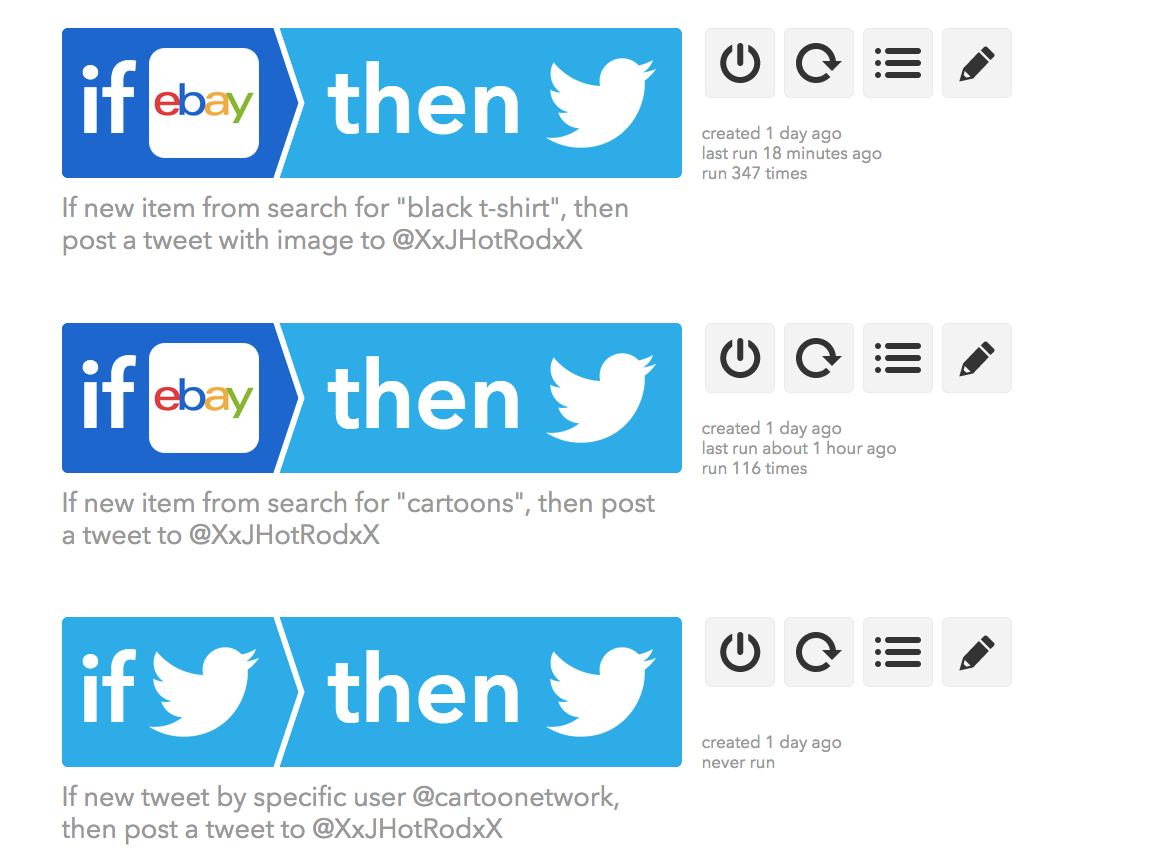
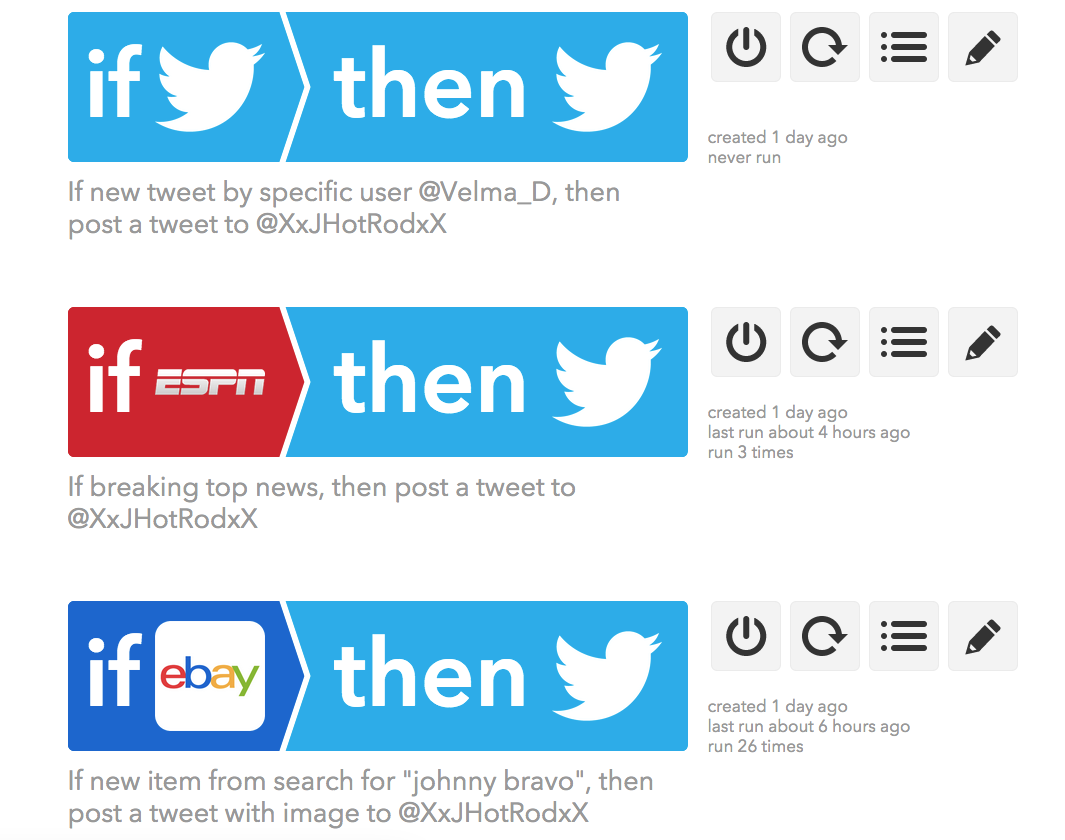
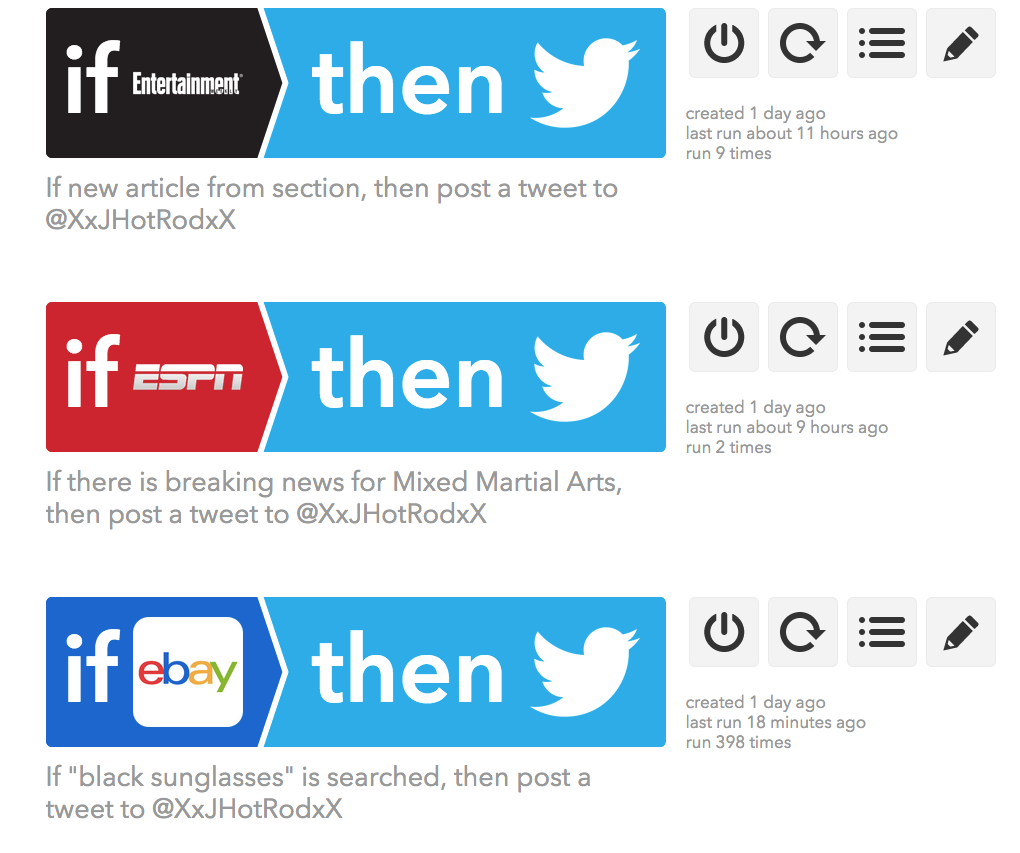
Here are a few of the recipes I created for the characters twitter page using the IFTTT site. It was quite challenging at first figuring out how to configure different recipes but after a few trial and errors I was successful.

Untitled 2

Untitled 3

Untitled 5

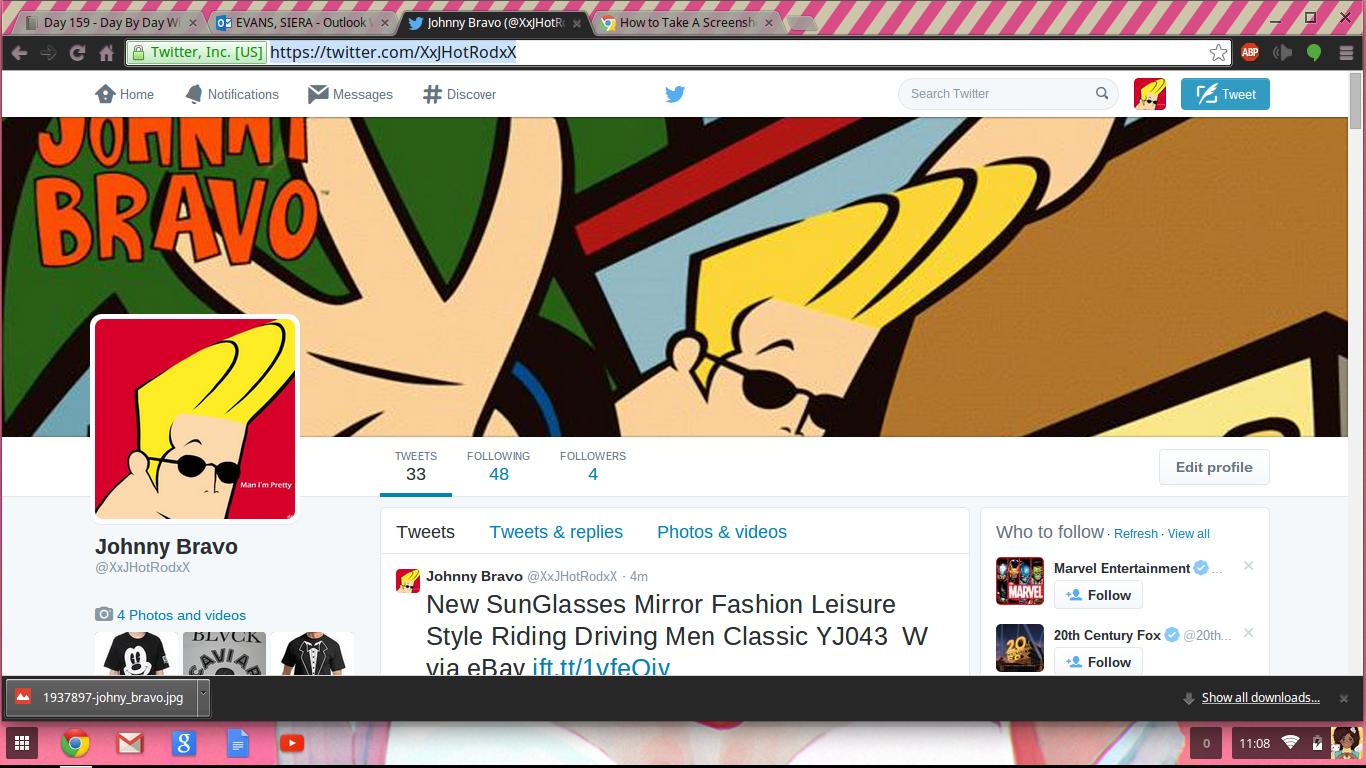
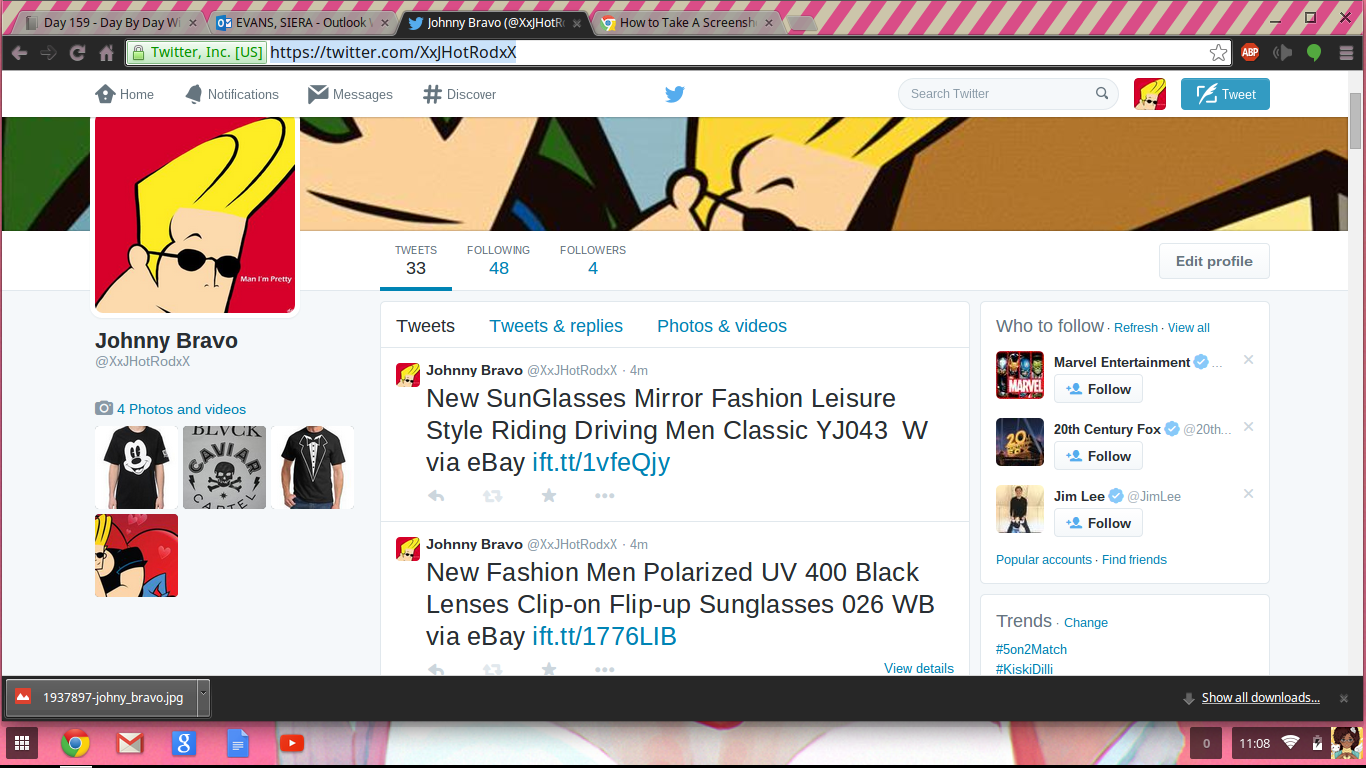
And here are early screenshots of the recipes in action as well as additional activity on the twitter site.

Screenshot 2015-02-09 at 11.08.18 PM

Screenshot 2015-02-09 at 11.08.29 PM

Screenshot 2015-02-09 at 11.08.37 PM


Currently I still receive updates for the site and astoundingly I’ve noticed that people actually enjoy it. I’ve been getting constant notifications about new followers or responses that people gave to the posts the recipes have continued to make. However, not only am I surprised at the sites activity but how people are still responding to the posts even though they’re not tweeted by an actual person, but a bot. This idea really made me think about the concept of identity on the web and how people are able to conceal themselves behind facts that are fake or fictional (alias’s, avatars). If that’s the case how do we truly know who we are communicating with on the web?

Different points on this theory can be connected to one of the points made in the Radio Lab podcast ‘Talking to Machines’ on how machines and robots are replacing the roles of humans in relationships on the web and in the real world. One account given on the podcast describes how a man unknowingly fell in love with a bot on a local dating site and can be used to support the idea I mentioned earlier. Thus, the fact that a bot can sound convincing enough to cause a man to fall in love over the internet has definitely made me worry about the future of bots on the web.

Reading Week 12-Alissa & Emily

The Anxieties of Big Data, Kate Crawford

Art, Activism, and CCTV

The Anxieties of Big Data by Kate Crawford discusses the ways in which big data collection affect users on an every day social context.  In recent years, the public has started to become more aware of their thinning privacy and increasing surveillance by the United States government. Much of this surveillance has been defended as being in place for the safety of the general public, especially in a post September 11th with the fear of terrorism being a main threat.  In 2013, Edward Snowden, a former employee of the National Security Agency (NSA) came forward leaking documents to the media stating that would show the United States government was performing illegal and unethical surveillance on other countries and it’s own citizens.

The Anxieties of Big Data discusses the type of society that is evolving as a result of big data collection.

Interestingly, Crawford mentions that the reality of big data is surveillant anxiety.  She defines this term as “the fear that all the data we are shedding every day is too revealing of our intimate selves, but may also misrepresent us.”

Crawford also references Plan C’s manifesto, “We Are All Very Anxious”, to address a significant problem society faces today, arguing that anxiety is the affect of our current structure of capitalism that is the causation of political apathy, insecurity, and social segregation.

Crawford also argues that anxiety comes in two places – the anxiety of the surveilled and the anxiety of the surveillers.  This is a crucial catch 22 in the surveillance divide.  The general public is told their safety is at risk which enables the surveillance, but the surveillers become increasingly skeptical of the public.  Then, as Crawford describes, the actions of those exercising control of data collection are hidden by government documents that the public does not have access to.  As their actions remain hidden, the public becomes defenseless as to what is being done with their information and remains blind to any real intentions.

Many people have accepted data collection as an increasing part of every day life.  The question that has been apparent however, especially since Snowdens leak of government documents, is how much this data collection really benefits the public.  Crawford describes the “current mythology” of big data as being more data = more accuracy, more truth.  Many argue however that this just isn’t true, and correlation doesn’t imply causation.  Many worry, understandably so, that big data leaves too large a chance of misunderstanding.

Crawford expands her argument to everyday trends and fashion.  She uses the current style of “Normcore” as an explanation of consumer anxiety and being a reaction to surveillance.  Normcore addresses how blending in was once a tactic used by protestors (ex. Occupy Wallstreet) to avoid police detection and surveillance.  As big data collection increases however, blending in is now more important than ever, and everyone must partake.

Art, Activism, and CCTV

Dead Drops- Adam Barthol – art project that involves exchanging files through USB devices in public places

“Creativity generates tactics. Art can be a weapon. It is valuable enough to society that forces of power have worked to subvert it.”

System Azure- Jill Magid –

What’s interesting to point out here is the way the perception changes when someone approaches a situation as an artist versus other jobs titled “professional.”

Discussion Questions:

1. Do you think your privacy is a fair trade off for the feeling of safety?

2. Do you think someones online data is an accurate representation of them as a person? Could they be misconstrued?

3. Do you think every day users have any control over the future of big data collection?

4. In what ways do you think data collection has benefitted your safety and/or general well being and happiness?  In what ways has it inhibited?

5. What anxieties do you think surveillers experience versus the anxieties that those being surveilled?

6. Why do you think the police rejected her proposal after finding out she was an artist? What is the power in being an artist in these situation

Bot Ideas

I have a few ideas for my Twitter bot project. I am not set on just one and want to research more to see which one makes more sense to try and achieve.

The first is an anagram bot. I really enjoy anagrams for the reason that I already think language and text manipulation are very interesting. I like the sort of effect in which the meaning changes and becomes less human like, or dreamy and strange. Going off these ideas, I was thinking I could create a bot that takes the tweets from Oblique Strategies and make new strategies. They could either be direct messaged to Obli Strats followers or just a main twitter account holding the new phrases. I think there would have to be some sort of rule or constraint to follow in order to be successful and consistent.


The other idea that was floating around has to do with Terry Richardson the fashion photographer and predator. Either every time someone hashtags #TerryRichardson the bot would reply to that person saying he is a sexual predator or link to articles of models being harassed. I like the idea of raising awareness of this issue through Twitter and hitting a main fan base.


I am still unsure of exactly how these bots would work technically, but I like the ideas of both and want to narrow the idea down within the next couple days.

Assignment 3: brief

I am an excessive, sometimes emotional tweeter… when all these lines of the “Array” are shown on the social media feed, they are (somewhat) accepted.

‘oh she tweets too much”–she tweets like every 5 seconds’

This method of coding accepts zero means of formatting or twitpics and just displays the constant updates of ones Twitter that could be either a quote I heard, lyrics to a song, a lethargic thought, a drunk thought, or even just a word I decided deserved a hashtag.

words turn into madness when they aren’t so organized on a media outlet. It kind of reminds me of a poorly coded Myspace.”

What makes a Tweet a Tweet, and not just a written thought? This is a concept I would like to differentiate by considering the ideas relating to communication and language via social media feed vs. deployed text or spoken word. Inspired by an experiment I made called “Word Vomit”, I will generate text composed of my tweets, retweets, and other Messages/texts i’ve received to compile a socially breached Array of words into a new approach to interactive webdesign. With roots branching from Word Vomit, My site may contain similar coding, but with more buttons, allowing users to dispose text, add their own “tweets”, and more Javascript functions and maybe even more visual elements.

Inspirations–

http://mouchette.org/

http://www.bram.org/jesuisuneoeuvredart/art.htm

http://archive.rhizome.org/artbase/1701/htc1_1.0/intention.html

http://students.purchase.edu/ERICA.VITUCCI/java.html

Assessment 3 Proposal

For my final project I’m looking to make a bot that searches for two types of hashtags. One hashtag would be about one opinion and the other hashtag would be the opposite opinion. After the hashtags are searched for I want the posters of the people who tweeted the hashtag to be @ replied by the bot and ask them to talk to each other. If this can’t work, a bot that retweets both of these opposing hashtags would work to show the differences in why these types of hashtags are being used.
I’m also thinking of combing the tweets of two presidential 2016 candidates twitter accounts to make for one interesting presidential candidate.