Archive for the ‘Uncategorized’ Category

Exercise 4: Google Diet

The Google diet has been a very interesting experience for me. Since the start of the exercise I completely made sure I logged out of all my Google accounts. I typically use Firefox so I just changed the default search engine to duckduckgo. In the entirety of this week there were only a few occasions where something Google related popped up. The only mishap I had was on Friday when my mom wanted me to search up recipes on this Italian recipe site. I immediately was disappointed and told my mom I had to stop because the website used Google for their searches.
Since Friday there were a few times where I was almost tempted. A person on my personal Twitter responded to me with a YouTube video, which I couldn’t watch. On the latest episode of HBO’s Girls there was a scene where the main character Hannah (played by Lena Dunham) was watching a YouTube video. Later in the week the Girls twitter account tweeted out a video which I thought was going to be on hbo.com, but to my surprise it was on YouTube and since I was on my phone I was able to back out of the site immediately without the video starting to play. The last uses of YouTube and Google Chrome occurred in my Junior Seminar Class yesterday when a majority of the presentations. My classmates presented using Google Chrome and some of them showed videos from YouTube.

For the most part this exercise really had me focus on my self-control. YouTube was almost everywhere and it was hard to get a fill of certain videos, but many video game websites were able to help me fill that void. Other websites that didn’t use YouTube to stream their videos also helped me out. All in all I realized that I’m not too dependent on Google in every area aside from YouTube and my backup Gmail account. I only used Bing once. I prefer DuckDuckGo more. I might leave it as my default search engine for a while.

Google Diet

This week, we were supposed to refrain from all Google products, including such websites as Youtube and Gmail. At first, I was most frightened about not having access to Gmail. I have several accounts that get constant email. But the simplest solution to that was to  forward all of my emails to an Outlook account. This got to be a bit confusing at first, because I was unsure of which emails were directed to whichever address. On the other hand, it was nice to have all of my emails contained in one place.


The second task was the search engine. At first I used Duck Duck Go because of the claim that it does not track your searches. In the surveillance heavy world we live in today, that was a comforting claim. But after a while, it was harder to find the content that I really wanted. I ended up giving up security over convenience and using Bing for the rest of the week.

I found it harder to refrain from Google on my phone. My Gmail app was racking up email notifications and it was hard to ignore the little red number over the app. iPhones tend to be pre-loaded with the Google app, and it was hard to avoid it, especially since I was so used to searching random little things through the day. I ended up cheating during the first Friday, using Google Maps for directions to my doctor’s office in Chinatown. My fear of getting lost overtook me and I depended on the map.

This experiment made me realize how invested we are in Google, how it’s become the standard in many ways on the internet. I really had to make an effort to avoid it, possible due to the fact that I was already invested myself. Being opened up to how watched we are constantly was unsettling, and it is obvious how hard Google pushes to be part of our lives automatically. It is hard to give up convenience for the sake of being completely private.


Assignment 1 – Fictional Character

When it came to conducting an experiment that required a fictional character to be the launch pad of your exercise, it took some research and role-playing in order to illustrate an illusion as if the character was real. The purpose of Exercise #3 was to interview a fictional character and design a way to project content online in which displayed the character’s interests and personalities. Overall, it felt like putting on a small digital “puppet show” for a virtual audience to see. The interviewer was the puppeteer where he or she incorporated information from an interview as if they it was the performance and a social network platform was the stage.

Fred is an energetic science geek and comic book fanatic that studied at a university in the fictional city, San Fransokyo. From the interview, the various questions were categorized in a way to simply ask the interviewee a little information about himself. For example, “What’s your occupation?” or “Do you still go to school?” These two questions are examples that helped keep the interview flowing smoothing.

With the interview as a source of guidance, establishing at least one social network account could form a pathway for the character to become alive. In other words, the experimenter used his or her subject to interact with the world, in this case, the Internet. For example, Twitter would provide a smooth connection when using IFTTT recipes. The following recipes that were used to illustrate Fred were helpful to showcase his interests and personalities. Mainly his Twitter page dealt with online shopping for monster action figures and technology from Best Buy or eBay to news alerts or discussions about superheroes from reddit.

In spite of concluding this experiment to be fun, there were several elements that taught others how significant it was when it came to developing “robotic” accounts in order to illustrate an illusion on how any form of artificial intelligent can magically use APIs; application programming interfaces. From Sherry Turkle’s book, Alone Together, in her introduction, she focused on the robotic movement of when, where, and how will human and robots interact with one another. Turke stated how “Robots have become a twenty-first-century deus ex machina.” (Turke, 9). If robots could be another “godly machine,” social networks that connected with any devices; computers or smartphone, could be another AI too. It’s like personifying a device with human qualities. Similar to how Turke reflected objects to have human qualities and the content to be treated as things. (10). For instance, the object was Fred’s Twitter page and content were the incoming tweets with IFTTT recipes displaying his interests are things.

Work Cited:

Turke, Sherry. “Introduction.” In Alone Together. 1st ed. Basic Books, 2012.

Assessment 1 (Sherry Turkle Reading Response)

In this summary of Sherry Turkle’s reading, I’ll focus more on the ‘Robotic Revolution’ and how it pertains to the relationship she describes between humans and machines.

Beginning with the prologue, Turkle touches on the publication of The Second Self in the 1990’s. From this book, she explains the growing personal relationship of a computer/machine and a human.

She states,

“By then, the computer had become a portal that enabled people to lead parallel lives in virtual worlds…discovered a sense of place.”

In having this development in the relationship between humans and computers, Turkle further states that as a result of this there has been a change in the boundaries built between the real world/real life, and the virtual world.

To further express this development, Turkle gives us the example of a college student named Doug who is active within many virtual worlds and balances the virtual along with real life. In this he says that real life

“is just one more window…it’s not usually my best one.”

It is in the emergence of a growing “networked life”, where popular search engines in today’s society appear as well (Google, Internet Explorer). Networked life changed drastically when the Internet went mobile, where “the network was with us, on us, all the time.”

With this new life the opportunity arises where people can “hide from each other”.

Untitled 2

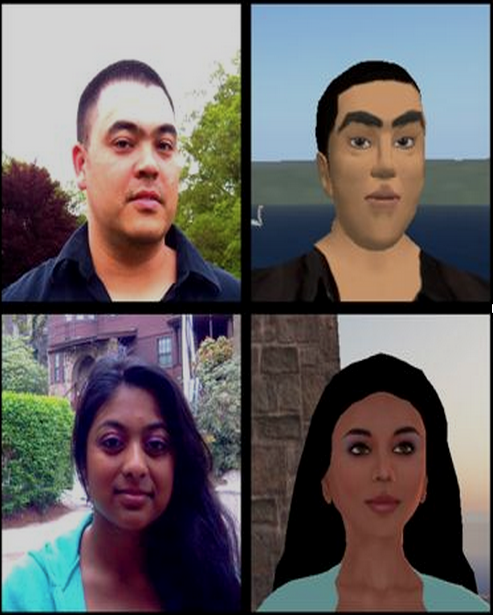
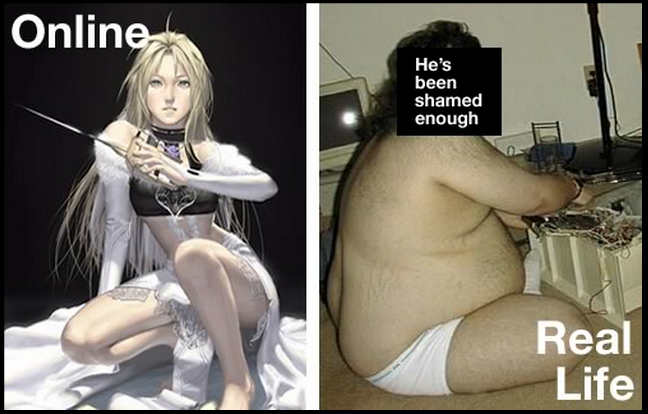
In the creation of these worlds the author states that certain individuals start to become captivated with these worlds, and thus begin to trade “RL” (real life) for the virtual. Chat rooms and online gaming become more popular resulting in people abandoning their true self for a persona or avatar, in which they can start a new life and become “a lot younger, thinner” version of themselves. This allows people to hide even deeper from the real world and each other with this new identity/avatar.

Untitled 3

Sherry Turkle also describes this “second life” to grant the user a “place for hope in life”, and an end to loneliness cured by the presence of people online.
Turkle includes this quote from an old woman about her I-phone,

“It’s like having a little Times Square in my pocketbook. All lights. All the people I could meet.”

She also gives the statement about the internet being “seductive” and to the average person presents a chance to escape the real world.
Turkle delves deeper into the discussion of the relationship between humans and machines with, robots. Whether it be love, companionship or loneliness, Turkle explains that individuals look for a variety of needs from robots that they cannot achieve in real life.

Companionship is what Turkle states throughout the reading as to why robots are often sought after, and in some ways can be considered controversial.
The element of insecurity, lack of trust, and fear of disappointment in relationships are common factors that add onto the growing interaction with robots. As a result, there is the emergence of “sociable” humanoid robots such as the ELIZA program in the 1970’s. Popular examples of sociable robots include the popular Tamagotchi, and Furbie toys for children. From these creations came the idea of us giving,

“human qualities to objects and content to treat each other as things”.


“No cheating. No heartbreak.”

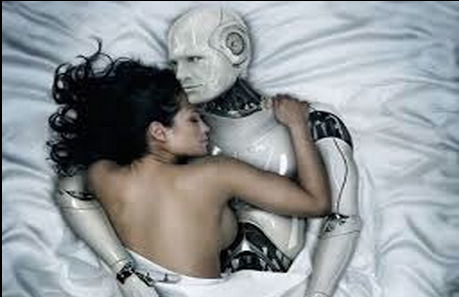
A romantic relationship with a robot is explored in the reading, and advocated strongly by David Levy. He argues that in time robots will teach humans to become better lovers, friends, and companions. Levy even goes as far as saying that robots will replace humans.

Untitled 7

“Beyond this, they will substitute where people fail.”

Turkle explores the possibility of this relationship and is surprised at the results of her findings. The popular reasoning behind these relationships or “technological promiscuity” that Sherry Turkle finds, are that robots do not come with the taxing demands, and disappointments, that humans bring.

“After all, we never know how another person really feels. People put on a good face. Robots would be safer….I’d rather talk to a robot. Friends can be exhausting. The robot will always be there for me.”

Overtime the possibility of actual relationships between humans and robots has grown, and so has the recurring belief that when,

“other things go wrong, science will go right.”

Hope has been put into machines, and as a result they have become “a twenty first century deus ex machina”

Bringing in points from other readings, like the reading Zack discussed on the Critical Engineering Manifesto, we discussed possibilities of future technology that we’d want to see in the future of our society. For the most part the conclusion of our discussion leaned more toward being opposed to new forms of technology like robotic ‘companions’, and even sci-fi related technology like talking toilets and wristbands that read our calories and go as far as determining what kind of insurance we’re able to have.

Having technology become too involved in our lives to the point where they’re able to recognize and dictate how we live is what we are the most opposed to when it comes to new technology. Even though the technology that we have in social media is closer now than its ever been to this theory. Platforms like Instagram and Facebook allow individuals to post and share every aspect of our lives in various forms like pictures, and has become a daily routine for most people who have become attached to these ‘social machines’.

In the first reading we discussed how social technology could bring us closer together and allow us to share information across large spectrums in cyberspace. Following this theory we had a similar discussion regarding whether or not this technology will benefit or corrupt future generations. The conclusion came out positive, in that technology can better the future of our society and allow us to excel whether it be in education or in the social spectrum.


Discussion Questions

1) Would you rather live in a world occupied by machines (lets try not to think of the Terminator here)?

2) Does an individuals social status affect their online persona?

3) Do you think our society would be better or worse without the presence of media and technology (such as Facebook, computers, Tv’s)?

4) Honestly speaking, would you prefer a mechanical companion or a real spouse? What are the pros and cons? Why do you think some people might choose the machine over flesh and blood?

5) Which do you prefer? Talking or texting? Do you think this preference conveys the decline or increase in social interaction within our society?

Here is a link to an example of a video project I made addressing these questions and more in the realm of cartoons and video games. (http://vimeo.com/93404898)

Friday 13 Google Maps

I don’t use the internet as much as I use iPhone applications and installed software. I try to use original photos and scans before I surf for content on google web and image. I lost my MacBook on Friday January 30th by a fatal Green tea spill.. So I haven’t been doing much web surfing during this assignment. I didn’t have trouble choosing Safari over chrome on the Library computers. All I had to do was delete the YouTube and Gmail app from my iPhone 5.

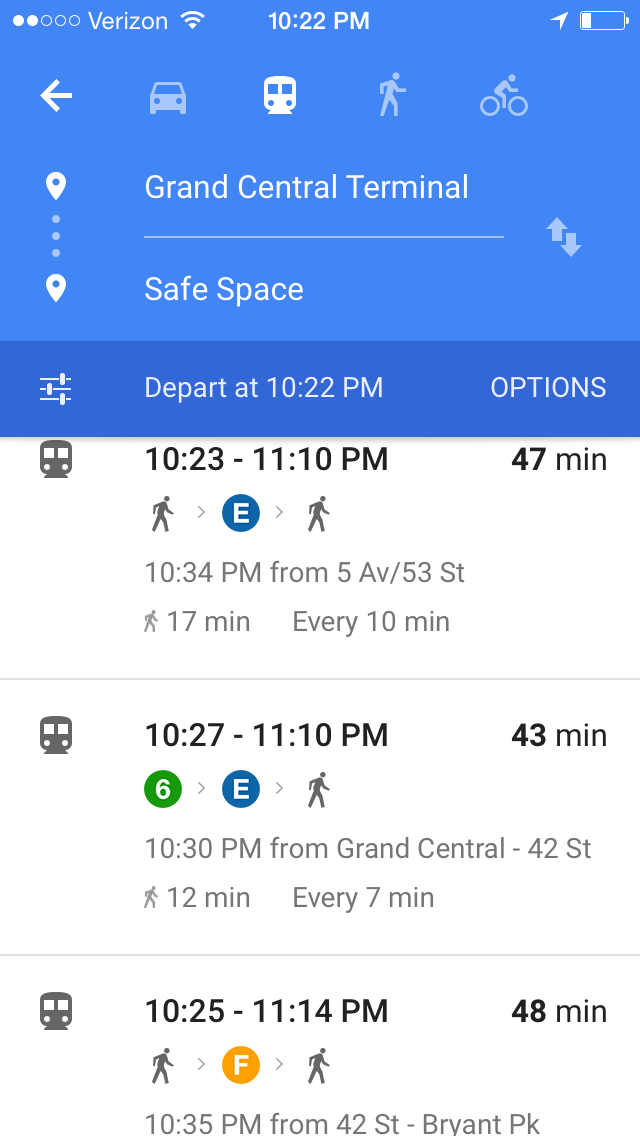
But on Friday 13th It was time for my commute that I made 1-3 times a week to a new Film/edit job in Jamaica Queens that I have been;

1) racking my brain to manage without a laptop in general

2) still trying to learn various commuting routes to see how to save the most time and money to get to

I didn’t suspect how helpful Google Maps would be (in a Walking scenario) in Class on Thursday; In terms of driving I basically cannot multitask and the GPS system and I have never gotten along. I never use this app because in the past it has always take me to blank locations, parking lots, and stores that closed down years ago.

I failed On Friday the 13th and used my enemy Google Map and now I’m sorry for doubting the App. I realize now that there is a variety Map Apps that I could have used, but at the time, I trusted Google to get me to work in the most efficient way. And then it brought me to the Metropolitan afterward. Today (February 18) I got my first Windows laptop since 2012. I’m using MSN right now and I think had I known the navigation/trains, from Purchase to Queens I really could have lasted a week without google. I really don’t watch much YouTube videos anyway.

untitled

So Thank you google Maps and Sorry To this excersize  .

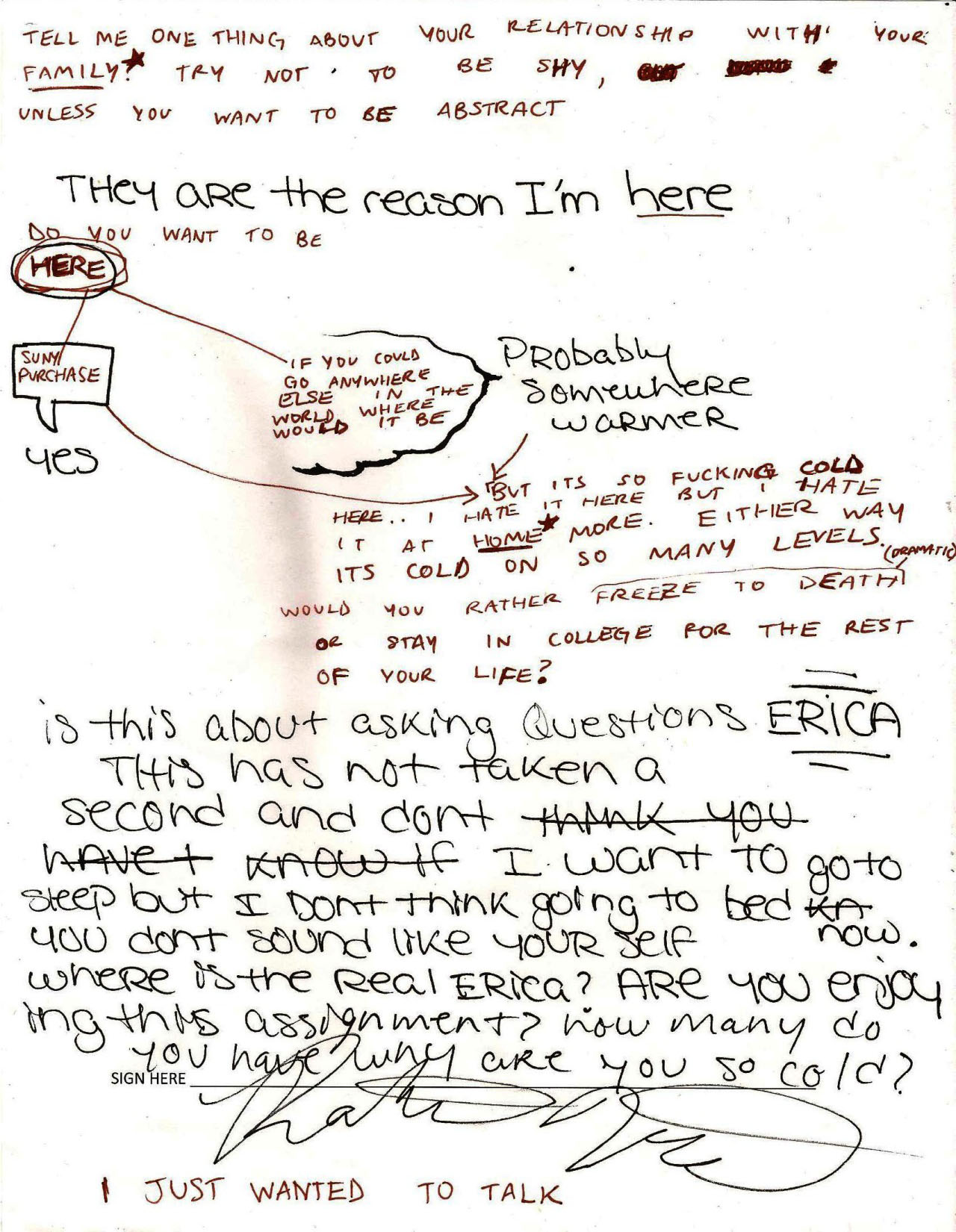
Assignment1: “Texting” in Person

The Presentation of Self of Everyday Life by Erving Goffman discussed the importance of human social interaction and how it is inconsistent due to certain attributes comparing it to a Theatrical Performance , as though we take on a variety of roles, observing each other constantly, judging each other. It is difficult for an individual to be themselves because of this feeling of a present audience, unfamiliar settings, attention to appearance, inconsistent manner etc.

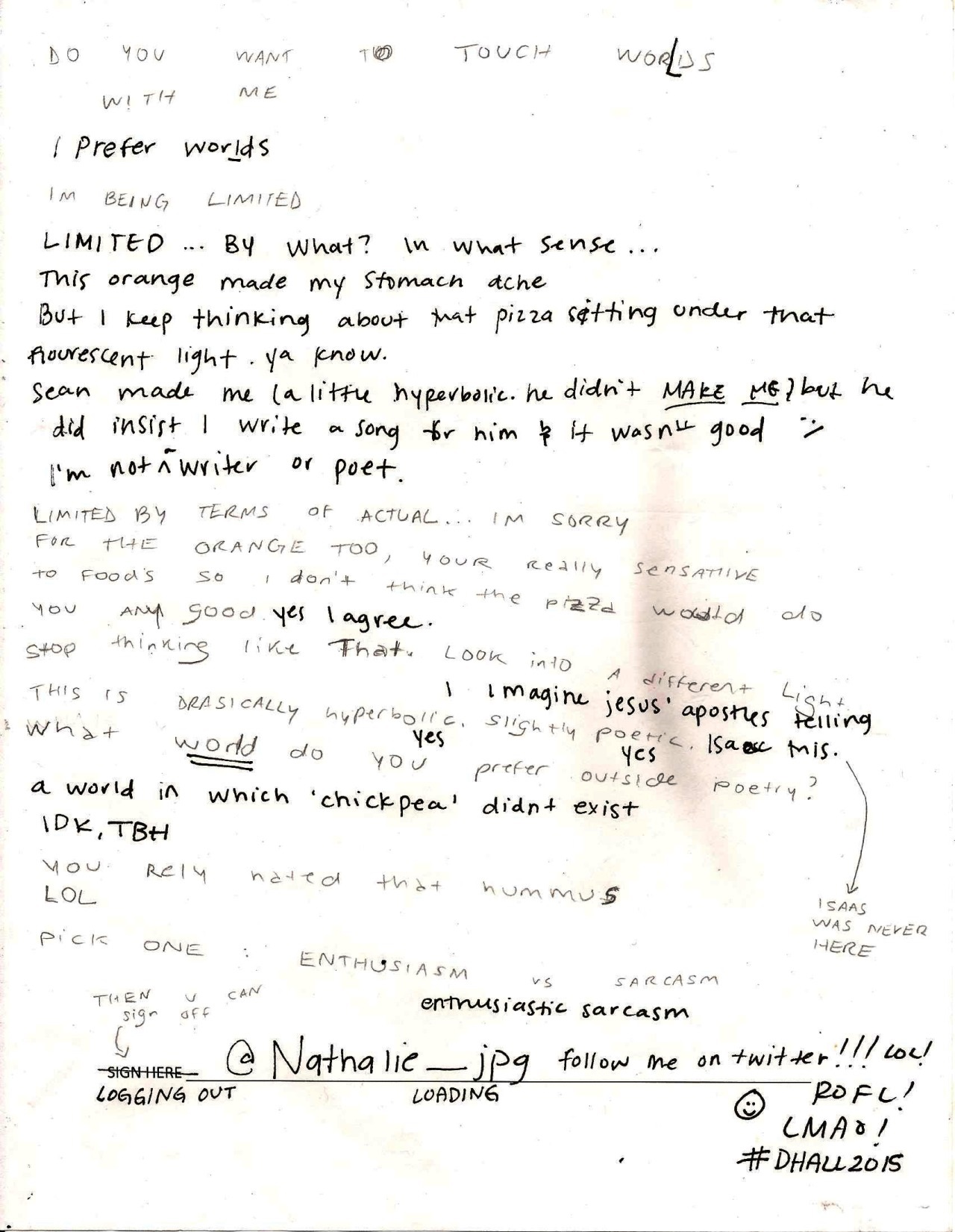
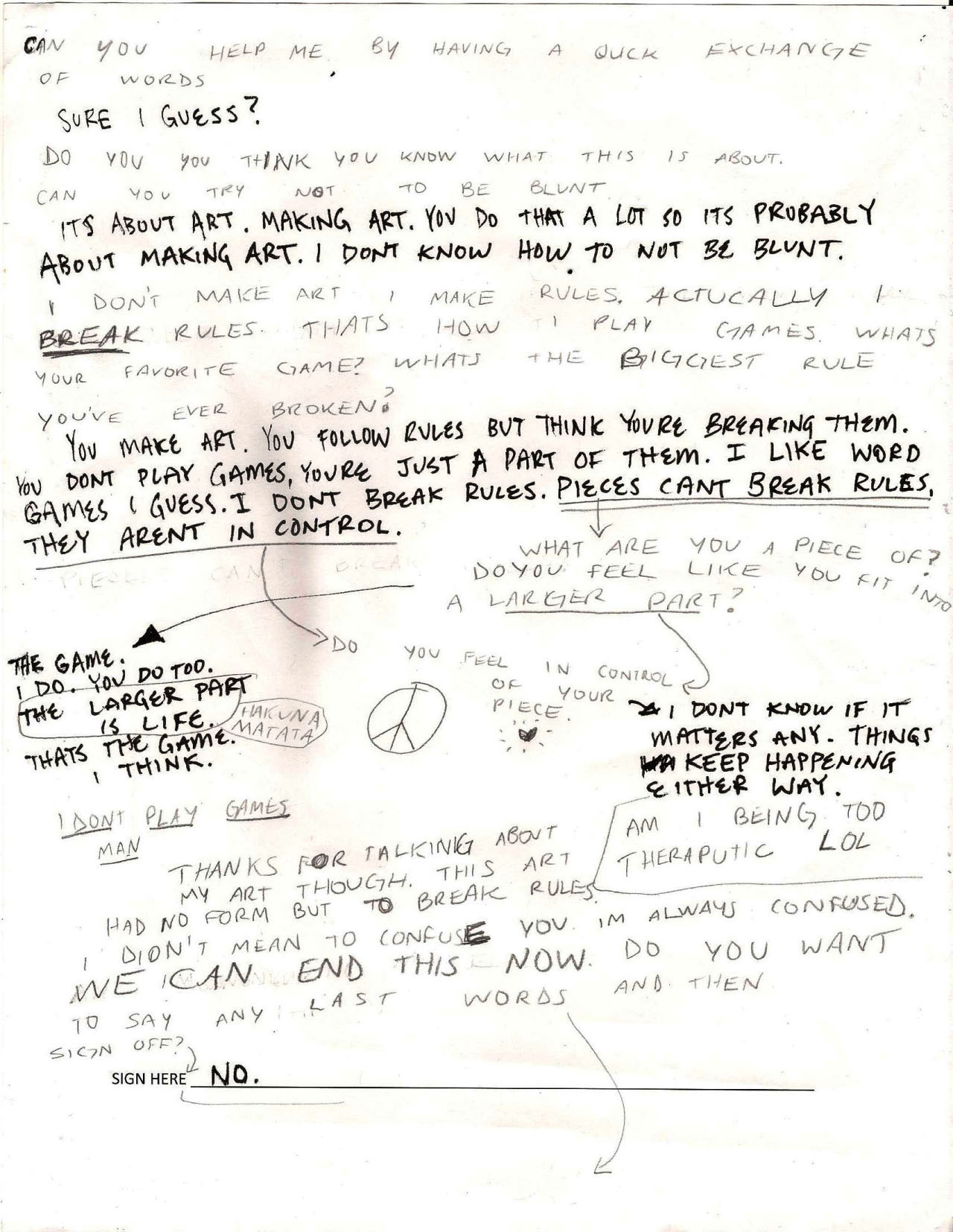
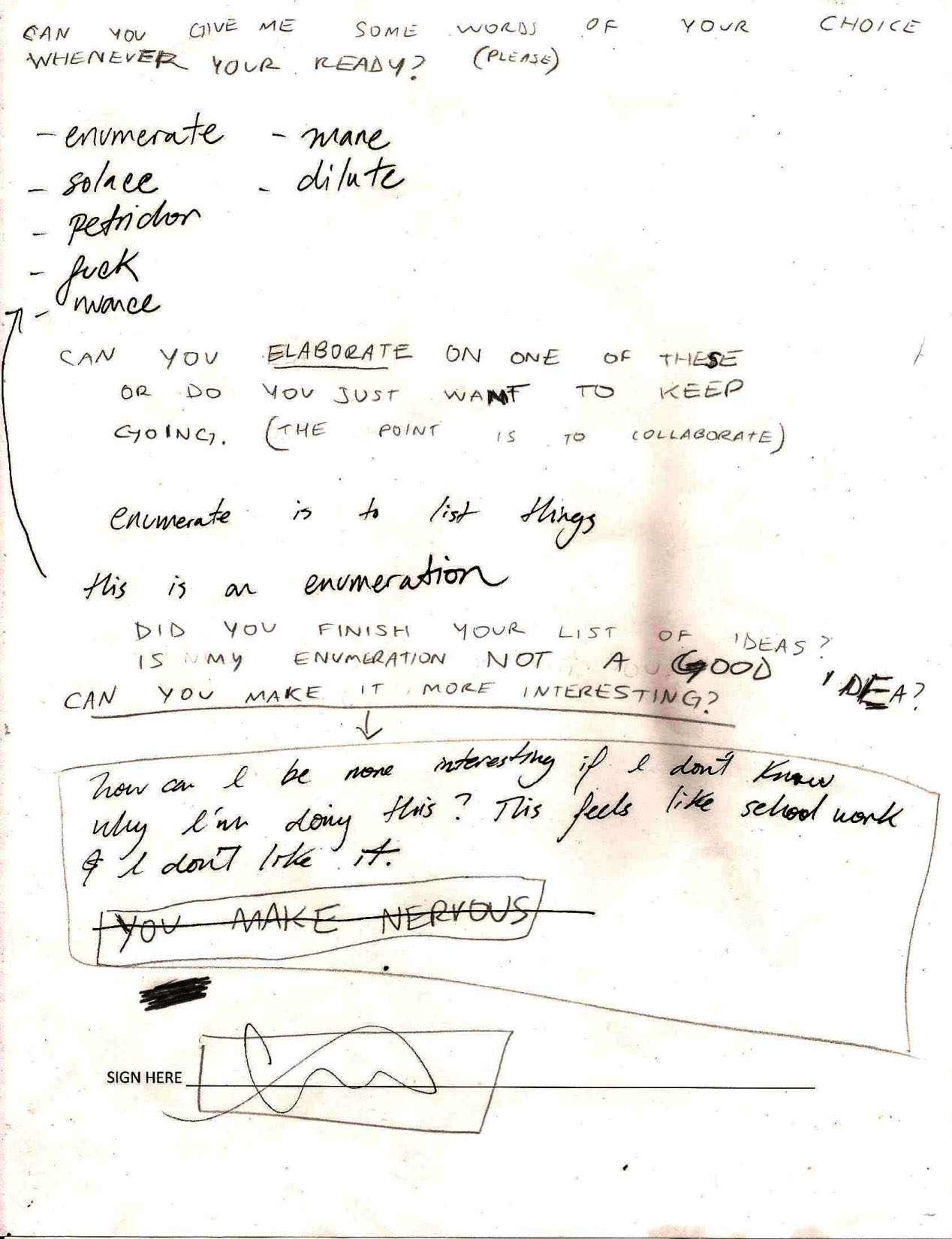
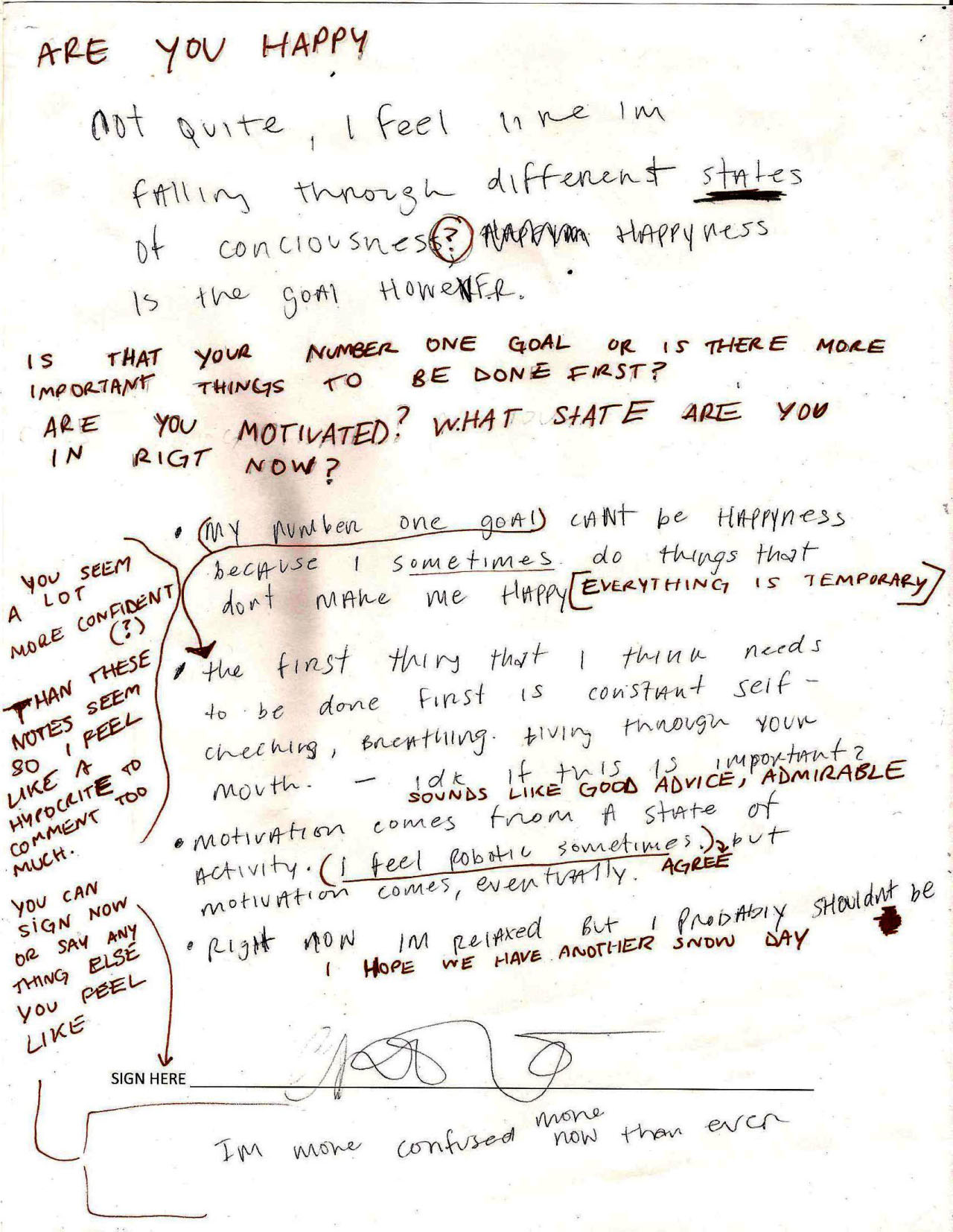
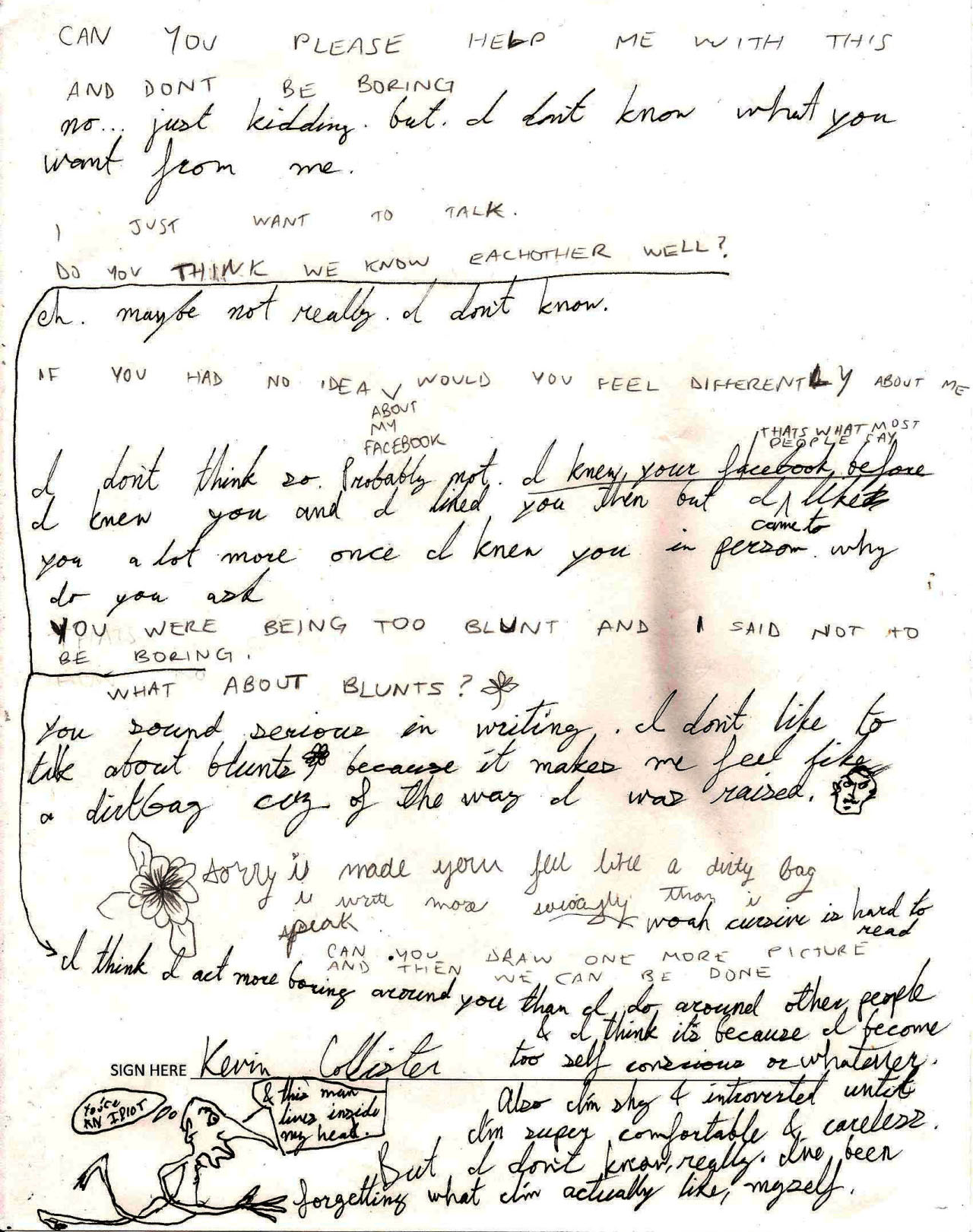
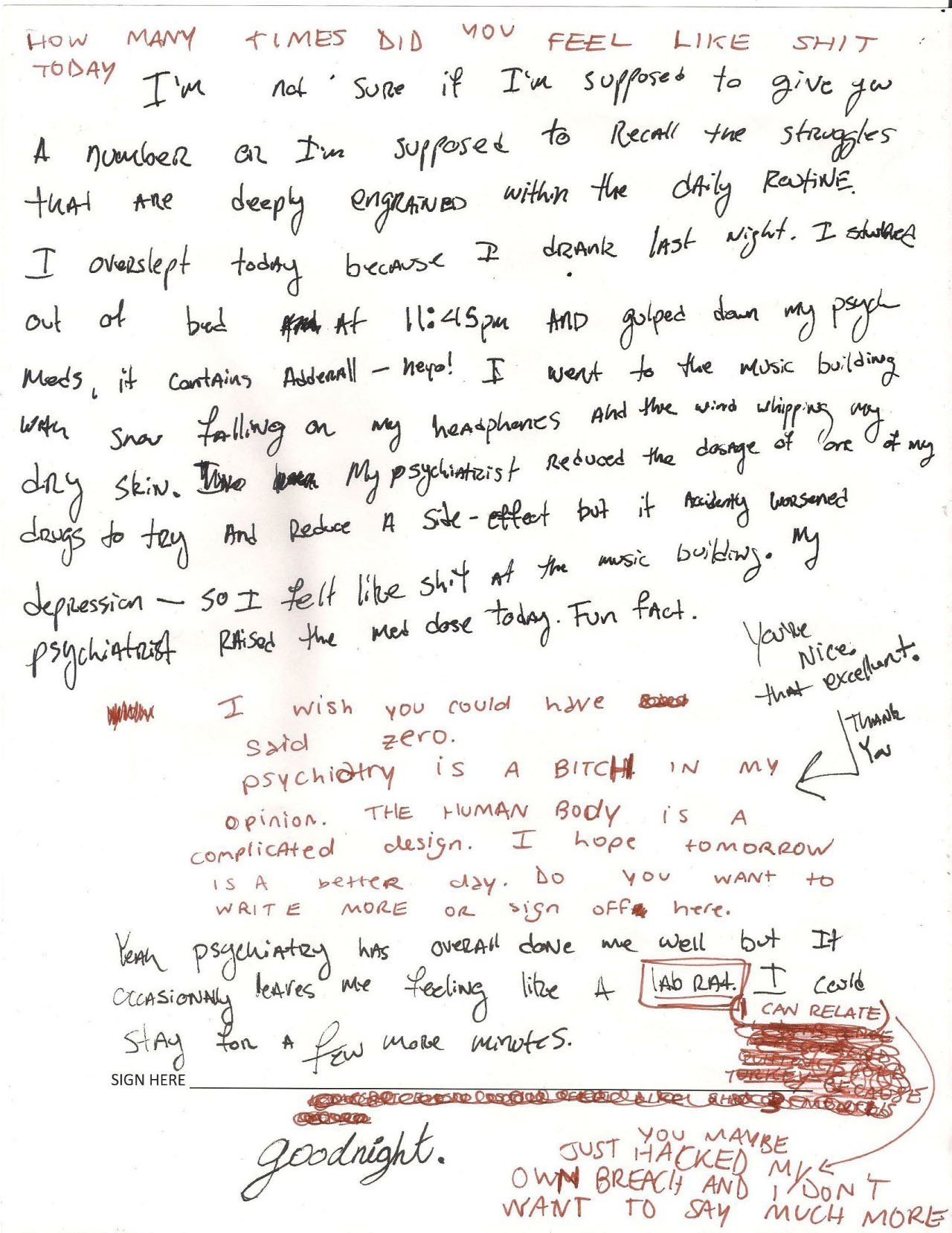
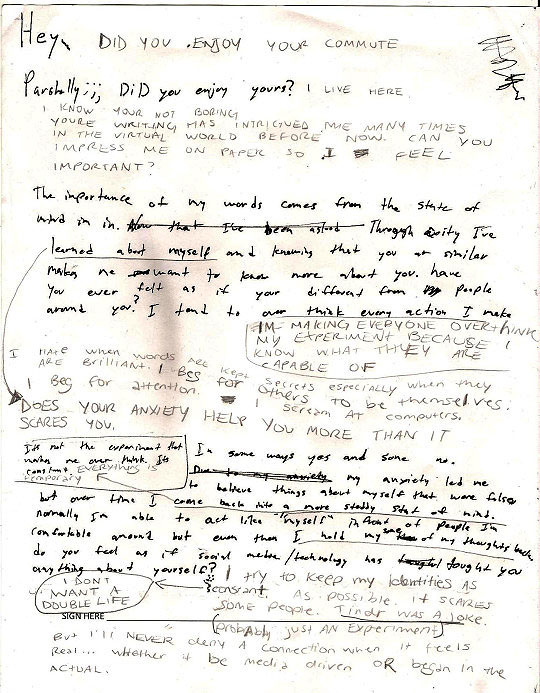
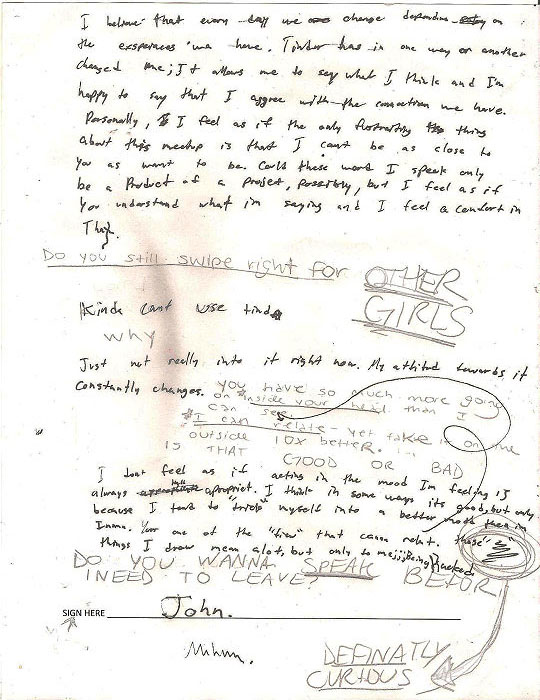
Goffman labels the actors Front as the individuals main image or impression to give off to their observers or audience. One performance I see and participate in everyday is digital communication. Whether it be through texting, Facebook message, tinder, twitter, .. everything is easier to communicate through these digital mediums because of the lack of Front. There is no Theatrical role to attain when the script is completely virtual. This is why I often argue that in terms of the Self (no performances involved) It is much more comfortable communicating through virtual interaction. . in order to create a social breach in physical space I chose Written Communication that took place with human to human contact. I sat next to each of my Subjects and passed a piece of paper back and forth as if it were a text message travelling through time and space but we made eye contact every time. I considered this a hack of human to human contact because I allowed them to temporarily un-adhere to the Theater of Real life and break conventions.

As far as what was written, I tried my best to break hack breach these conventions as well. My subjects each have known me as a silly friend who would not normally write them a note unless it was a letter for serious means. “Tell me about your Family”

“Are you Happy” some friends gave me silly and sarcastic answers and chose not to break their front.

1NE— my playful friend

2RB— i think he was high

3TM— thought this was just another one of “my games”

I hacked my own experiment by looking for some subjects who I really thought might have something to say had I given them the chance. I wasn’t really looking for anything groundbreaking, but I was really looking for the outcome of my experiment to contain more depth than some giggling and note passing. Some conversations turned awkward and emotional.

4GO— a great friend whom I occasionally sleep with

5CE— a best friend who secretly intimidates me

6KN— accidently broke his heart

7MK— we both have a lot of experience with prescription drugs.. He made me a little uncomfortable. (my own experiment hacked!)

My last Conversation was with a Tinder Match who was willing enough to meet me in physical space.. This was unexpected and very breaching itself. It really enforced my initial challenge of relying on comfort ability in digital communications since that is all we had made until our brief human contact and Written communication. I may have pushed him to meet very early in our ‘relationship’ but thanks to virtual technology and connections I found he has similar interests wanted to help me out with my experiment.8EP 9EP


I chose this form of documentation (writing) because It feels true to the Subject (person).. The Viewer can see where we confronted each others formal or informal roles. I can review each written piece despite what was going on in that moment of time and see what we each independently thought about the conversation…. or the experiment. The outcome is that some participants were willing to break their front during our in-person Written Communication, and some were hesitant.

“And to the degree that the individual maintains a show before others that he himself does not believe, he can come to experience a special kind of alienation from self and a special kind of wariness of others.”

Erving Goffman

Lukic Week1: Breach

for my breach I chose to do two things. One was to invade personal space by stepping closer to the person i was talking to and the other was staring at them in the eyes will having a conversation while keeping a straight face. Keep the straight face was the hardest thing to do. So i went up to different family members and did it. my family all get frustrated very easily. So it was evemn funnier. So i would start the conversation asking how they were and they day was. First i kept a good distance then i moved clsoer and closer until i made them step back or have them say something like what are you doing back off. Each and every one of them had the same reaction. thye all were so confused and took a step back to get that personal space back. I got a lot of what the **** is wrong with you. can you stop. BACK OFF.  they got so angry it was great as i expected for them to do. You could tell that they were uncomfortable because their facial expressions and how their body reacted to the experiment. I even got a few shoves. HOW RUDE.

Coming Clean (Google Challenge ‘Fails’)

To start off, the only kind of word processing software that I’ve been using consistently is with Google Docs because of how convenient it is to not only be able to have all of your material accessible from anywhere, but because I can work on my assignments while on the go or at home.

Even though I have an iMac at home with word-processing software like ‘Pages’ and  ‘Keynote’, I still used Google drive to do personal writing projects and work related assignments.


This challenge was even harder for me as well because my parents recently got me a laptop for my birthday, and the laptop happens to be a ‘Chromebook’. So from the OS to the control panel, everything on it was Google. I’ve been using it for awhile and gotten accustomed to using it for school so its been harder not to use it completely.


February 12th,

I had no choice but to use the Excel app on Google drive for an assignment for my Arts Management class… Then while I was working I was tempted to go on Youtube…and I did. I was ashamed…

I tried to stop but then I found a thread on Todd Hiddleston dancing and couldn’t stop. (-_-

February 13th

My brother (unaware of the Google challenge) wanted to show me funny video on Youtube. I resisted at first but after he pried I watched it.

February 17th

Unfortunately the Mac computers in the Natural Science building did not have the cable port for my Gdrive that I needed to turn in  homework files… so I had no choice but to use google drive.


Besides those incidents I think I did pretty well in this challenge. I cheated a little at times but for the most part I was strict with myself. I found ‘Bing’ to be extremely annoying, and Firefox to be bearable but I missed Google…

However despite all of my efforts to avoid using Google, I found that you couldn’t completely get away from it! Firefox automatically uses Google to search and even when I wanted to use another search engine like ‘DuckduckGo’ I needed to go through google to find it. (It wasn’t until a friend told me, that I figured out how to insert the address of the search engine without going through google)

ex: ‘bing.com’

I think I didn’t know about this mainly because I was so use to just typing something into the search bar and automatically having google search for it.

Overall I believe this test was successful and showed just how much I relied on Google for daily tasks…but I wouldn’t want to do this again.


Cheated Google Diet

I realized a couple minutes into a video that my friend was showing me that we were watching it on YouTube. Oops.

~~

The Google Diet was very hard for me because I am dependent on Google as a search engine. I realize that there are multiple search engines available, but I have always been an avid user of the G. What I thought was interesting was that I did not go on Youtube as much as I thought I did. I now use Spotify which is easier and more convenient for me. I also use Gmail for random email friends, which was hard to stop using, even for a week.

I liked this exercise because it made me think more about Google in the sense that I was unaware of how many companies they own. It was fascinating to read the list and be stunned every time I read a familiar name.