Posts Tagged ‘#assignment1’

Assessment 1 Part B: Her, AI , and Social Relationships

Spike Jonze’s ‘Her’ is a look into a near future where artificial intelligence is practically human. The film explores how an AI can feel human and how much a human can become attached to something that inherently isn’t. The main character Theodore, going through a divorce, begins to find companionship and intimacy with his operating system. Theodore himself chose his OS to have a female voice and then she gave herself the name Samantha. At the start Theodore viewed Samantha as a computer, but once he says he “couldn’t believe he was talking to a computer”, Samantha says, it’s “ not a conversation with a computer, it’s a conversation with me.” Samantha wants Theodore to perceive her as a human being and once Theodore sees her that way he eventually begins to see her as a significant other.
Throughout the film there is this constant focus on the relationship Theodore is having with Samantha. He see’s her as another person and he wasn’t the only person who was doing so. In one scene Theodore and his friend Amy are having a discussion about an article that talked about people having romantic relationships with their OS’. This reveals that Theodore isn’t the only person involved in a relationship like this. It’s as if there is a stigma the might be attached to people dating OS’ for a while since Theodore initially tells his Goddaughter about who Samantha is. Theodore slowly opens up more to others about his relationship with Samantha once it begins to feel more real. Similar to normal human relationships, Theodore and Samantha constantly try to make their relationship work as much as they can. By looking at how close Theodore becomes with Samantha it parallels the relationships people have with technology today.
Part of Sherry Turkle’s ‘Alone Together’ discusses how many people today are going to robots for comfort. She states, “Sociable robots and online life both suggest the possibility of relationships the way we want them.” In ‘Her’ Theodore’s ex-wife see’s his relationship with Samantha as one that is programmed and one that didn’t come with the emotional struggles that existed between that of two people. The film brings to life what Turkle describes in her book, “Our first embrace of sociable robotics (both the idea of it and its first exemplars) is a window onto what we want from technology and what we are willing to do to accommodate it.” Theodore embraces the technology because it gives him what he wants out of a romantic relationship. As Turkle points out, with our interest and acceptance of social robotics, we may be very close to the future that exists in ‘Her.’
Both ‘Her’ and ‘Alone Together’ work well in thinking about how we can see AI working to meet our social needs in the future. Today’s constant use of social media may even be considered detrimental to our own relationships with others. If we start having IA/OS’ like Samantha becoming the norm, the society and culture around it needs to begin to think about the positives and negatives that are associated with these new technologies. It mainly comes down to our interactions with others and how much we want to let some of those actions be with an AI.

Her. Spike Jonze. Elite Film, 2014. Film.
Turkle, Sherry. Alone Together: Why We Expect More from Technology and Less from Each Other. Print.
D’Ambrosio, Anthony. ‘5 Reasons Our Generation Just Isn’t Cut Out For Marriage’. The Huffington Post. N.p., 2015. Web. 17 Apr. 2015.
Assignment 1 – Fictional Character

When it came to conducting an experiment that required a fictional character to be the launch pad of your exercise, it took some research and role-playing in order to illustrate an illusion as if the character was real. The purpose of Exercise #3 was to interview a fictional character and design a way to project content online in which displayed the character’s interests and personalities. Overall, it felt like putting on a small digital “puppet show” for a virtual audience to see. The interviewer was the puppeteer where he or she incorporated information from an interview as if they it was the performance and a social network platform was the stage.

Fred is an energetic science geek and comic book fanatic that studied at a university in the fictional city, San Fransokyo. From the interview, the various questions were categorized in a way to simply ask the interviewee a little information about himself. For example, “What’s your occupation?” or “Do you still go to school?” These two questions are examples that helped keep the interview flowing smoothing.

With the interview as a source of guidance, establishing at least one social network account could form a pathway for the character to become alive. In other words, the experimenter used his or her subject to interact with the world, in this case, the Internet. For example, Twitter would provide a smooth connection when using IFTTT recipes. The following recipes that were used to illustrate Fred were helpful to showcase his interests and personalities. Mainly his Twitter page dealt with online shopping for monster action figures and technology from Best Buy or eBay to news alerts or discussions about superheroes from reddit.

In spite of concluding this experiment to be fun, there were several elements that taught others how significant it was when it came to developing “robotic” accounts in order to illustrate an illusion on how any form of artificial intelligent can magically use APIs; application programming interfaces. From Sherry Turkle’s book, Alone Together, in her introduction, she focused on the robotic movement of when, where, and how will human and robots interact with one another. Turke stated how “Robots have become a twenty-first-century deus ex machina.” (Turke, 9). If robots could be another “godly machine,” social networks that connected with any devices; computers or smartphone, could be another AI too. It’s like personifying a device with human qualities. Similar to how Turke reflected objects to have human qualities and the content to be treated as things. (10). For instance, the object was Fred’s Twitter page and content were the incoming tweets with IFTTT recipes displaying his interests are things.

Work Cited:

Turke, Sherry. “Introduction.” In Alone Together. 1st ed. Basic Books, 2012.

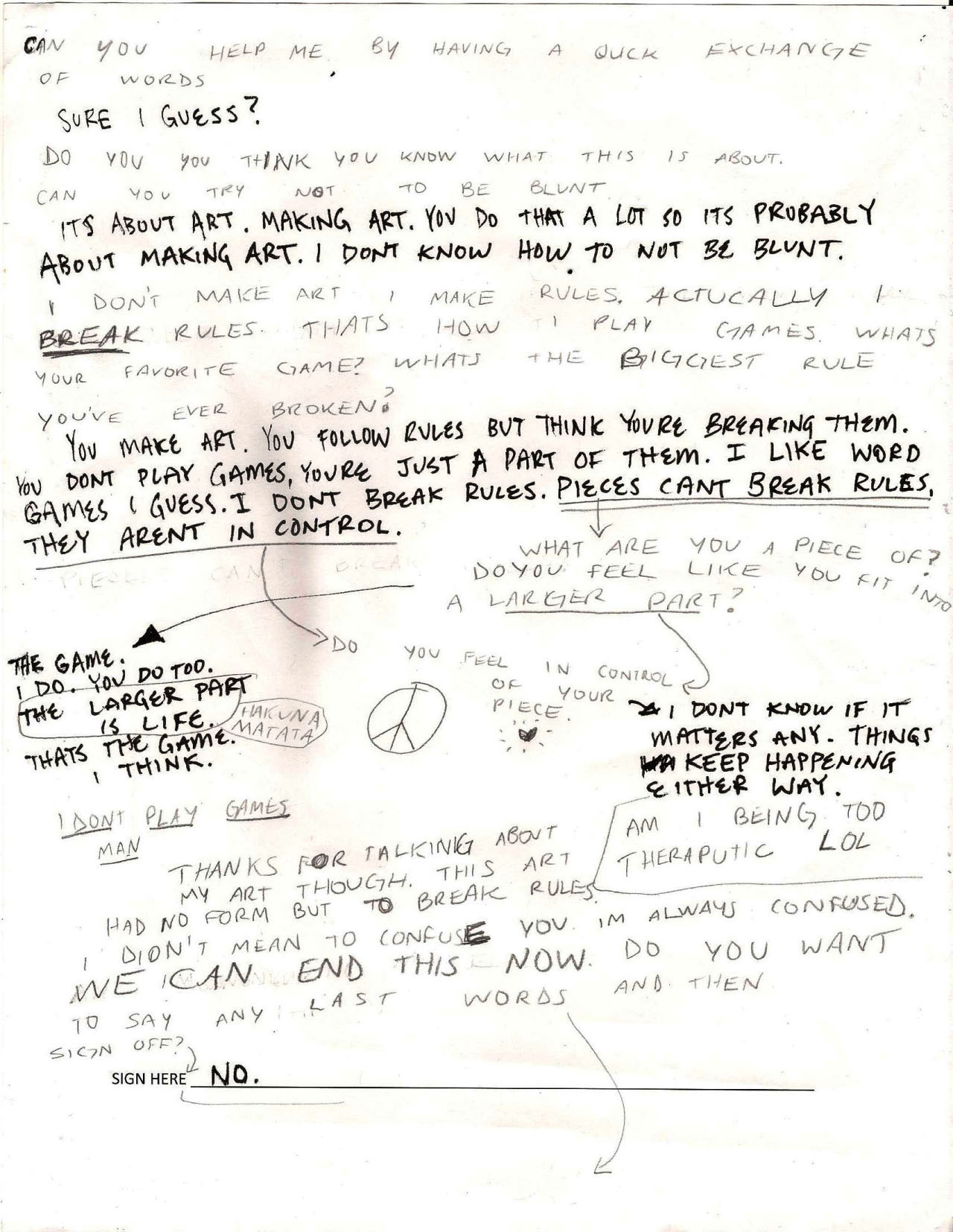
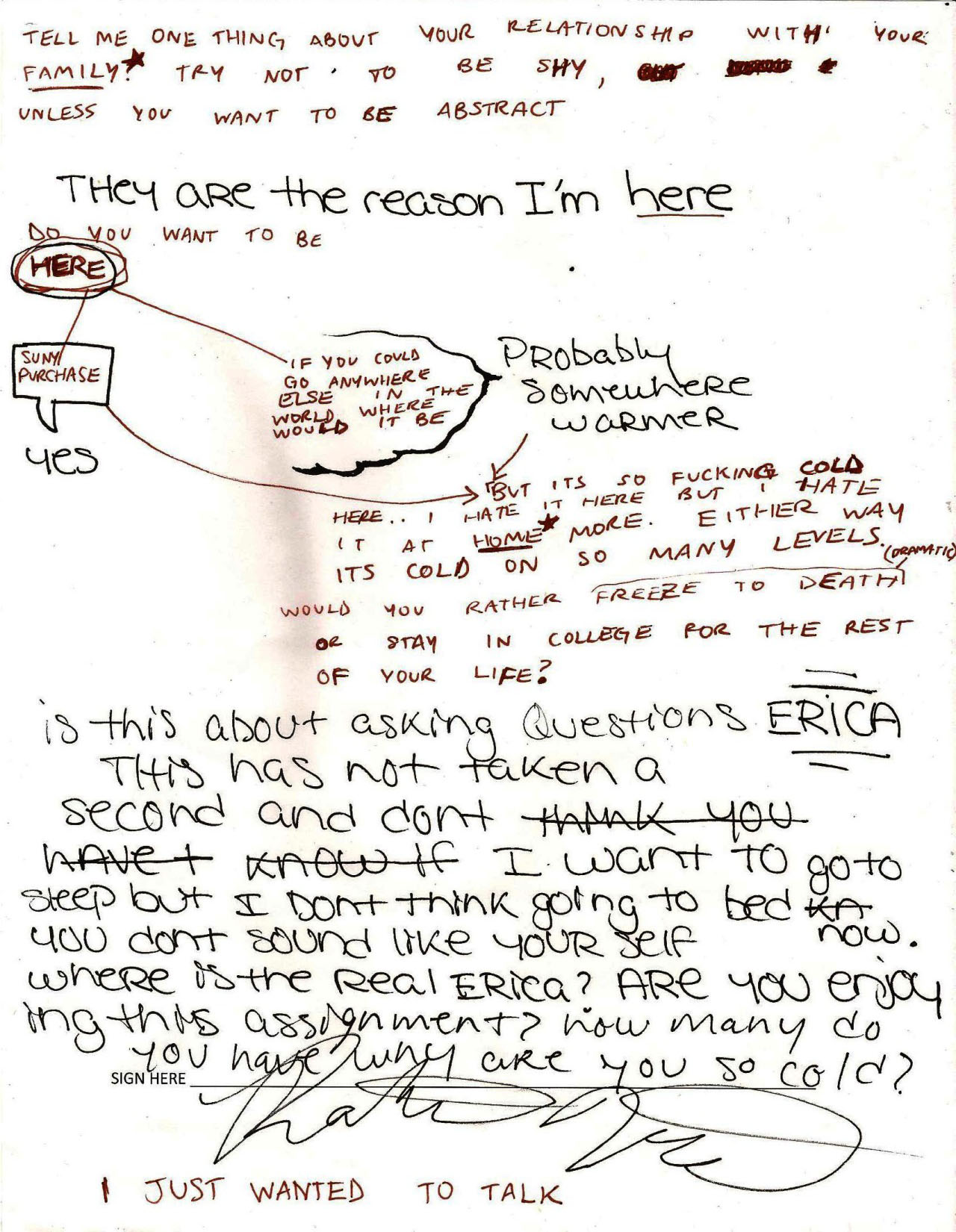
Assignment1: “Texting” in Person

The Presentation of Self of Everyday Life by Erving Goffman discussed the importance of human social interaction and how it is inconsistent due to certain attributes comparing it to a Theatrical Performance , as though we take on a variety of roles, observing each other constantly, judging each other. It is difficult for an individual to be themselves because of this feeling of a present audience, unfamiliar settings, attention to appearance, inconsistent manner etc.

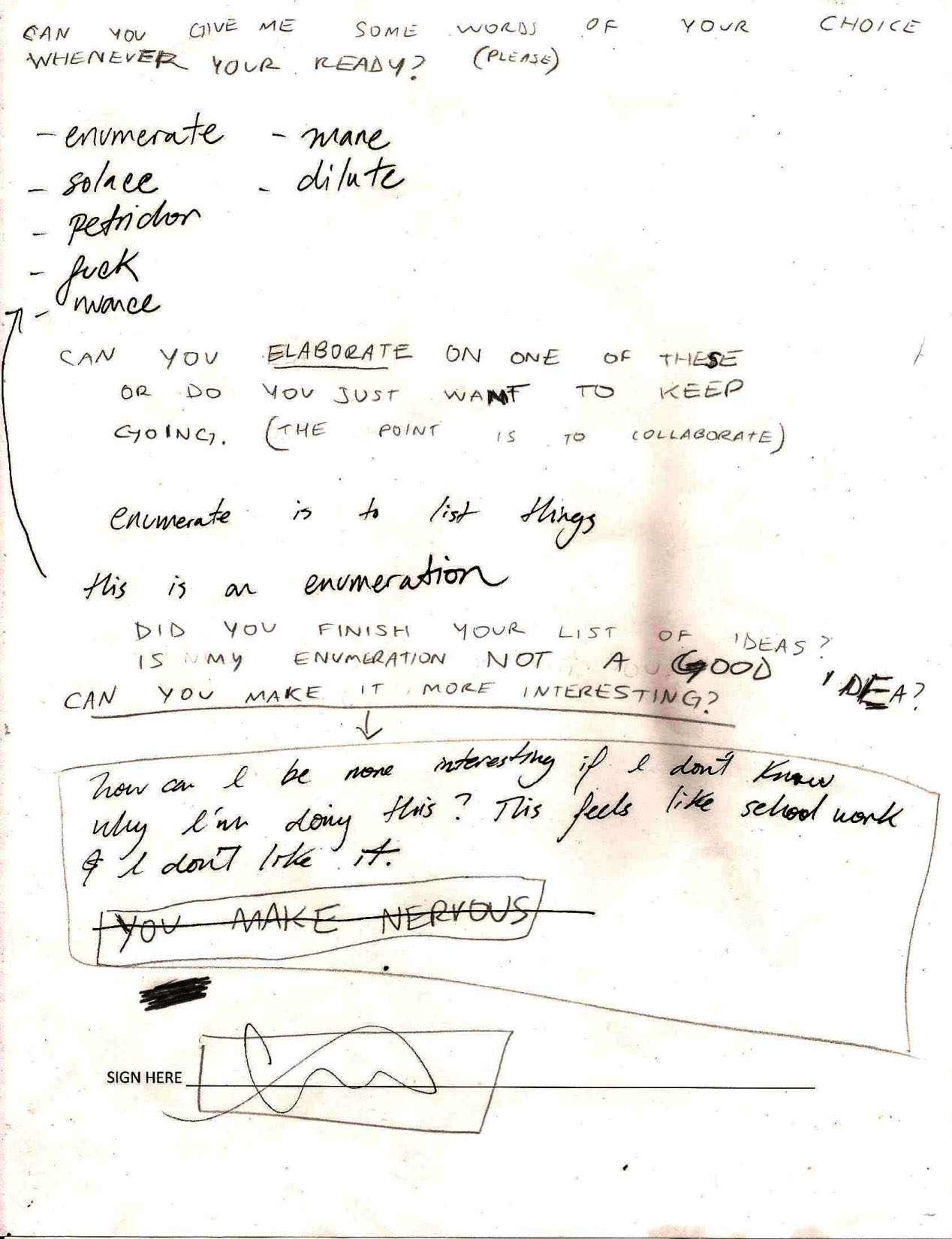
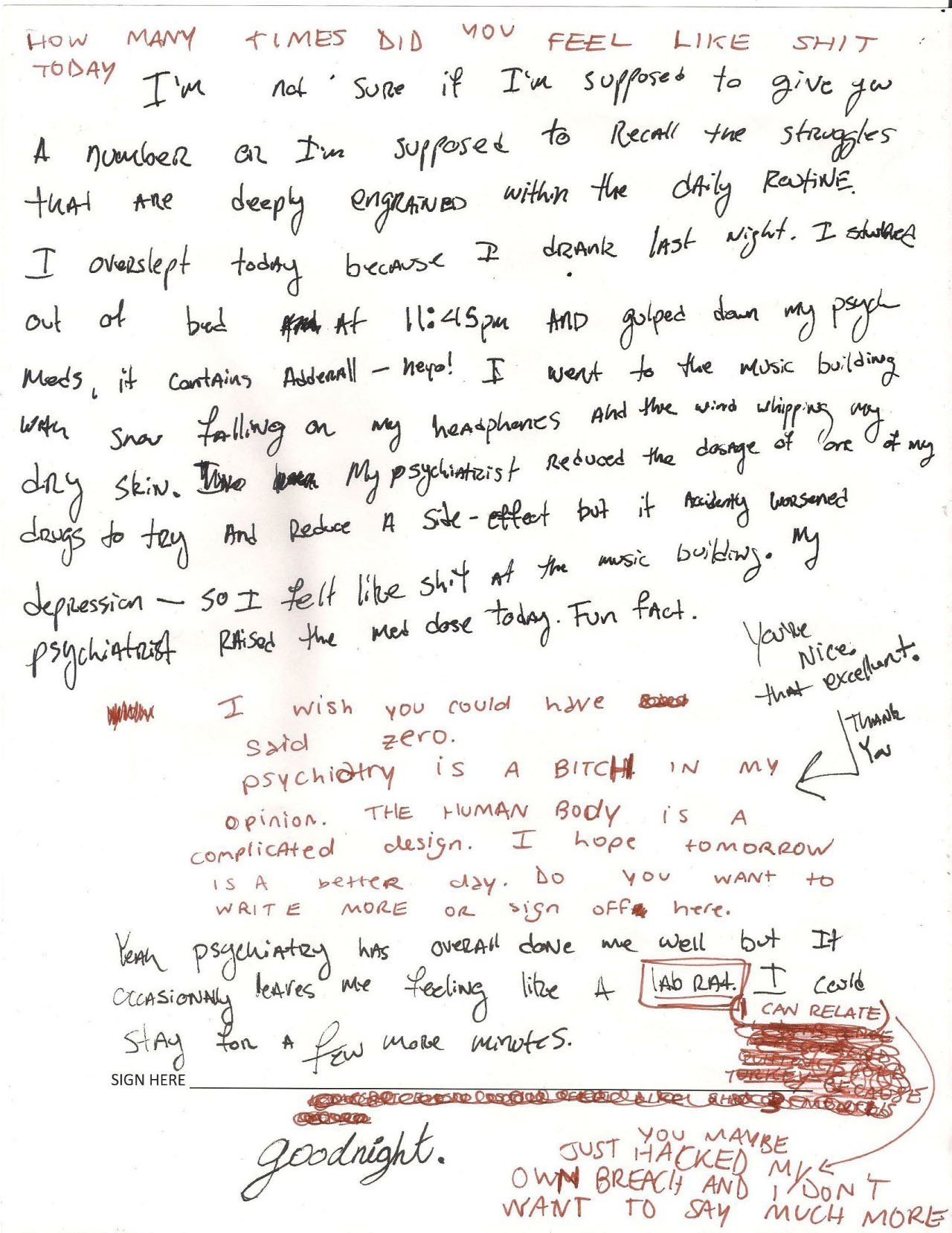
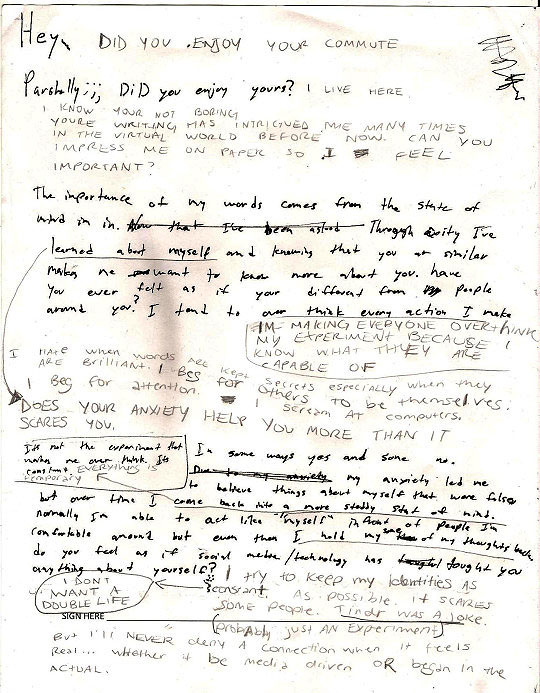
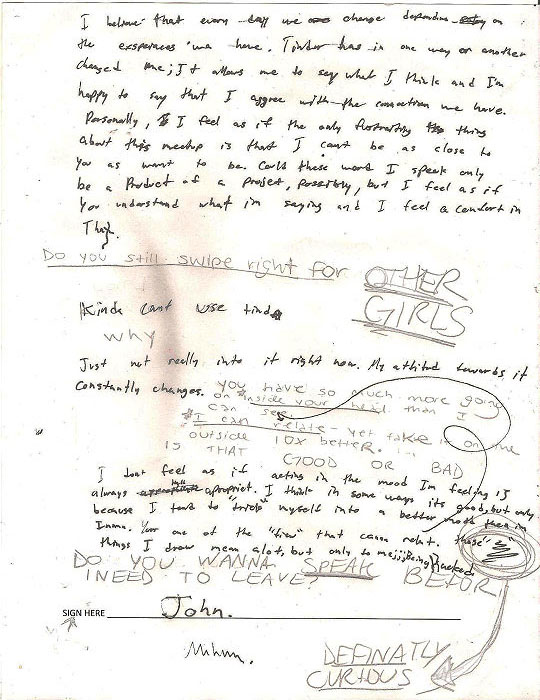
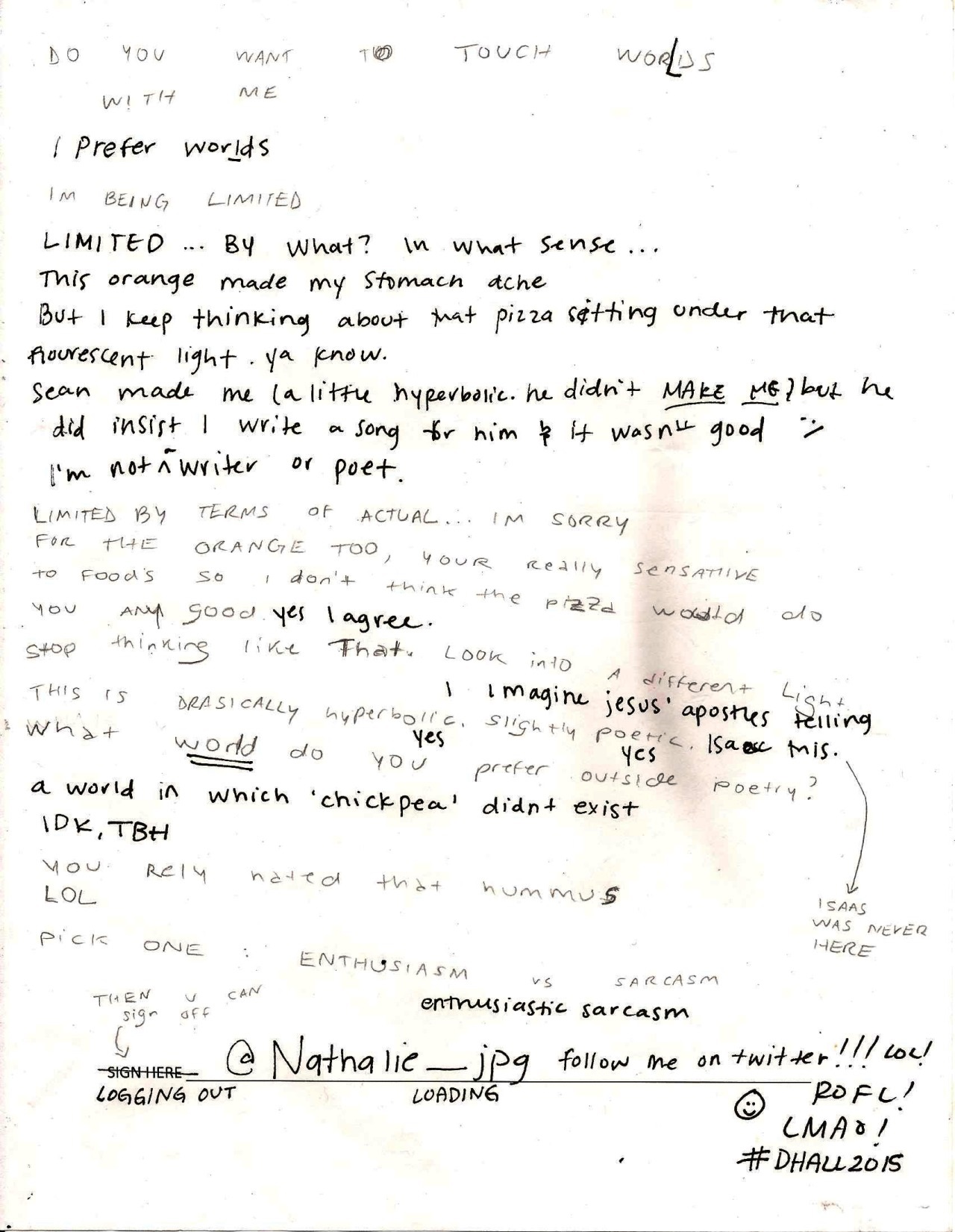
Goffman labels the actors Front as the individuals main image or impression to give off to their observers or audience. One performance I see and participate in everyday is digital communication. Whether it be through texting, Facebook message, tinder, twitter, .. everything is easier to communicate through these digital mediums because of the lack of Front. There is no Theatrical role to attain when the script is completely virtual. This is why I often argue that in terms of the Self (no performances involved) It is much more comfortable communicating through virtual interaction. . in order to create a social breach in physical space I chose Written Communication that took place with human to human contact. I sat next to each of my Subjects and passed a piece of paper back and forth as if it were a text message travelling through time and space but we made eye contact every time. I considered this a hack of human to human contact because I allowed them to temporarily un-adhere to the Theater of Real life and break conventions.

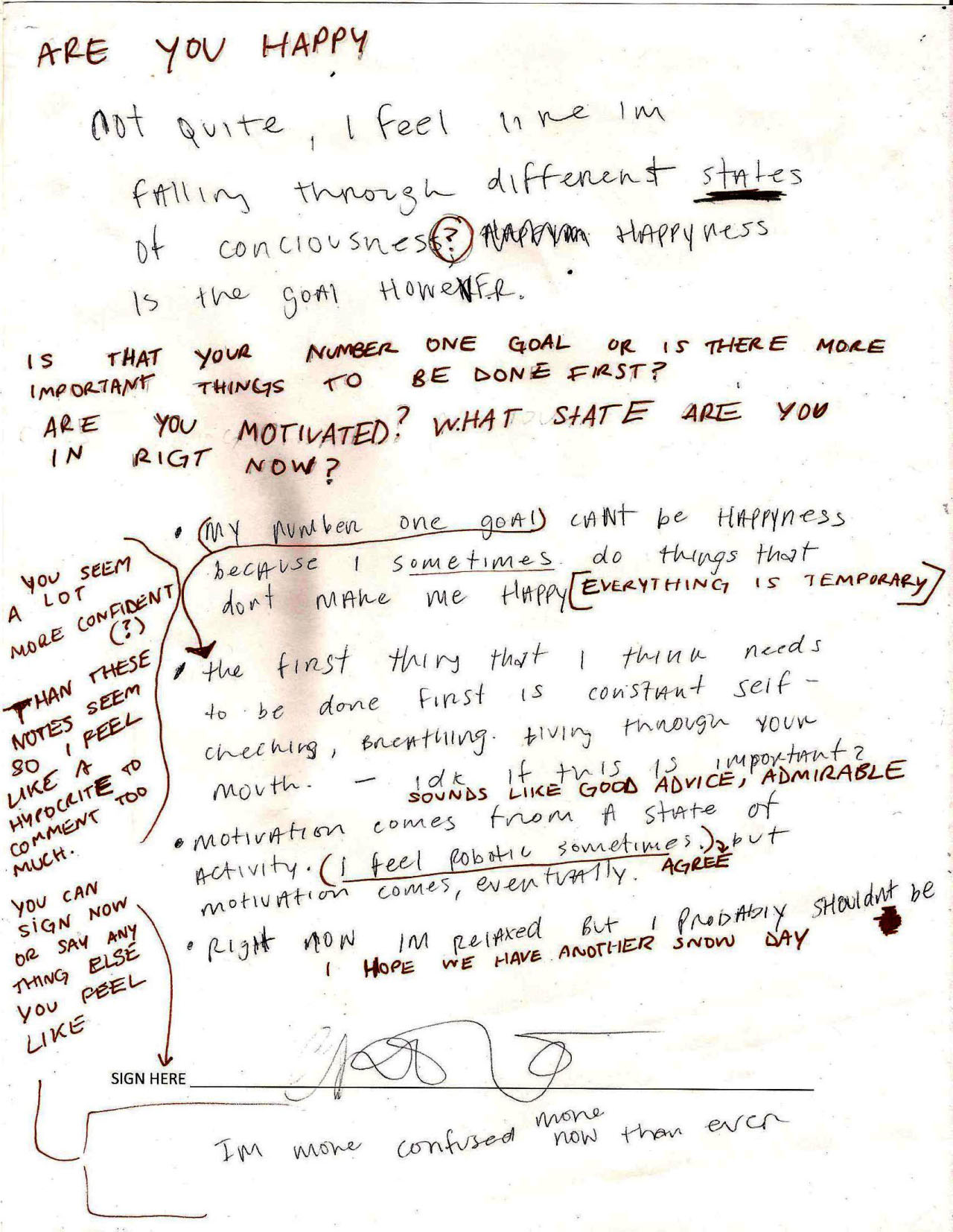
As far as what was written, I tried my best to break hack breach these conventions as well. My subjects each have known me as a silly friend who would not normally write them a note unless it was a letter for serious means. “Tell me about your Family”

“Are you Happy” some friends gave me silly and sarcastic answers and chose not to break their front.

1NE— my playful friend

2RB— i think he was high

3TM— thought this was just another one of “my games”

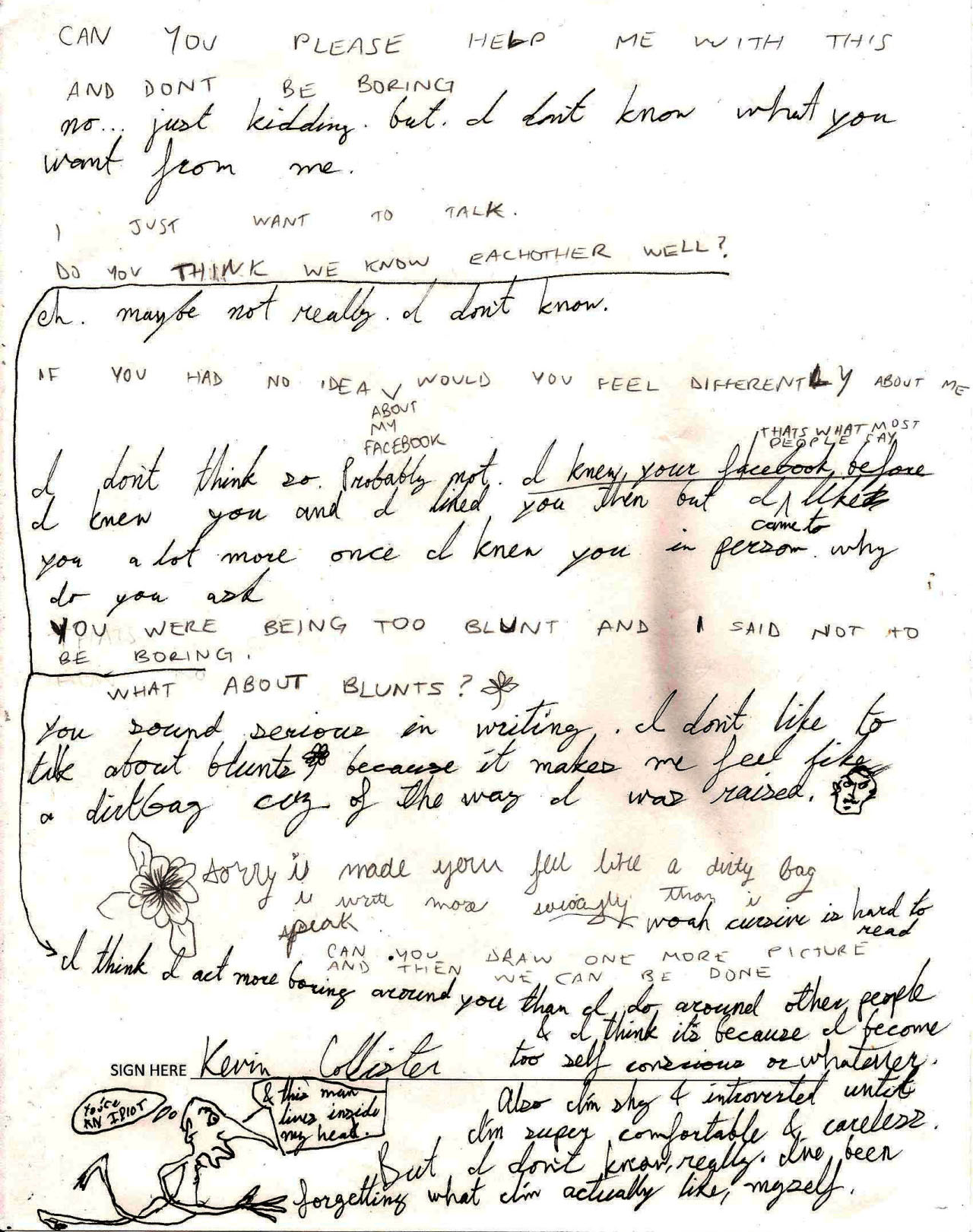
I hacked my own experiment by looking for some subjects who I really thought might have something to say had I given them the chance. I wasn’t really looking for anything groundbreaking, but I was really looking for the outcome of my experiment to contain more depth than some giggling and note passing. Some conversations turned awkward and emotional.

4GO— a great friend whom I occasionally sleep with

5CE— a best friend who secretly intimidates me

6KN— accidently broke his heart

7MK— we both have a lot of experience with prescription drugs.. He made me a little uncomfortable. (my own experiment hacked!)

My last Conversation was with a Tinder Match who was willing enough to meet me in physical space.. This was unexpected and very breaching itself. It really enforced my initial challenge of relying on comfort ability in digital communications since that is all we had made until our brief human contact and Written communication. I may have pushed him to meet very early in our ‘relationship’ but thanks to virtual technology and connections I found he has similar interests wanted to help me out with my experiment.8EP 9EP


I chose this form of documentation (writing) because It feels true to the Subject (person).. The Viewer can see where we confronted each others formal or informal roles. I can review each written piece despite what was going on in that moment of time and see what we each independently thought about the conversation…. or the experiment. The outcome is that some participants were willing to break their front during our in-person Written Communication, and some were hesitant.

“And to the degree that the individual maintains a show before others that he himself does not believe, he can come to experience a special kind of alienation from self and a special kind of wariness of others.”

Erving Goffman