Archive for the ‘Uncategorized’ Category

exersise 1 – pt2 – the tinder match is present

in physical space

..

he was a good sport i got him to stare at me for a while as a second form of “Social hacking”

https://www.youtube.com/watch?v=Dp5xg4hH3Sg&feature=youtu.be


and then he participated in my my Passing notes in person experiment

https://www.youtube.com/watch?v=MsrIPtfB8VY

this is just a little extra documentation since i did excersize 1 so late

he was a really good sport.. doesn’t he kind of  look like a Lawrence brother from the Disney channel?

51844444

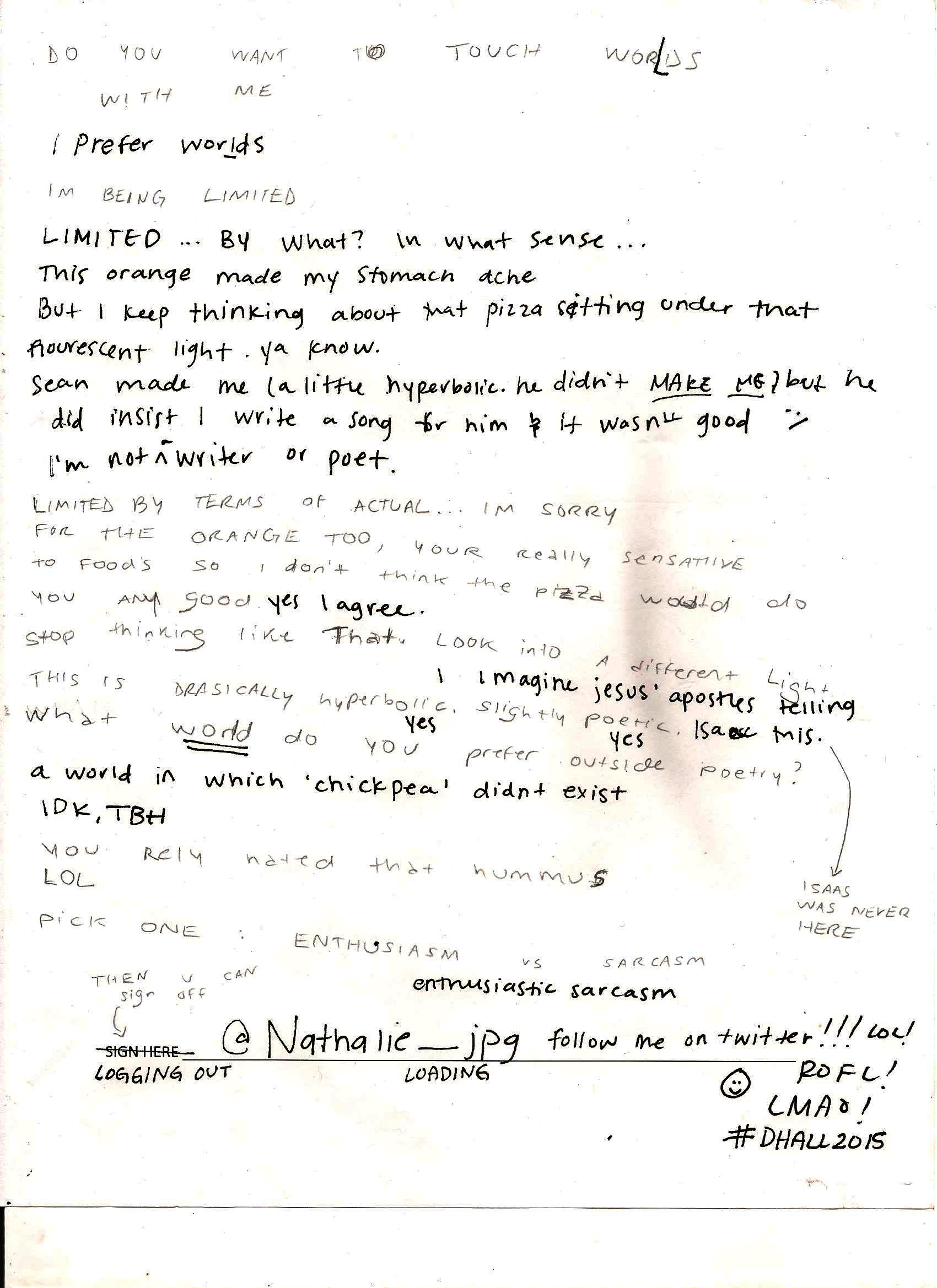
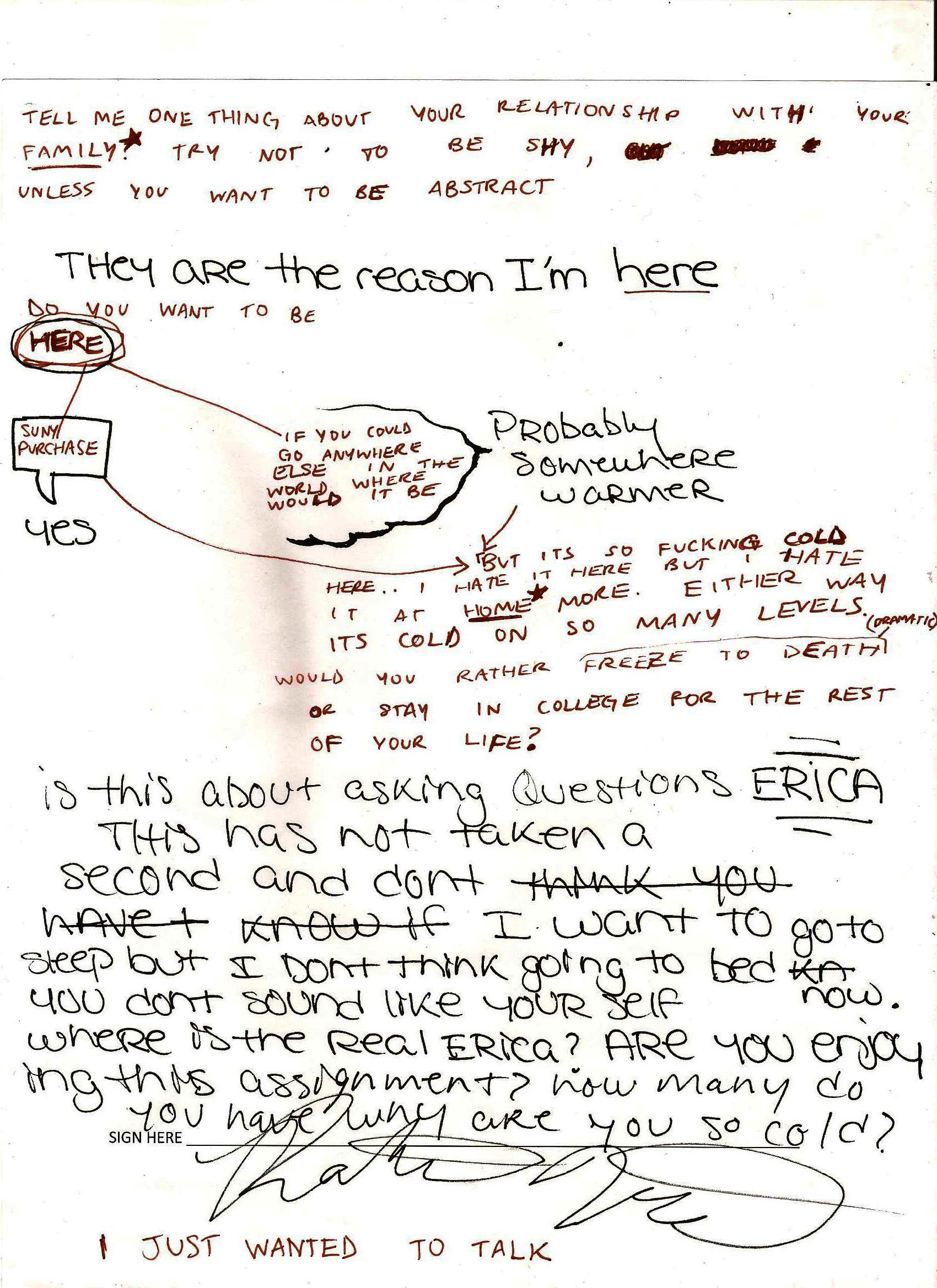
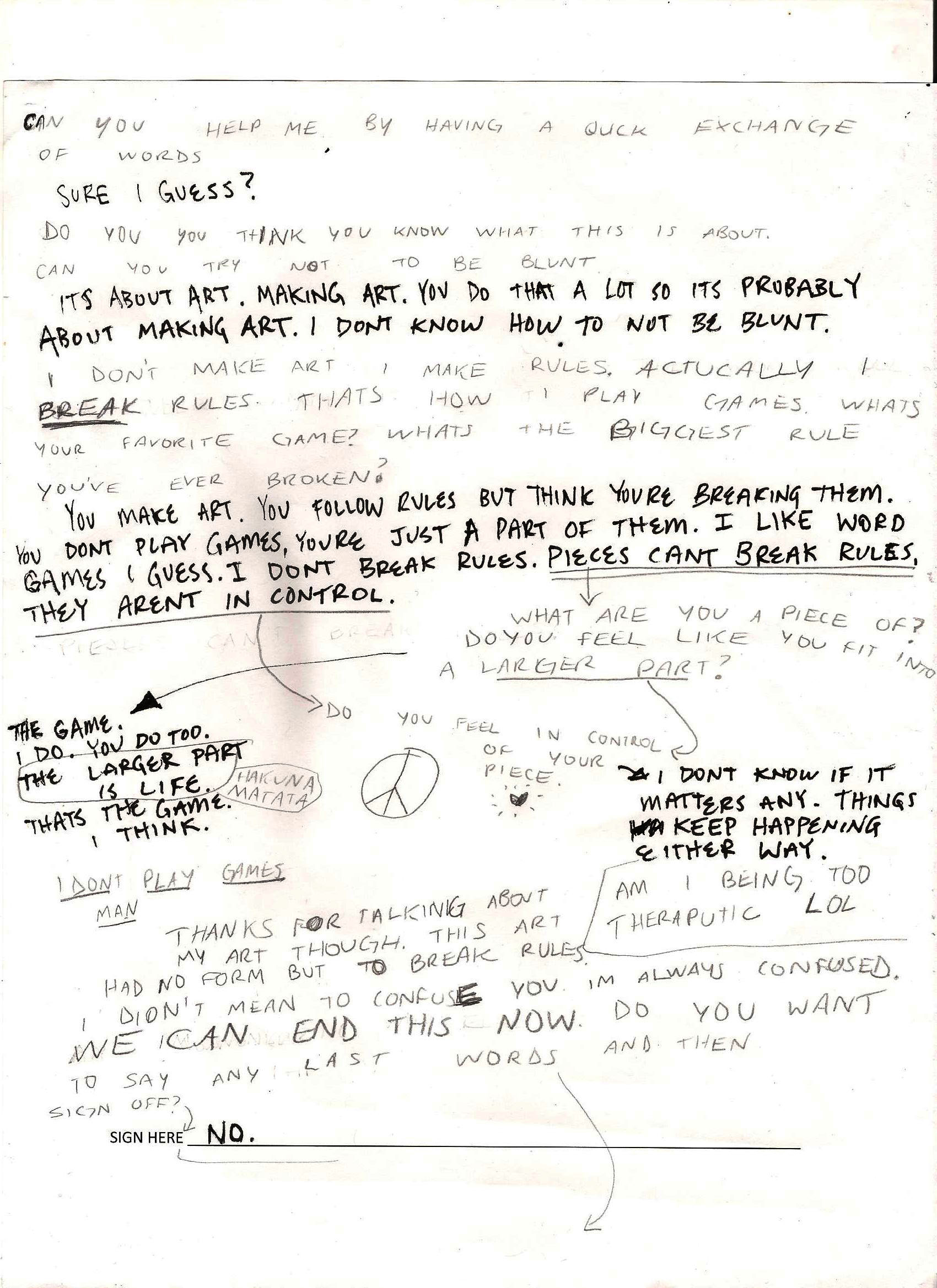
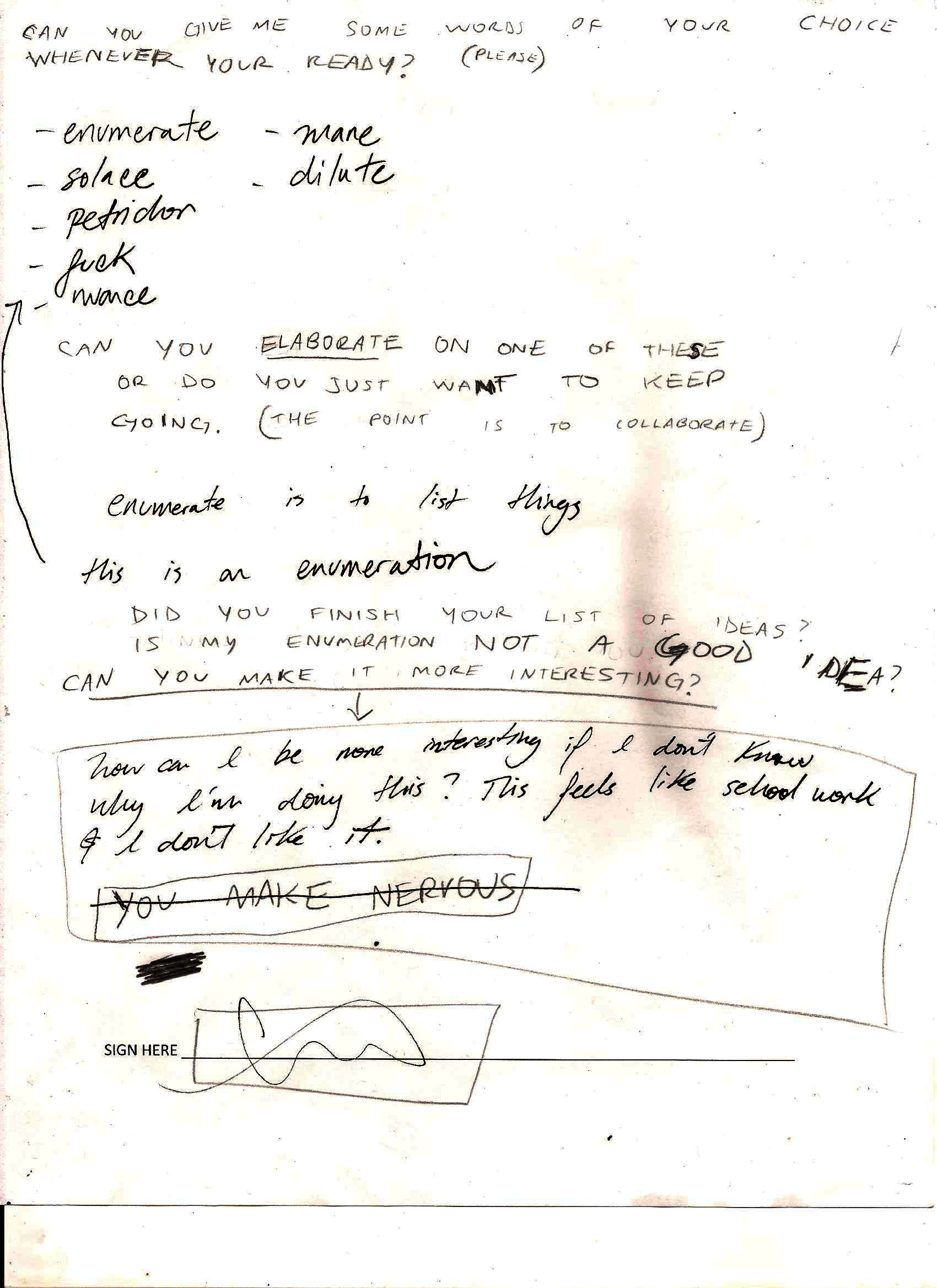
exersise 1 – Passing Notes in Person

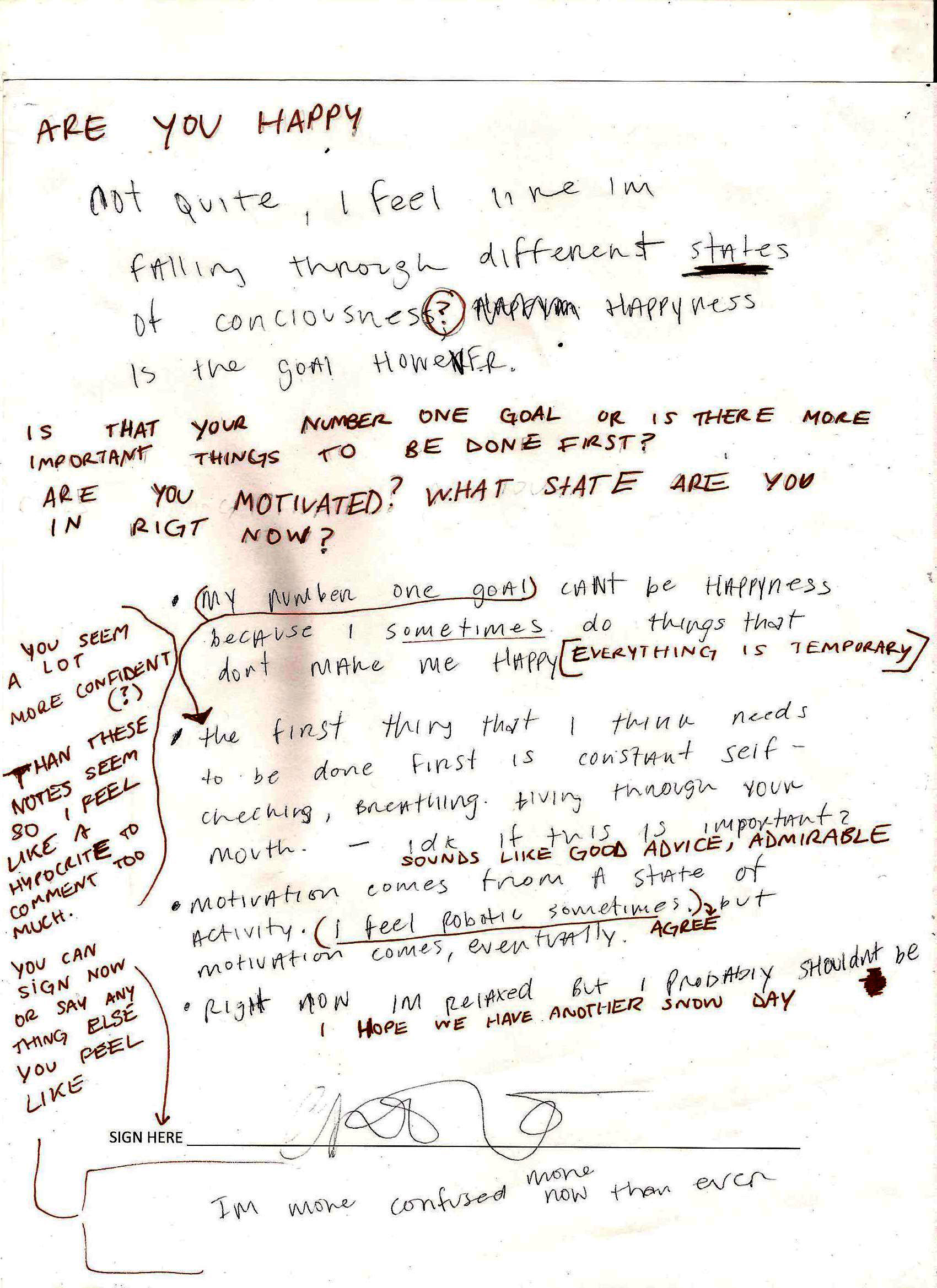
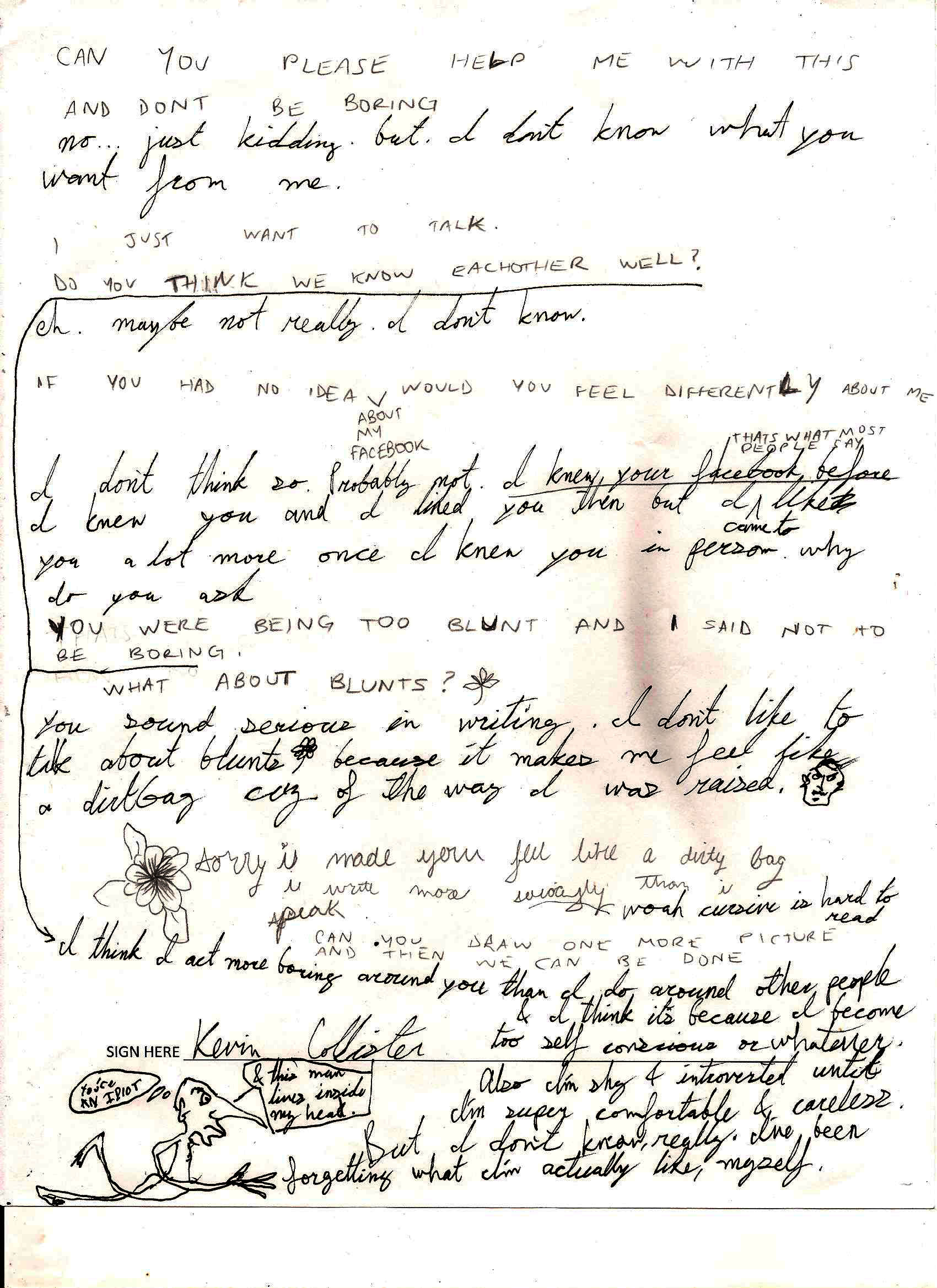
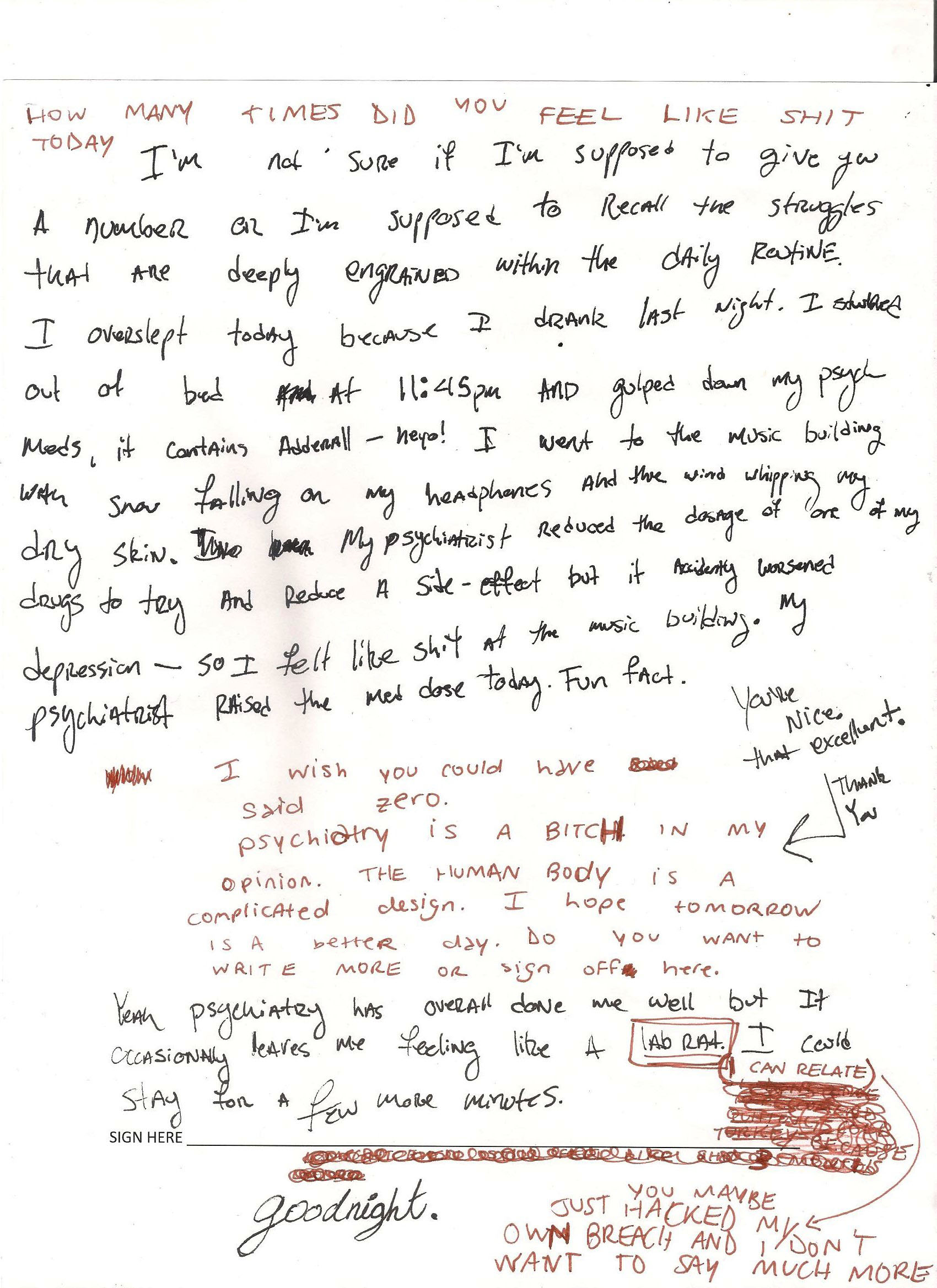
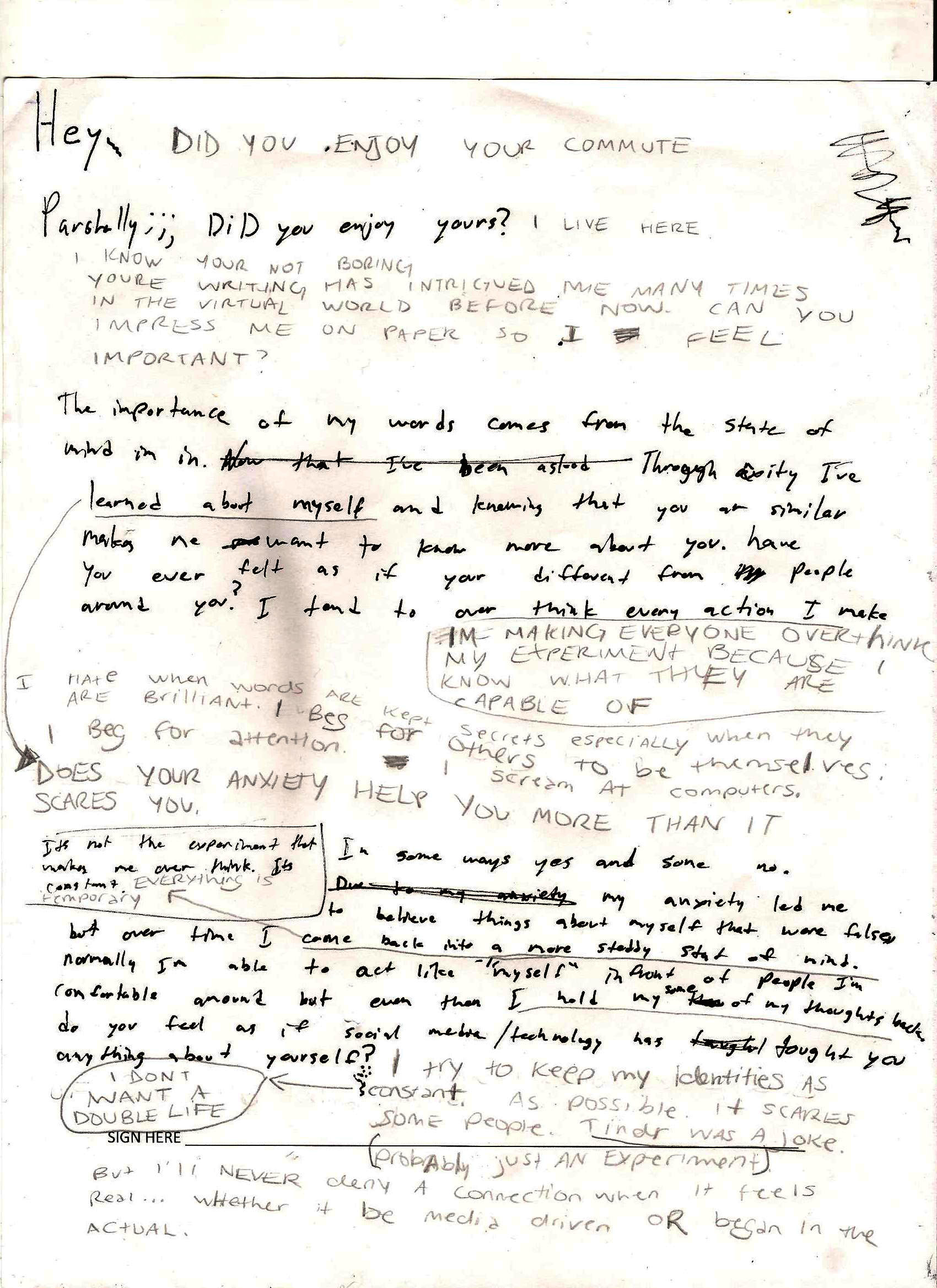
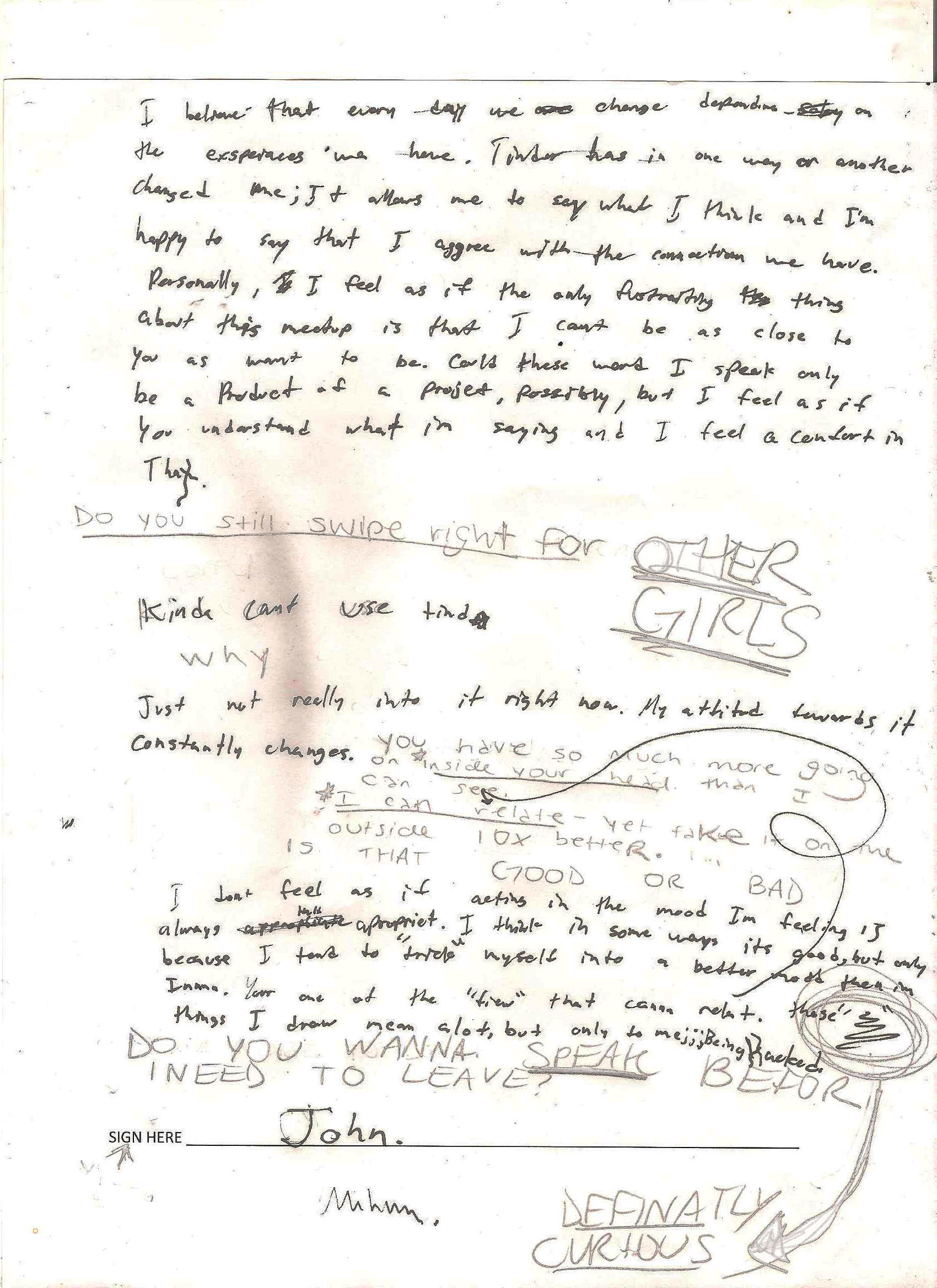
My social breach was Passing Notes in Person. I wanted to do something that didn’t include taking  video documentation of myself doing something breeching in public because that’s nothing out of the ordinary so a written conversation between me and my loved ones felt more passionate and I wondered what the outcome would be.

A lot of my subjects found what I was doing silly, and knew me better than to start “notes” with them with questions like “Tell me about your Family” and “Are You Happy?”…. They gave me sarcastic answers as I tried to poetically pry (hack) them.

nat .. my playful friend

robert   .. i think he was high

tommy –tried his best to play “The Game”

Some conversations felt emotional, as I knew the subject already and had reasons to not ask them any breaching notes or questions but I did my best to try my experiment on different types of people in my life.

gio—My friend with benefits

craig–  one of my best friends
that secretly intimidates  me

kevin—  accidently broke his heart

One  of my subjects pretty much hacked me me.. I couldn’t handle their response and decided to end the conversation.

micah–  we both have a lot of experience with prescription drugs.. I wasn’t ready to go that deep for a school project

My last unexpected subject in physical space was a Tinder match who was kind enough to meet up in person. This was the only subject whom I had never spoken to (in person) until we Passed notes in Person:


evan1evan2


and…. i made a really quick tumblr for Clearer documentation because WordPress really freaks me out for some reason—-

http://ruhappylol.tumblr.com/

Exercise 3: Project ‘Bravo’

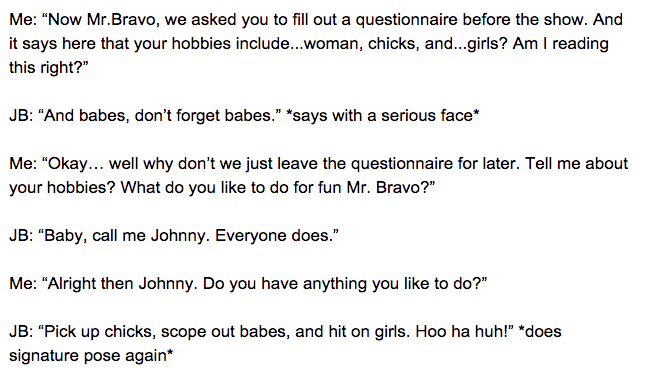
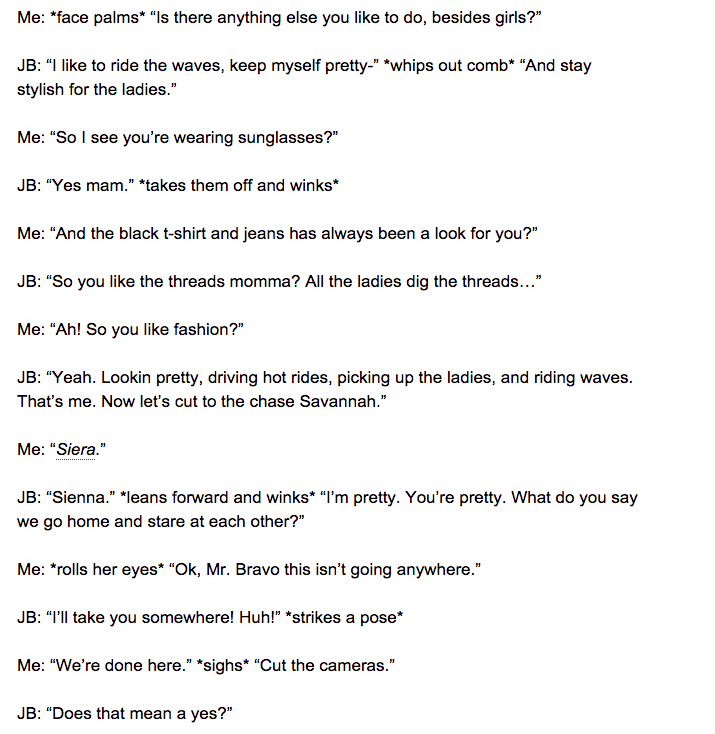
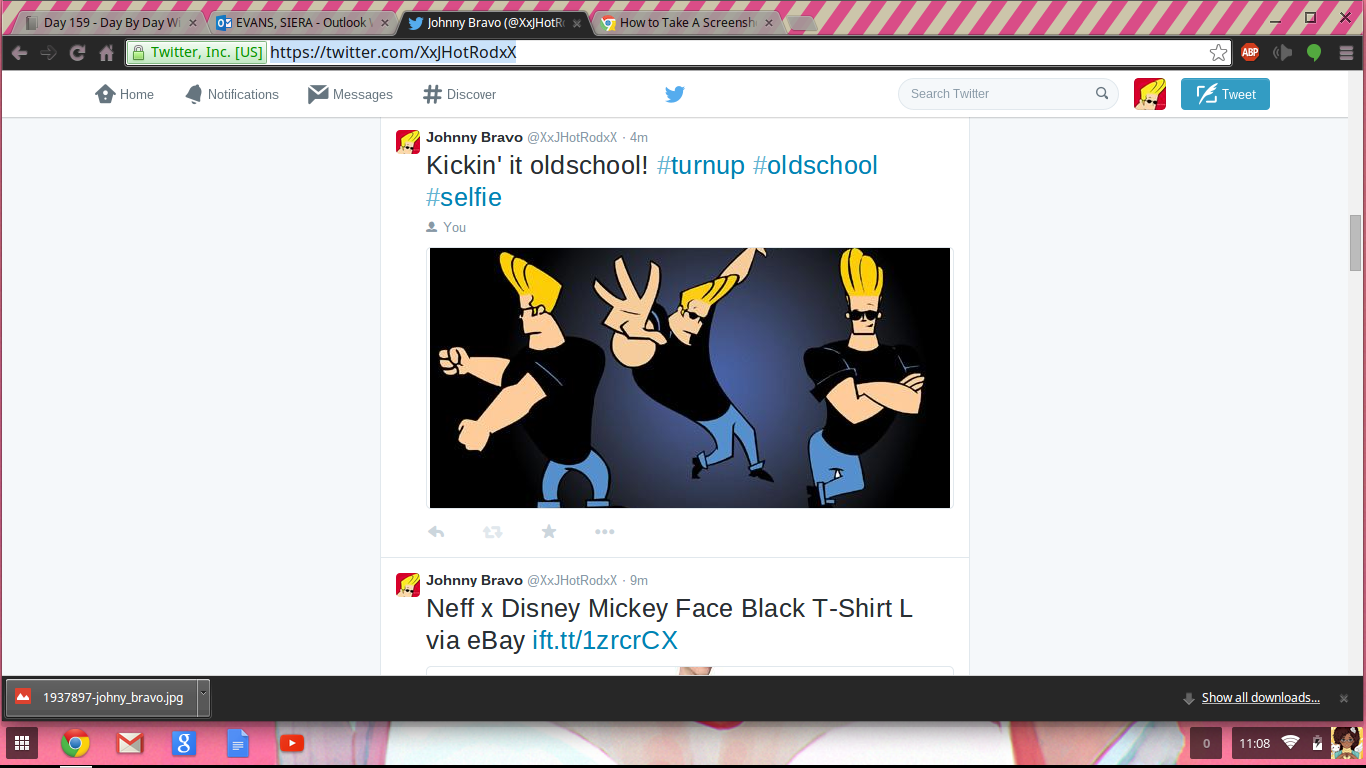
For this exercise I chose to conduct an interview for the fictional cartoon character ‘Johnny Bravo’. In writing the interview I greatly took into account his overall character and considered how it would apply to the scenario of an interview.

For those of you who are unfamiliar with his character I included a link to one of the episodes of his TV show.

https://www.youtube.com/watch?v=xnGnl-UElVA

Here are a few snippets from the interview I conducted,

q p


If anyone wants to read the full interview.

https://docs.google.com/document/d/1zFqqI4OR0v6XWo39lZWeWWOnZRG3zJEjd-U-CKg6ZKQ/edit?usp=sharing

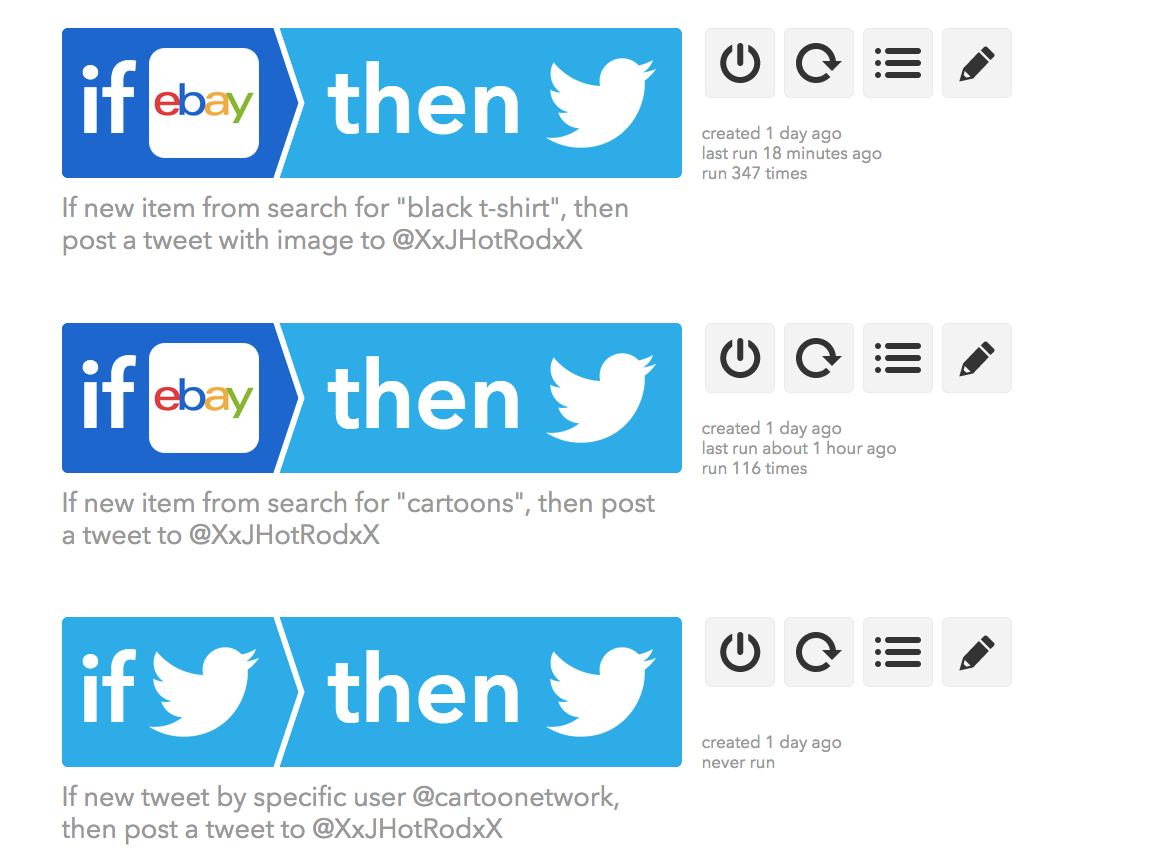
Continuing this exercise I wanted to create a page on social media that the character could visit and receive information on what he enjoyed or the products he liked in one location.

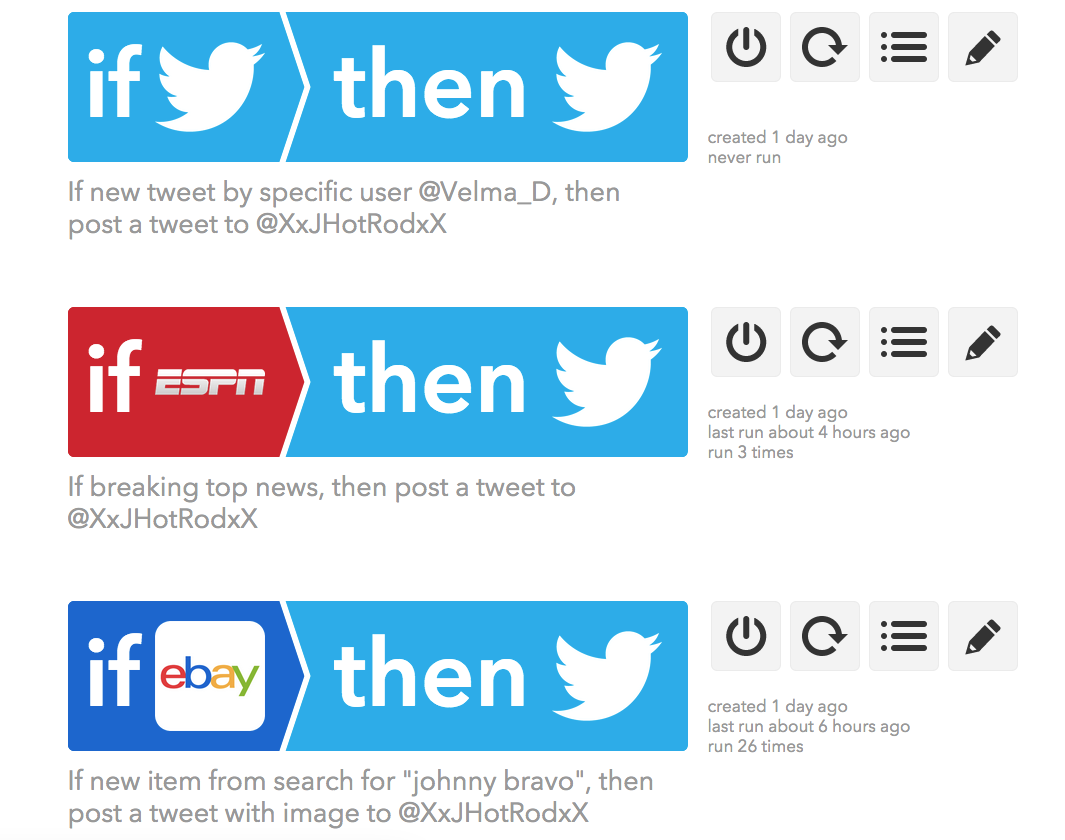
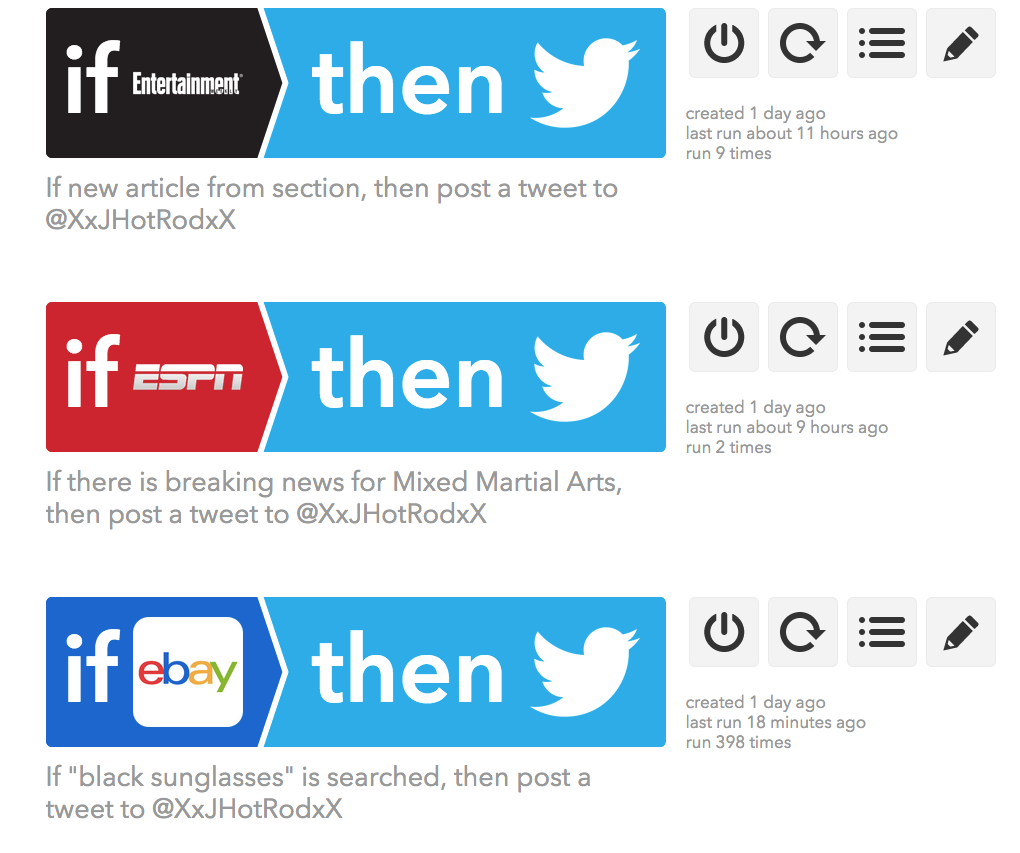
Here are a few of the recipes I created for the characters twitter page using the IFTTT site. It was quite challenging at first figuring out how to configure different recipes but after a few trial and errors I was successful.

Untitled 2

Untitled 3

Untitled 5

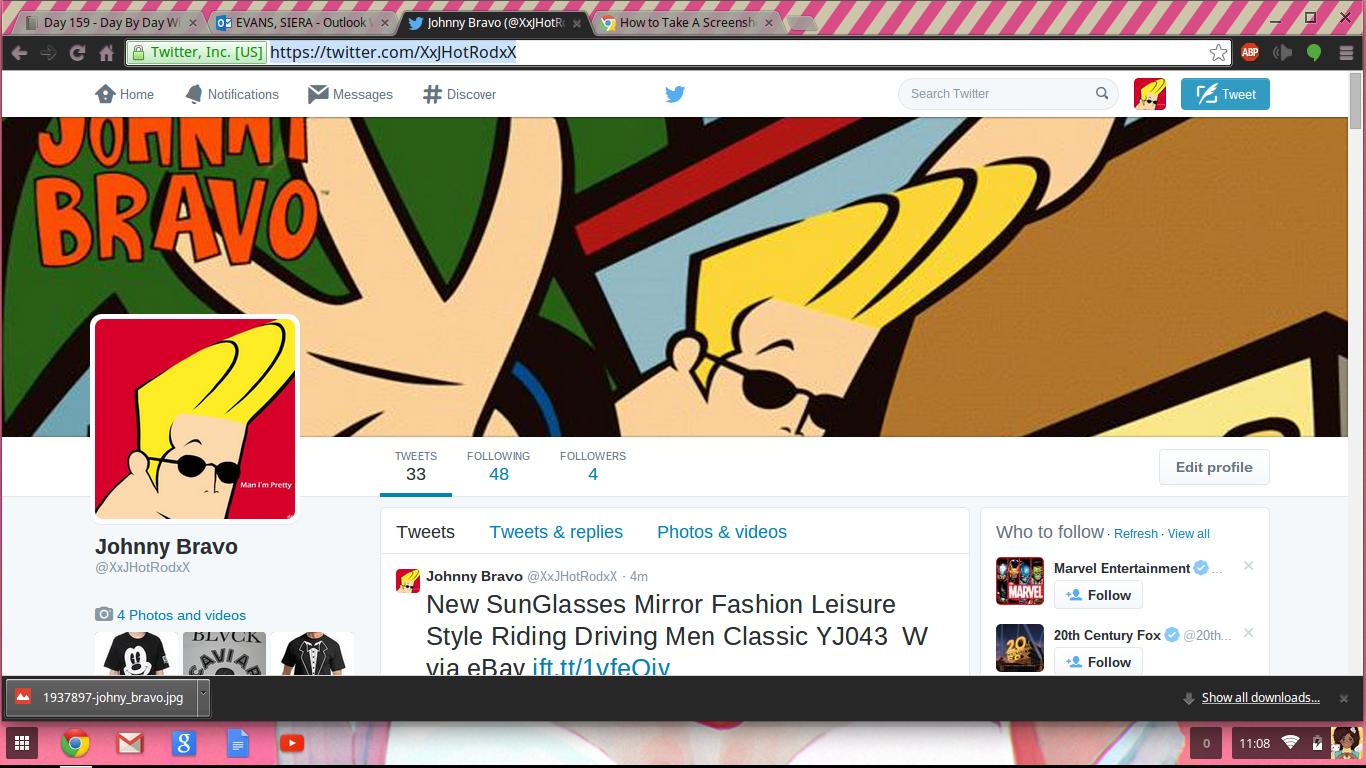
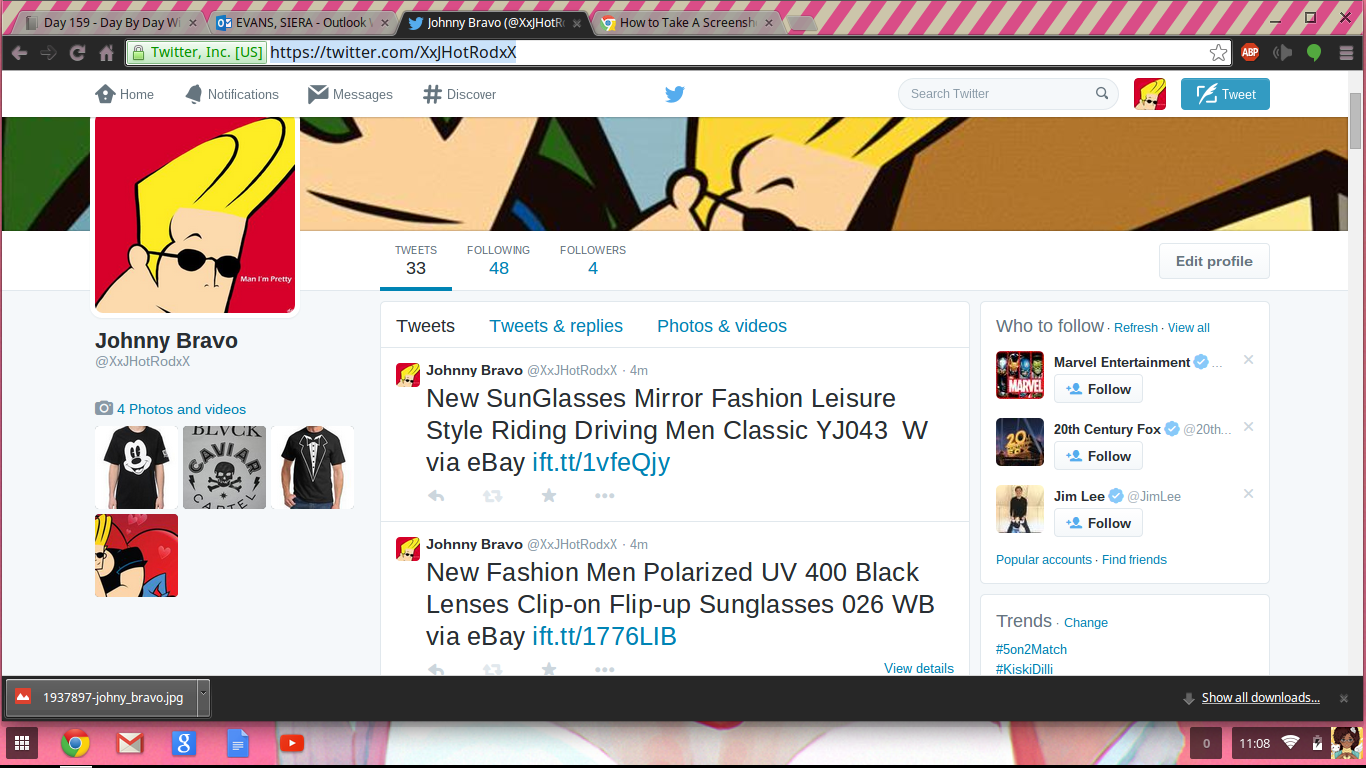
And here are early screenshots of the recipes in action as well as additional activity on the twitter site.

Screenshot 2015-02-09 at 11.08.18 PM

Screenshot 2015-02-09 at 11.08.29 PM

Screenshot 2015-02-09 at 11.08.37 PM


Currently I still receive updates for the site and astoundingly I’ve noticed that people actually enjoy it. I’ve been getting constant notifications about new followers or responses that people gave to the posts the recipes have continued to make. However, not only am I surprised at the sites activity but how people are still responding to the posts even though they’re not tweeted by an actual person, but a bot. This idea really made me think about the concept of identity on the web and how people are able to conceal themselves behind facts that are fake or fictional (alias’s, avatars). If that’s the case how do we truly know who we are communicating with on the web?

Different points on this theory can be connected to one of the points made in the Radio Lab podcast ‘Talking to Machines’ on how machines and robots are replacing the roles of humans in relationships on the web and in the real world. One account given on the podcast describes how a man unknowingly fell in love with a bot on a local dating site and can be used to support the idea I mentioned earlier. Thus, the fact that a bot can sound convincing enough to cause a man to fall in love over the internet has definitely made me worry about the future of bots on the web.

Week 4 Reading ‘Alone Together’ by Sherry Turkle

In this summary of Sherry Turkle’s reading, I’ll focus more on the ‘Robotic Revolution’ and how it pertains to the relationship she describes between humans and machines.

Beginning with the prologue, Turkle touches on the publication of The Second Self in the 1990’s. From this book, she explains the growing personal relationship of a computer/machine and a human.

She states,

“By then, the computer had become a portal that enabled people to lead parallel lives in virtual worlds…discovered a sense of place.”

In having this development in the relationship between humans and computers, Turkle further states that as a result of this there has been a change in the boundaries built between the real world/real life, and the virtual world.

To further express this development, Turkle gives us the example of a college student named Doug who is active within many virtual worlds and balances the virtual along with real life. In this he says that real life

“is just one more window…it’s not usually my best one.”

It is in the emergence of a growing “networked life”, where popular search engines in today’s society appear as well (Google, Internet Explorer). Networked life changed drastically when the Internet went mobile, where “the network was with us, on us, all the time.”

With this new life the opportunity arises where people can “hide from each other”.

Untitled 2

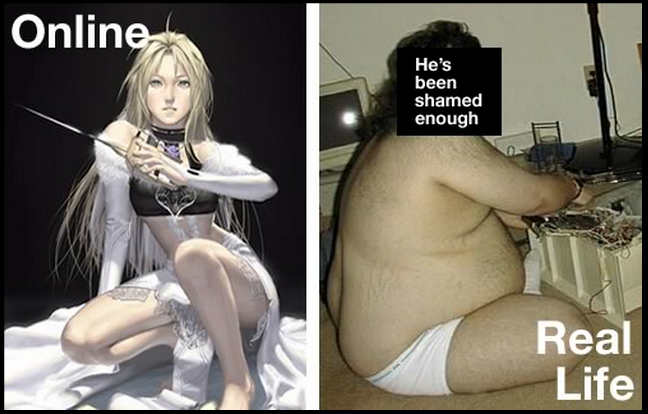
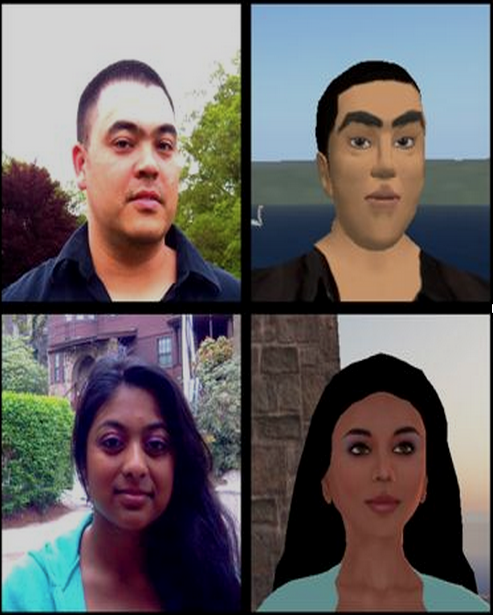
In the creation of these worlds the author states that certain individuals start to become captivated with these worlds, and thus begin to trade “RL” (real life) for the virtual. Chat rooms and online gaming become more popular resulting in people abandoning their true self for a persona or avatar, in which they can start a new life and become “a lot younger, thinner” version of themselves. This allows people to hide even deeper from the real world and each other with this new identity/avatar.

Untitled 3

Sherry Turkle also describes this “second life” to grant the user a “place for hope in life”, and an end to loneliness cured by the presence of people online.
Turkle includes this quote from an old woman about her I-phone,

“It’s like having a little Times Square in my pocketbook. All lights. All the people I could meet.”

She also gives the statement about the internet being “seductive” and to the average person presents a chance to escape the real world.
Turkle delves deeper into the discussion of the relationship between humans and machines with, robots. Whether it be love, companionship or loneliness, Turkle explains that individuals look for a variety of needs from robots that they cannot achieve in real life.

Companionship is what Turkle states throughout the reading as to why robots are often sought after, and in some ways can be considered controversial.
The element of insecurity, lack of trust, and fear of disappointment in relationships are common factors that add onto the growing interaction with robots. As a result, there is the emergence of “sociable” humanoid robots such as the ELIZA program in the 1970’s. Popular examples of sociable robots include the popular Tamagotchi, and Furbie toys for children. From these creations came the idea of us giving,

“human qualities to objects and content to treat each other as things”.


“No cheating. No heartbreak.”

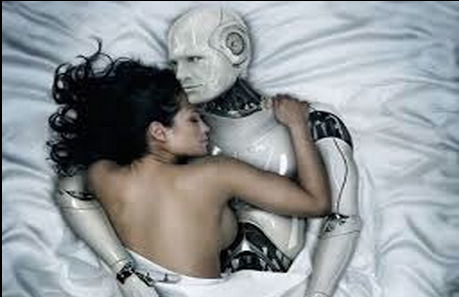
A romantic relationship with a robot is explored in the reading, and advocated strongly by David Levy. He argues that in time robots will teach humans to become better lovers, friends, and companions. Levy even goes as far as saying that robots will replace humans.

Untitled 7

“Beyond this, they will substitute where people fail.”

Turkle explores the possibility of this relationship and is surprised at the results of her findings. The popular reasoning behind these relationships or “technological promiscuity” that Sherry Turkle finds, are that robots do not come with the taxing demands, and disappointments, that humans bring.

“After all, we never know how another person really feels. People put on a good face. Robots would be safer….I’d rather talk to a robot. Friends can be exhausting. The robot will always be there for me.”

Overtime the possibility of actual relationships between humans and robots has grown, and so has the reoccurring belief that when,

“other things go wrong, science will go right.”

Hope has been put into machines, and as a result they have become “a twenty first century deus ex machina”


Discussion Questions

1) Would you rather live in a world occupied by machines (lets try not to think of the Terminator here)?

2) Does an individuals social status affect their online persona?

3) Do you think our society would be better or worse without the presence of media and technology (such as Facebook, computers, Tv’s)?

4) Honestly speaking, would you prefer a mechanical companion or a real spouse? What are the pros and cons? Why do you think some people might choose the machine over flesh and blood?

5) Which do you prefer? Talking or texting? Do you think this preference conveys the decline or increase in social interaction within our society?

Here is a link to an example of a video project I made addressing these questions and more in the realm of cartoons and video games. (http://vimeo.com/93404898)

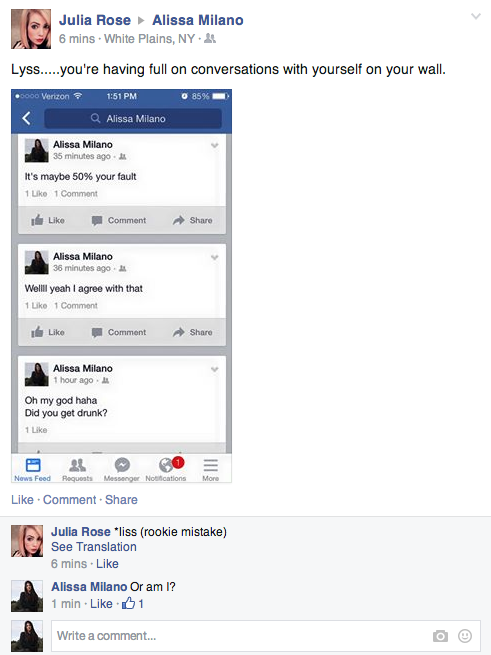
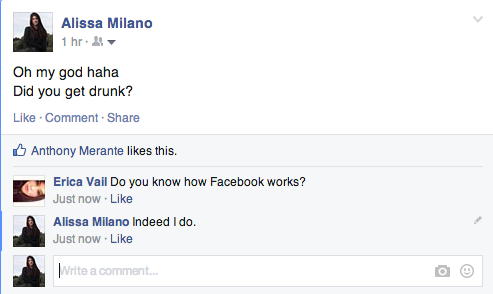
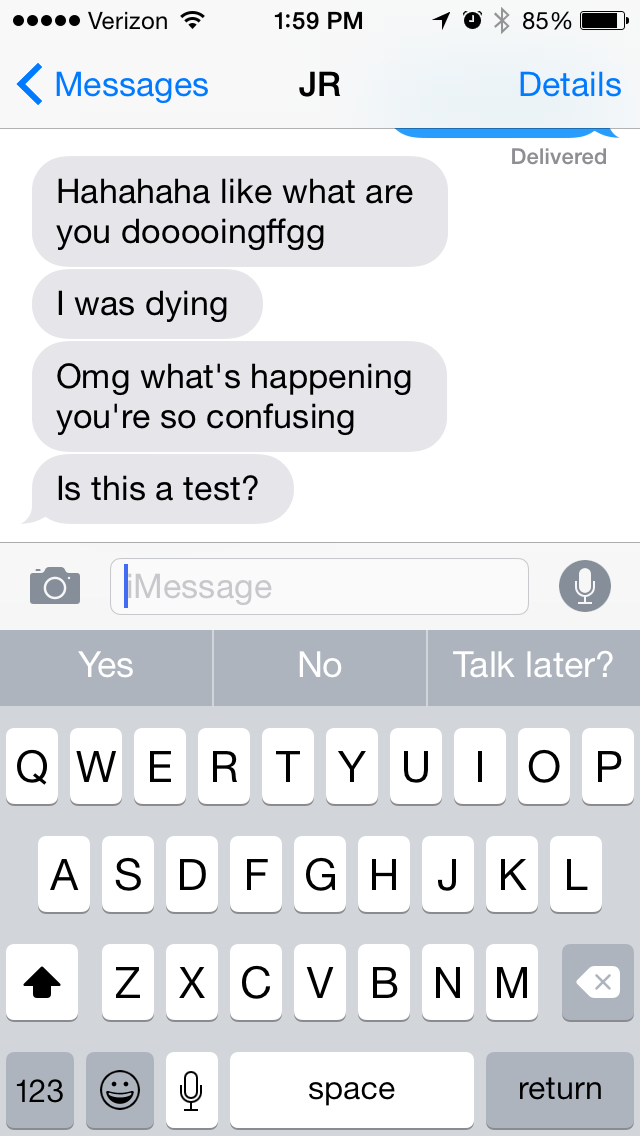
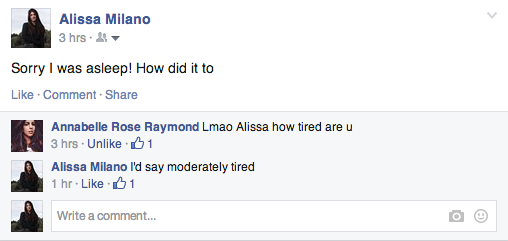
Exercise #2: Facebook statuses out of my incoming texts.

Screen Shot 2015-02-05 at 1.57.46 PM Screen Shot 2015-02-05 at 2.04.52 PM Screen Shot 2015-02-05 at 1.58.22 PM Screen Shot 2015-02-05 at 1.57.55 PM Screen Shot 2015-02-05 at 2.15.27 PMNew IMG_2710 Screen Shot 2015-02-05 at 1.58.38 PM

Screen Shot 2015-02-05 at 1.58.11 PM


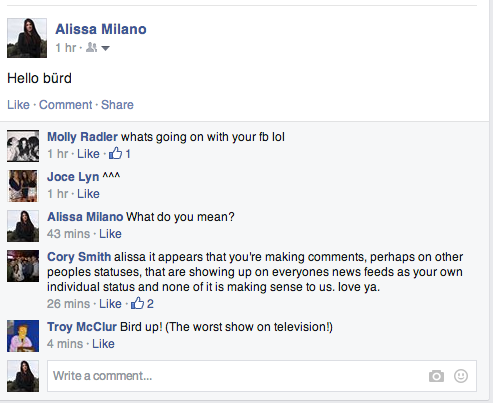
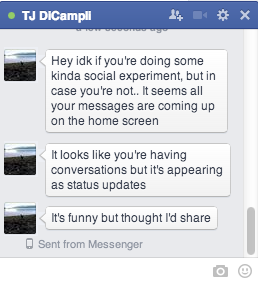
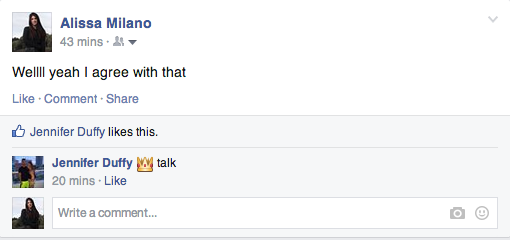
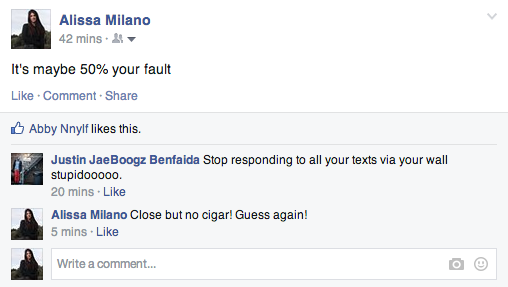
For this weeks social breach experiment, I decided to address a topic I have been thinking a lot about lately; which is playing with what we perceive as private and public space on our devices.  To do this, I made Facebook statuses of my incoming text messages.  Throughout the day I would make statuses that only said the text I was receiving, without including the name of the person sending the message.

I had a few expectations when I started this experiment.  My main expectation and worry was that the people sending me the texts would see them and be uncomfortable.  While this did happen, it was actually other people that reacted strongly to my sudden strange behavior on Facebook.  I thought maybe a few people would “like” or comment the statuses, but I didn’t expect just how much people would react.  A lot of people commented, asking if I understood how to use Facebook and some messaged me to let me know something strange was going on.  I was surprised to see that people I hadn’t talked to in months, and one in particular I hadn’t spoken to since high school, went out of their way to ask if I knew what was happening.  In lighter reactions, people that knew me better knew I was doing some sort of experiment and they had fun trying to figure out what the system was.

When I think about why I expected the people who were acting sending the text messages to react the strongest, it’s because there is some unsaid rules we have put up regarding text messages.  In some way, I believe we expect them to be private, despite knowing that we are sending them to a device that is not our own.  I find the idea of “unsaid rules” to be interesting though, because at times you don’t even know you are living by them.  In “The Oversharer” by christian Sandvig, he discusses how this is addressed in Harold Garfinkels social experiment “the boarder” (or the lodger).  In this experiment Harold Garfinkel (a sociologist and college professor) assigned his students to go home to their families and act with the manners they would as if they were in someone else’s home.  The result was that family members were extremely taken back and concerned that something was wrong with the students.  I enjoyed Garfinkels view that a good way to study how we act in every day life is to de-familiarize ourselves with it.

The Critical Engineering Manifesto has also influenced my reflection on this experiment.  The manifesto expresses the importance of engineers looking at developing technology objectively and questions ethical issues behind any platform that creates a rich user experience or user dependence on it.  In relation to the way my experiment exposed certain expectations we have of social media, I think the manifesto addresses a valid point that we should not blindly accept any interface as the way things must be, just because it is the way they are now.  I believe it is important to consider that the use of our devices now serves as a permanent trace of our interactions.  I think for many of us this is hard to accurately imagine.  The Critical Engineering Manifesto urges the importance of considering how our devices affect our social interactions and communication.

Overall, I found this exercise interesting and revealing about how people feel about what should be posted.  I also found it telling on peoples boundaries.  When people I was not close to were commenting and messaging me about what was going on I couldn’t help but wonder what reason these people had to care about what was going on with my profile, and whether or not I would reach out to someone I wasn’t close with had the same thing been happening on theirs.

Social Media Breach

After last weeks discussion about how media affects different generations and how it has affected social interaction, I entertained the thought of whether or not the cycle could be broken.
So I decided to perform my own personal social media breach assignment and completely cut off ties with the social world (meaninfor at least five days…which was agonizing to say the least.

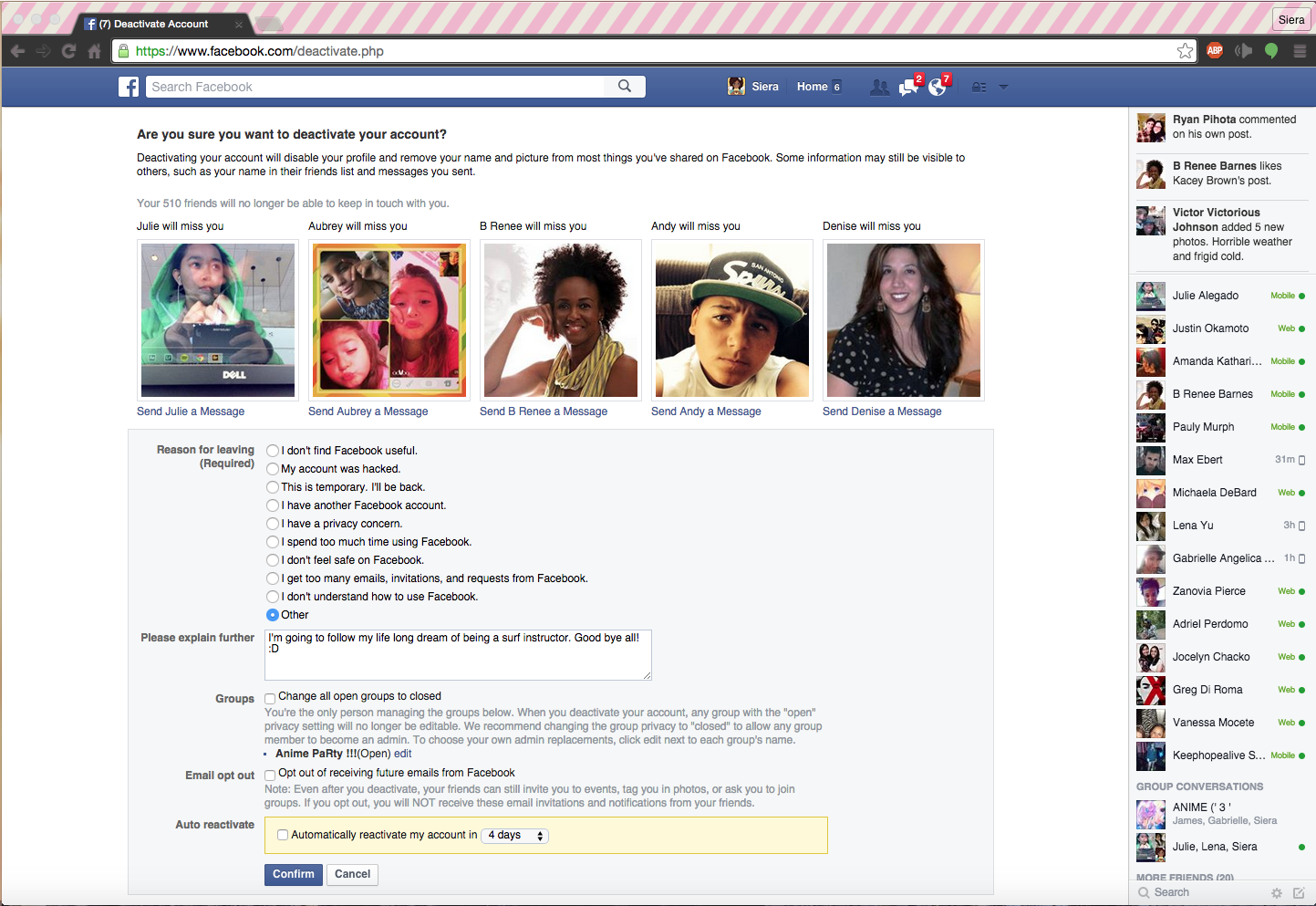
One of the biggest steps in this process was disconnecting my Facebook account.
In disconnecting my Facebook account I left a fake message,
ss project

I also refrained from connecting with my Deviantart and Youtube accounts, which I am both actively involved in on a regular basis and visit at least five times a day.

Overall, I’d say that this experiment was quite successful in that I’m now aware of how much technology, and social software impacts our everyday lives. By day three however I realized that certain aspects of social media are unavoidable. For instance, I had no choice but to use the internet to stay in contact with professors and updates concerning the weather. The same went for using my phone where in certain situations during the week I had no choice but to use it to keep in contact with my family during my commute, and of course friends (who were very annoyed in the fact that I didn’t answer them at all during the time period I began this experiment). I learned that not all technology is ‘evil’, or in other words ‘poisen’ to our society that negatively affects communication, but that technology in some ways is a necessary evil.

Exercise 2 twitter breaching

For my technological social breach I decided to use twitter, since it was a platform I had little experience with but was somewhat aware of how it worked.  I set up a simple bot using IFTTT, and connected it to a Twitter account I set up @BottingtonC.  BottingtonC tracks things like my location, text msging, and likes on reddit and posts them in the vein of surveillance.  Instead of tweeting to update people about my day, this surveillance bot tweets for me automatically.  I’m breaching the use of twitter as a platform to follow others and gain followers, instead it is only following me.  A detailed stream of location updates and tweets can be used to track someone, but in this case its the only use.

twitter.com/BottingtonC


I also made an additional twitter account, @solitary_follow name “Only Follower”  I had planned to automate it to find users with no followers and follow them, but stop following if they gained other followers.  The automation proved difficult, as there is no way to search for people based on how few followers they have or how recently they made their accounts.  So I decided to start out doing it myself, by searching for most recent tweets with “first tweet ever” and clicking each name to see who had 0 followers.

The intent of this account is to invert twitters ingrained system of focusing on popular accounts, while also potentially annoying people by pointing out their lack of followers.  Is it better to have no followers or a solitary follow?


twitter.com/solitary_follow

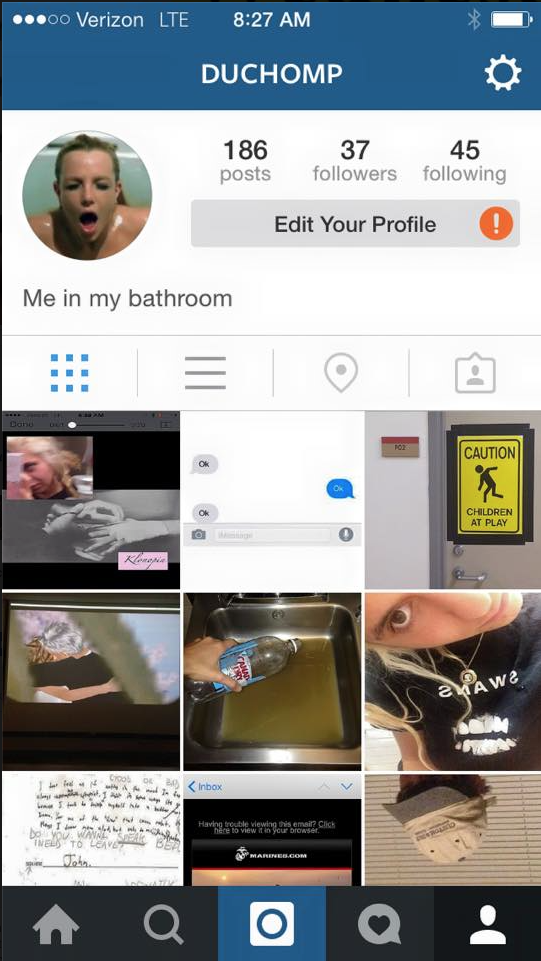
exersise 2- me in my bathroom

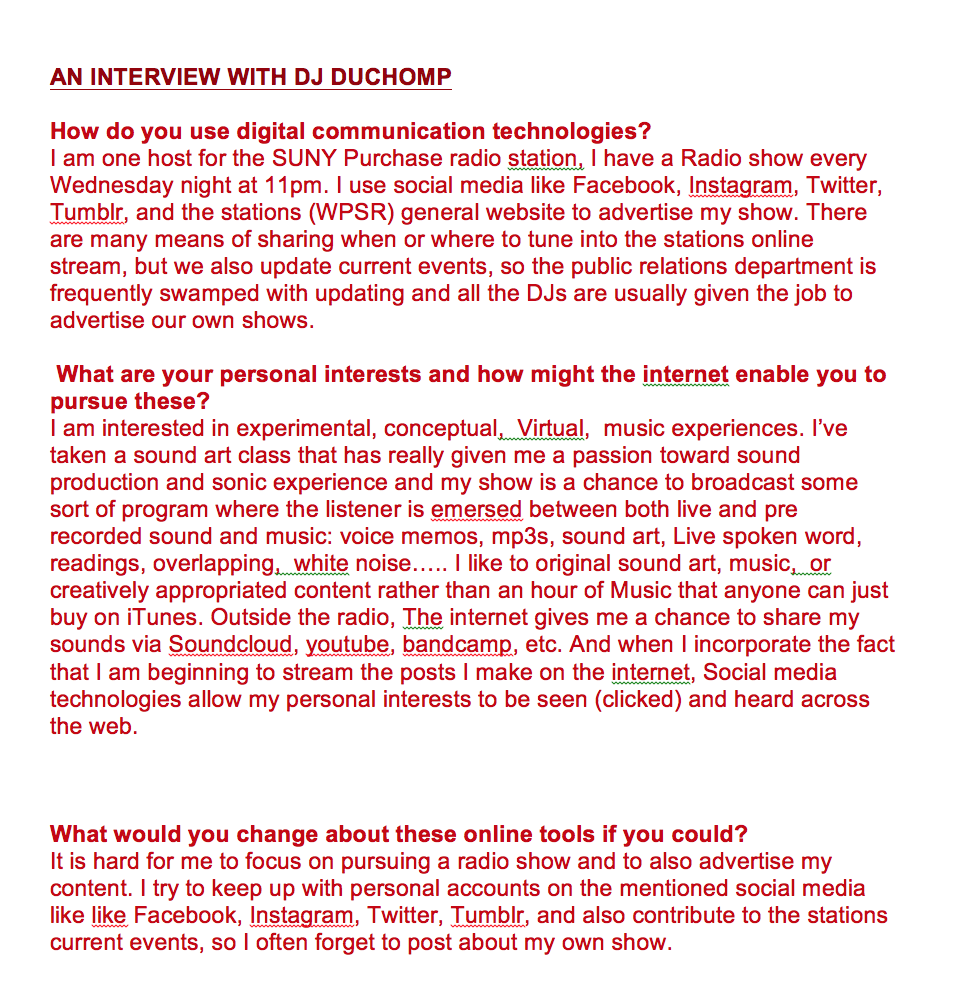
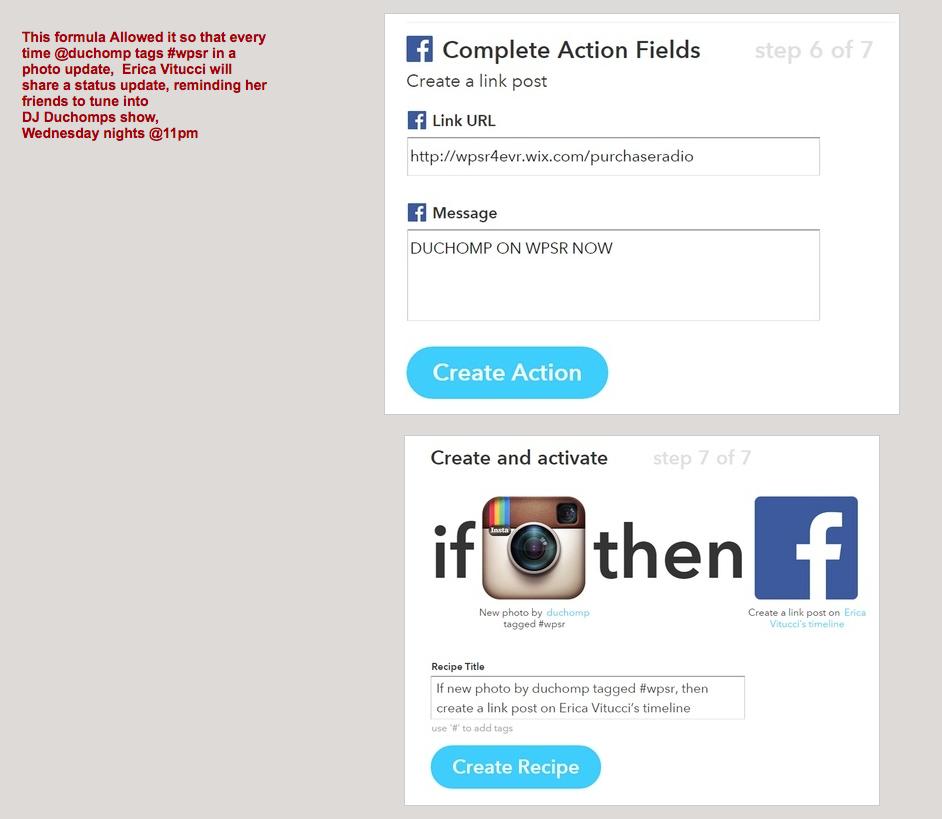
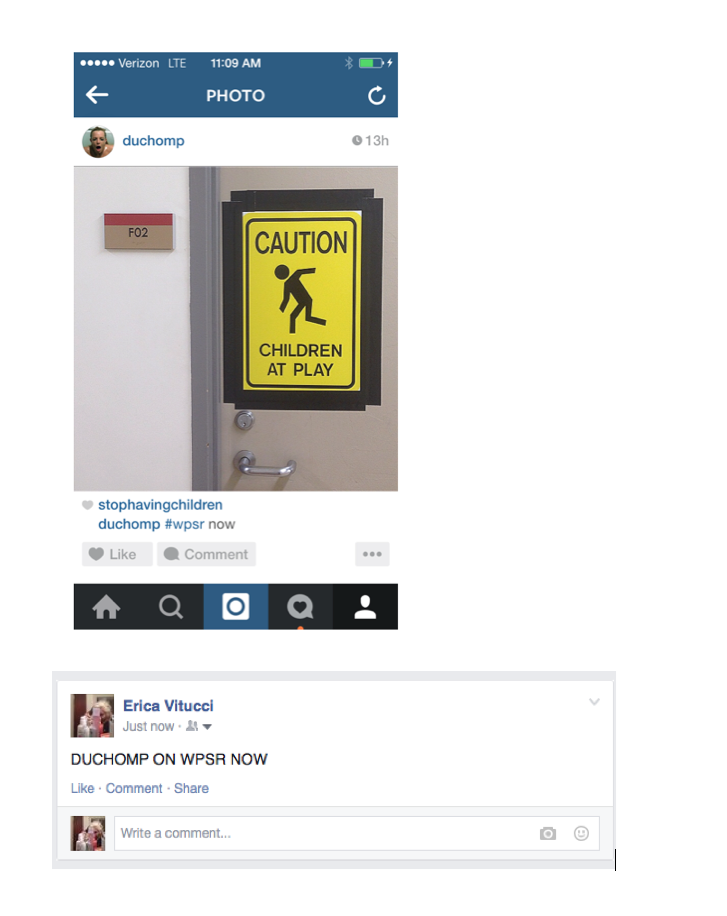
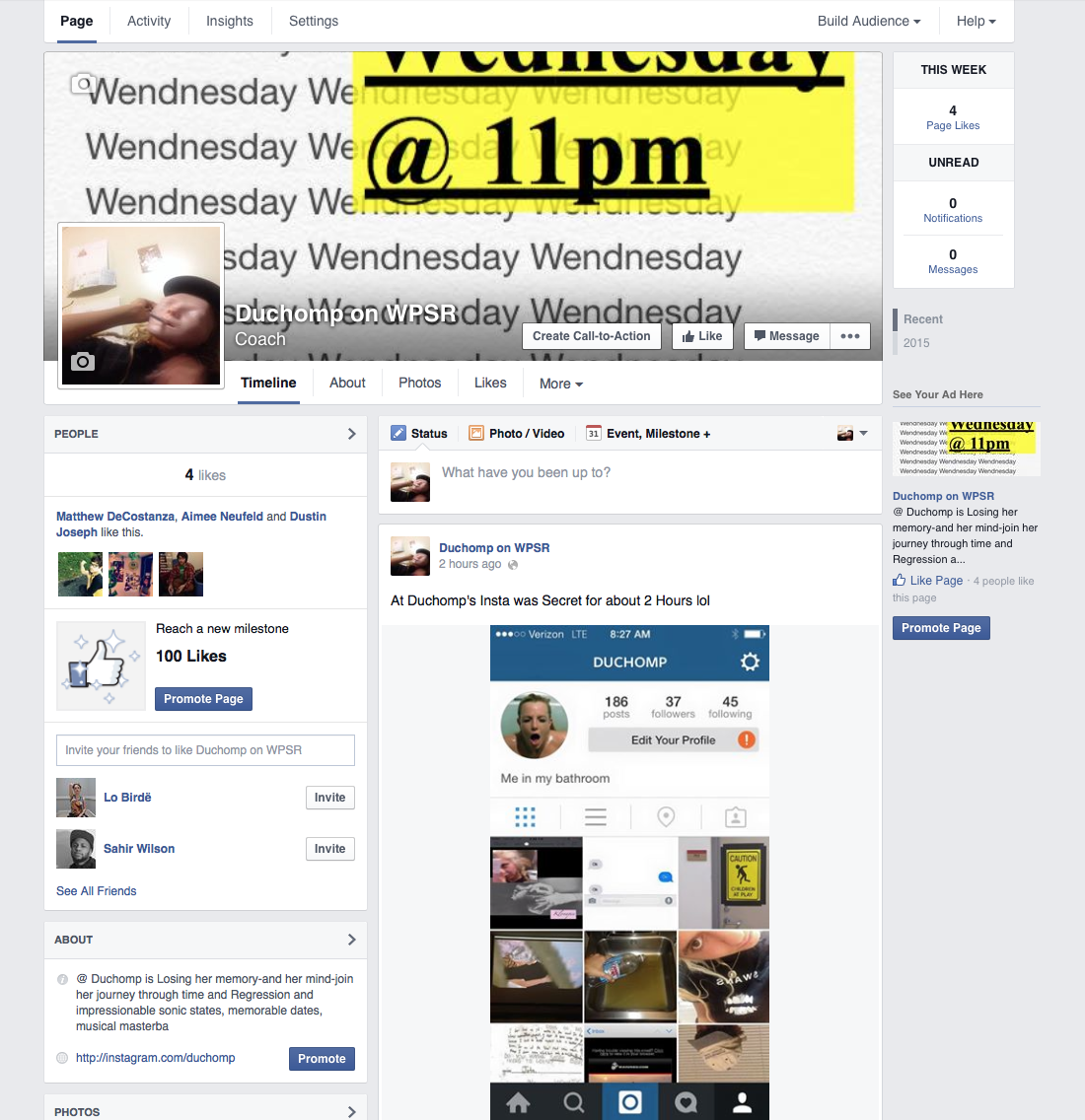
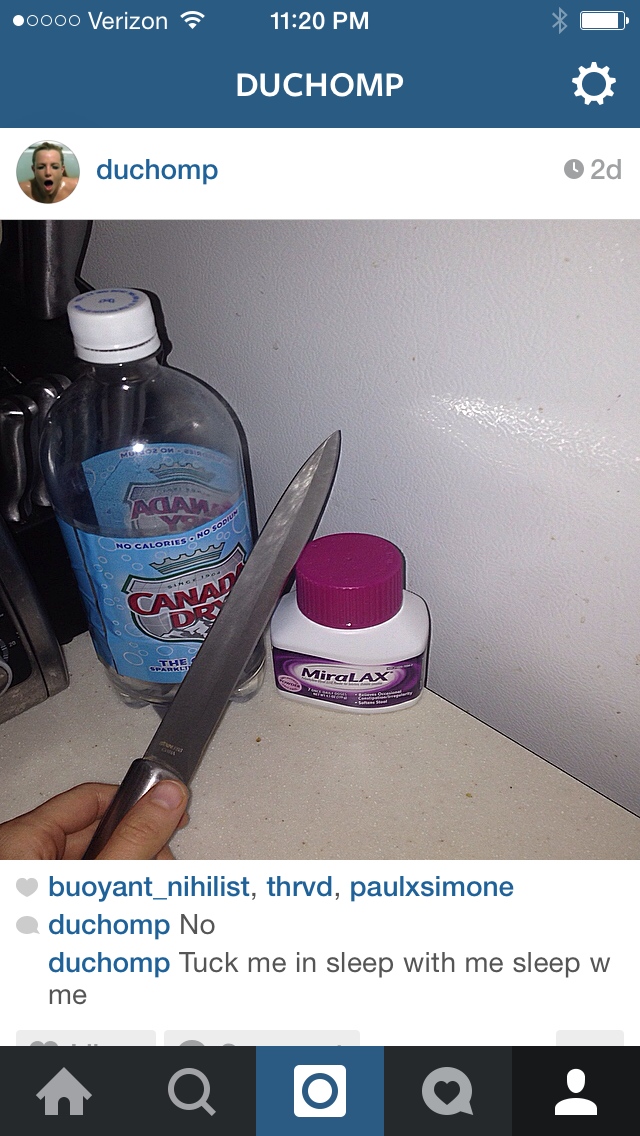
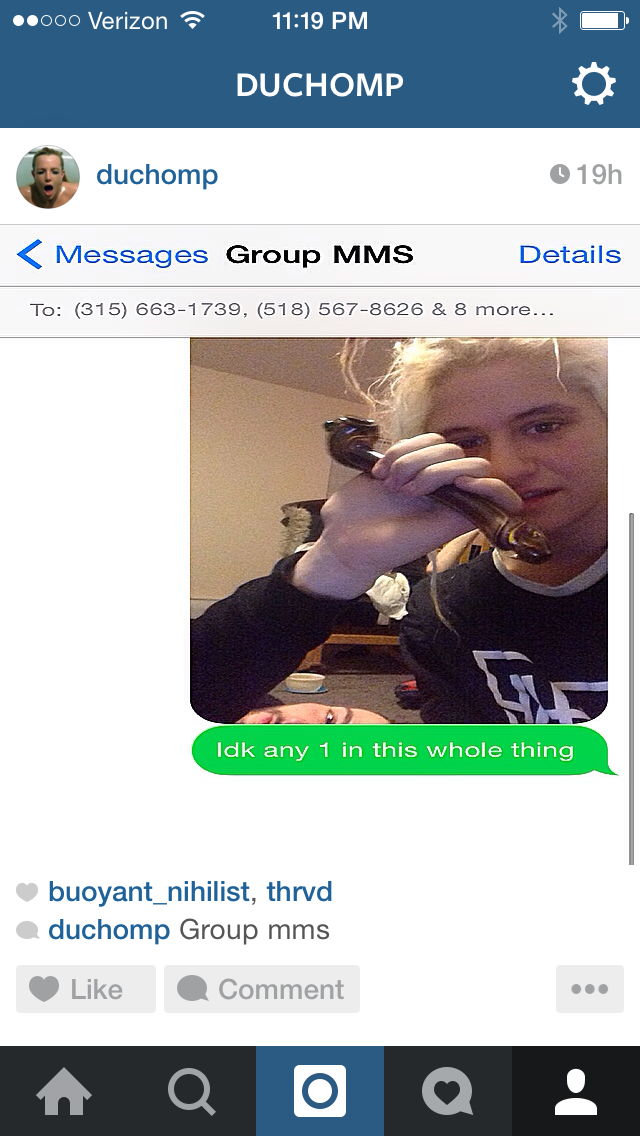
This week I created an Instagram blog called @Duchomp, posting unconventional videos and conceptual photos to breach the basic uses of the application that I commonly see. I didn’t post any (attractive) selfies or food or use any filters. A couple times I use the Sharpen effect. In addition to uncanny iPhotography and Vlogs, the captions featured meme-like yet poetic descriptions of how I was feeling at the time of the photo being (taken and immediately) posted. I only followed about 7 friends to start and made it up to 22 followers. This experiment is a common performance I may test on my own on any given day so the first 7 followers (IRL friends) were not radically surprised with my behavior. It started out as a blog called “Me in my bathroom” as I commonly film most video art projects and shoot photos/ selfies in my Apartment bathroom. Duchomp broke out of the bathroom when I got bored with the concept. I also think toilet blogs have been done already (??).

I chose Instagram because it is probably the easiest way for me to gain followers. It is also the most pleasing form of Text+photo+video to me, I really enjoy sharing all 3 to get my point across. The text captions turned my social media account to my Medium. Without the descriptions of the disruptive untraditional Instagram photos, they were truly vulnerable to the exact moment of the port. They were very important to the medium as an art piece and I hope they were read but I am not sure. It wasn’t meant to be a comical account, it displayed many sentimental moments to me. (but it definitely has some comical posts)… As far as likes and comments go, many of my followers didn’t give more attention to any specific type of post. Many enjoyed the aesthetic. The excersize illustrated that I didn’t receive much attention for any type of emotion and I may just in fact have a stupid following of anti-artist friends…

Here’s the link to Duchomp

duchomp – http://instagram.com/duchomp

and a Webs page with some of my (normal?) other instagram account post contrasted to it

duchomps concept explanation – http://duchomp.webs.com

IMG_5264 IMG_5258

Fake Job Breach

According to my social glitch experiment, I preformed a similar exercise which Nathan Fielder established when sending out a message to his loved ones where he showcased different point of views and reactions to the messages he sent out. For a little background about myself, I enjoy doing nature photography to small cinematography projects where I film the environment around me.

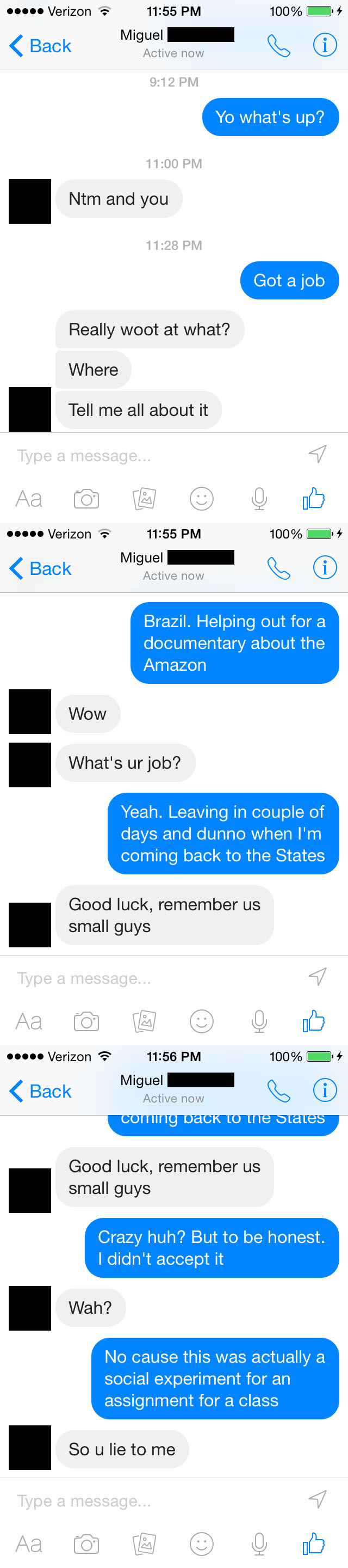
The way I first started this experiment was a casual, friendly conversation with a loved one, in this case, I messaged a few friends on Facebook. The topic of the conversation was to tell them the news where I was hired to work on a documentary that required me to hop onto a plane to Brazil as soon as possible. The catch is that I don’t know how long this project would take to produce and finish.

I first tried it on two friends who lives out of state. We haven’t seen each other for a while, but, I still have a strong communication with them. However, one of them was a bit worried about the news. She seemed more practical over how my education was more important than right away getting this job.

test 1

A contrast to my other friend, she was fully on board with the idea and was super excited for me. Overall, when I told them it was a lie, my particular friend wasn’t so happy about being tricked. While my excited friend was disappointed that she won’t be visiting me in Brazil.

test 2

As you can see, my first two friends were female and were distanced away. So I expanded on getting more different results by testing it out on an old friend. On the other hand, my male friend lived in the same town, but, we sometimes talk to each other whenever we have time. The general outcome of his reaction was a mixture of happiness and bitterness. Though he acted humble over reminding me to “remember the small guys,” I broke the news and told him it was fake and was just an experiment.

test 3

In conclusion, I found this exercise to be refreshing to see how well certain people know you and their personalities at play when it came to particular topics that related to life issues; in this case, future jobs and careers. If I could have expanded more onto this experiment, I would have messaged either of my parents or maybe a complete stranger. Why? There is many different perspective when telling these type of news to a parent verse to a friend. It just depends on how well these people know you and you know them. To finish off, social glitch experiments can be interesting, but, how would this experiment be tested if you told a person face to face or through old school communications, like a phone call?