Try this:
http://blog.bobbyallen.me/2014/03/07/how-to-install-git-without-having-to-install-xcode-on-macosx/

In this week’s reading, “Objects of Intense Feeling: The Case of the Twitter API,” by Taina Bucher, it mainly discussed about the growing movement of APIs. From how the social networking phenomenon started to how it changed the culture, politics, and business of applying this “tools” online.
To start off, Bucher introduced how social media became more than online services for entertainment, communication and productivity. Bucher reflected on how communities and individuals rely on Facebook and Twitter as an everyday source. As she stated we “live and breathe” with these services. She even stated how these services expanded from household names to actual spaces where people occupy and socialize.
“We live and breathe social media, as services like Facebook and Twitter have not only become household names, but something like actual households themselves – places people choose to live and socialize.”
However, these “places” contained various data that could either be beneficial or harmful to the public to obtain or know. According to Bucher, social media can also be tools that can be utilized by the use of APIs (application programming interfaces).
To move onto the movement on how Twitter APIs became popular in the technology world, it gave growth to how programming became a form of art where communities exchanged codes rather than keeping the tools for themselves. When Bucher discussed about how Twitter was freely given to the public; mostly third party developers, she emphasized on how these individuals or business can build products around their main tweeting system. Though it was a simple offer by Twitter, the social network was taking a risky on giving out interfaces that would lead to collect data being either be used for good or be abused.
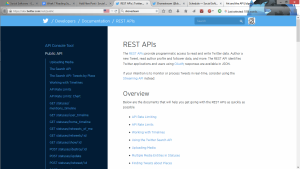
The developers that Bucher interviewed gave an inside perspective on how these API’s were providing those who were very fluent and not so fluent in coding a chance to work on services that wouldn’t be possible without the API. It gave people a chance to just ‘open up’ what was given to them, play around with what it could do and create something entirely different from what Twitter gave them access too.
Though it became a fun way for some people to make better services for Twitter, even one that utilized a better search engine that lead to Twitter buying the company and hiring the programmers, Twitter still has the upper hand no matter who is using the API. It was very open and free when Twitter initially launched their API. But, by 2011 they had a much stricter rule set for developers using the API. Bucher mentions Jacob’s case as being one that results from the developers not being able to continue developing with Twitter because features they need access to were being denied.
“I’m no longer interested in contributing anything to Twitter’s API. Their hostile stance toward developers like me has been very discouraging, not to mention costly – they killed my business; it has cost me many thousands of dollars.”
APIs continued to have a focus on being future oriented and a part of the Silicon Valley ‘entrepreneurial mindset,’ while the companies that own these APIs have the final say on how they can be used and how they can be used for the companies’ advantage. By looking at the API as a quasi-object there is a lot of power it has over how we navigate websites and applications in the future. At her conclusion, Bucher says we should look at the API as a governing technique in the current state of the social web.
“While there is nothing wrong with using APIs to collect data, of course, researchers should be wary about letting any current obsessions with big data overshadow the fact that APIs are far from neutral tools.”
According to Bucher there seems to be protocols, which APIs follow or are designed by in order to fulfill its main purpose. Their main purpose is to share content and data online from one computer or device to another. Like from Jer Thorp’s blog post, “Art and the API,” he reflected how APIs are like bridges for letting computers communicate with one another, regardless of what operating system they have.
As recalled, APIs contributed to a cultural phenomenon that would affect society’s political and business spectrum when using APIs for collecting data. What kind of data or information? In a political example, from Thorp’s post, he acknowledged Josh Begley; a data artist, who developed an API that allowed access to information on every US drone strike from using data from The Bureau for Investigative Journalism. As a result, Begley used these data to develop “Dronestream,” an app with a Twitter API that streamed every US drone attack. Overall, journalists can utilize this app for feeding off stories relating to this controversial topic.
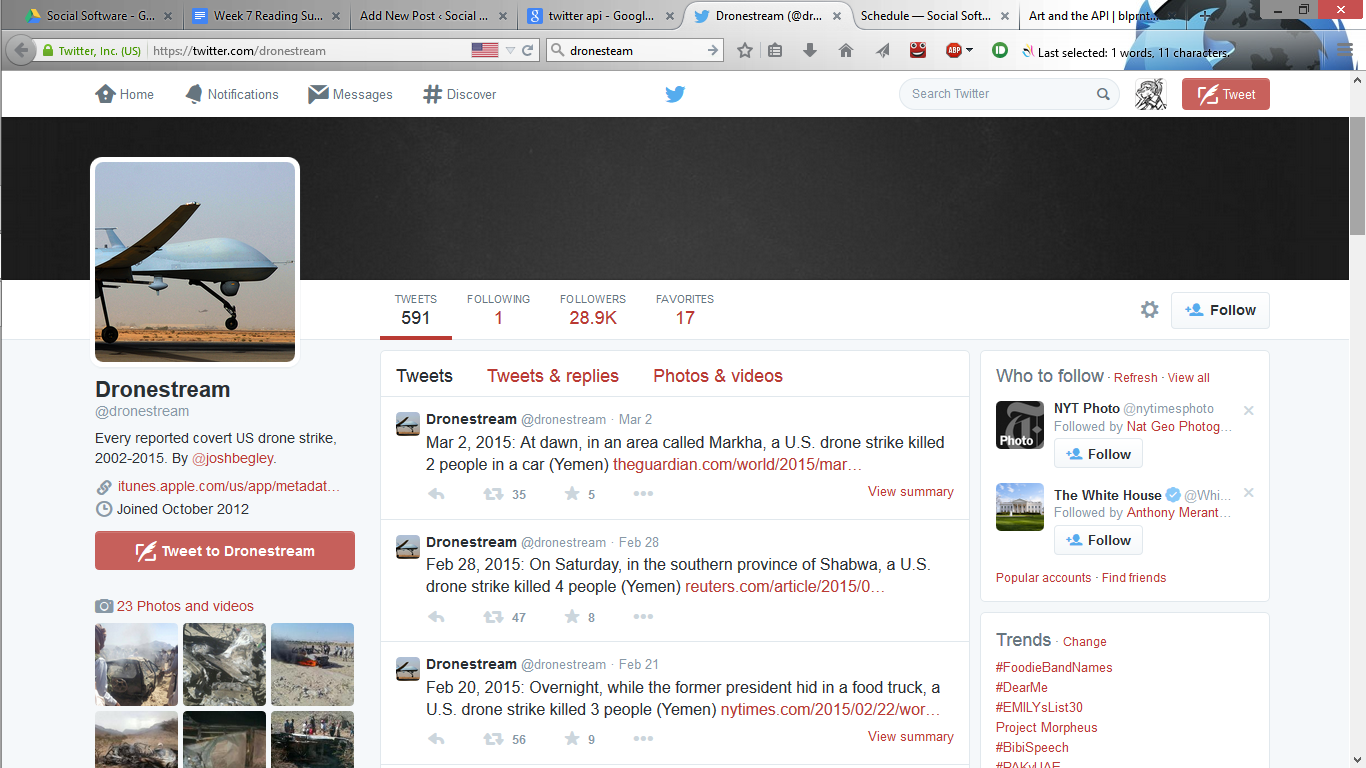
By expanding on Josh Begley’s app, beside collected data, there would be the possibility of a list of drone strikes that can give out personal information about those who were killed. Thorp reflected how a single information can evolve into something else that wasn’t expected.
Looking at the examples presented by Thorp it shows the many ways in which artists are exploring APIs. The ways in which they are used can help us think about the projects we’re working on in this class and beyond it by taking advantage of the technical use and creating a conceptual meaning out of it.
Discussion Questions:
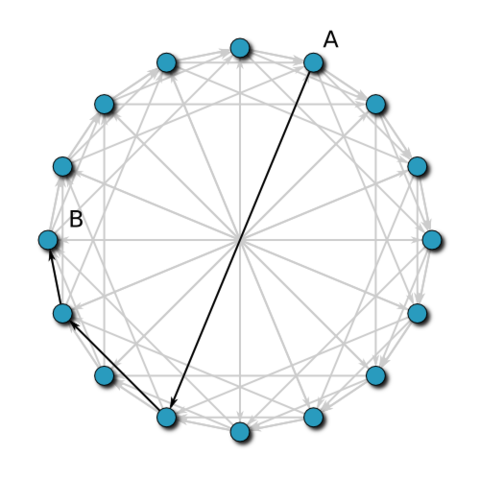
Some food for thought for tomorrow’s discussion in this list of technologies that aim to decentralize.
Summary:
The readings can be found below:
——————————————————————————–
Points touched on in readings/ Brief summary:
“Here comes everybody” – Clay Shirky:
Collective action, group function and the affect on society, viral growth, social visibility, judgment, public scrutiny, online power, transfer of capabilities formerly only found by professionals to the hands of the public, global publishing cost. These are some of the points Shirky hit on in the first chapter of “Here Comes Everybody”. In the first chapter, Shirky explains how we are all now a large connected entity. The power of the collective now lies in the hands of the public, never further than a click away. The ability to reach out and touch the lives of thousands, offer advice, seek help, and share upon the interests of others are all things that every one of us now has access to thanks to the World Wide Web. Shirky demonstrates that we hold a new power in the palms of our hands, the ability to connect and tap into the minds of many.
“Backspace to the future: The Dislike Club Part 1” – Benjamin Walker:
One night while sitting at home, drinking beers on the couch and browsing twitter, Benjamin Walker decided to create the website “tilde.club”. He posted a tweet that offering people shell accounts upon request, shortly to find out that the whole idea was going viral. Many people made “tilde” sites and posted things from ASCII art to retro web code. Benjamin wanted people to “Not feel like they were under siege when they were expressing themselves”. Walker goes on to point out that inhabitants of the 21st century have a newfound focus… “The screen in my hand”, which makes it “impossible to get lost” in todays world. Modern social media has created a vicious social media loop, where people are constantly browsing between various social media pages instead of enjoying their real lives. It’s been “15 years of signing up!” and “staring at screens” says Walker in his blog. At the end of the blog, Walker thinks about creating incentives to help people “like the disliking”.
——————————————————————————–
Discussion Questions:
1. How has socialization changed since the assimilation of social media/ the internet into our daily lives?
2. What are the pros and cons of this “new” way of socializing?
3. How do you think modern methods of socializing will affect the youth of the twenty first century?
4. Does social media change how we interact offline? How?
5. How has being connected helped give power to groups?
6. Clay Shirky hinted that the internet could behave as a sort of pseudo army. What do you think?
7. Has the internet created an “I want everything, and I want it now” society? How does this influence social interactions?
8. Do you agree or disagree on the points touched on in the readings? Why or why not?