Archive for the ‘Uncategorized’ Category

“Her” – Overview

Since growing up into a culture of action-suspenseful sci-fi films, the typical theme on how the human race is placed in the middle of a movement where robots or artificial intelligences would become a part of our lives. The traditional mindset of robots either being our slaves to satisfy our wants and needs or where a company or secret organization developed a machine that goes into a man-killing rampage. However, when the technology world goes beyond the barrier of reality and fantasy, programmers to engineers produced modern-day devices that resembled themselves as robots or artificial intelligences.

After watching the movie, “Her” by Spike Jonze, as the audience, the plot of this modern day sci-fi was focusing on a sensitive and soulful writer, named Theodore, who later on built an “interesting” relationship with an operating system named Samantha. Like today’s sci-fi films, there wasn’t the cliché-terminating robot or a community of robots rebelling against the human race, but these OS’s preferred to live one with humans as whole. However, this trend of robots and humans becoming friends, or in this film’s case, lovers, the bond between humans and artificial intelligences isn’t well developed to maintain a bond over friendship or love. Unlike typical romantic or good-buddy films, these two worlds do collide, but ended before the story is finished. In other words, Theodore and Samantha ended up separating from each other because their worlds are completely different and their bond isn’t practical for a “healthy” relationship. Despite the bittersweet relationship between Theodore and Samantha, their unique bond was close being to be forbidden or abnormal.

Theodore waiting for OS to work

When Samantha and the other operating systems decided to leave, the movement had established this sense of evolution on how both humans and artificial intelligence developed dependence and independence among each other. Furthermore, these aspects would question on how well and strong does the human race trust and relate to robots or artificial intelligence. Darwin’s Theory of Evolution came to mind to illustrate if one-day bionics would walk among humans and it’s decedents.
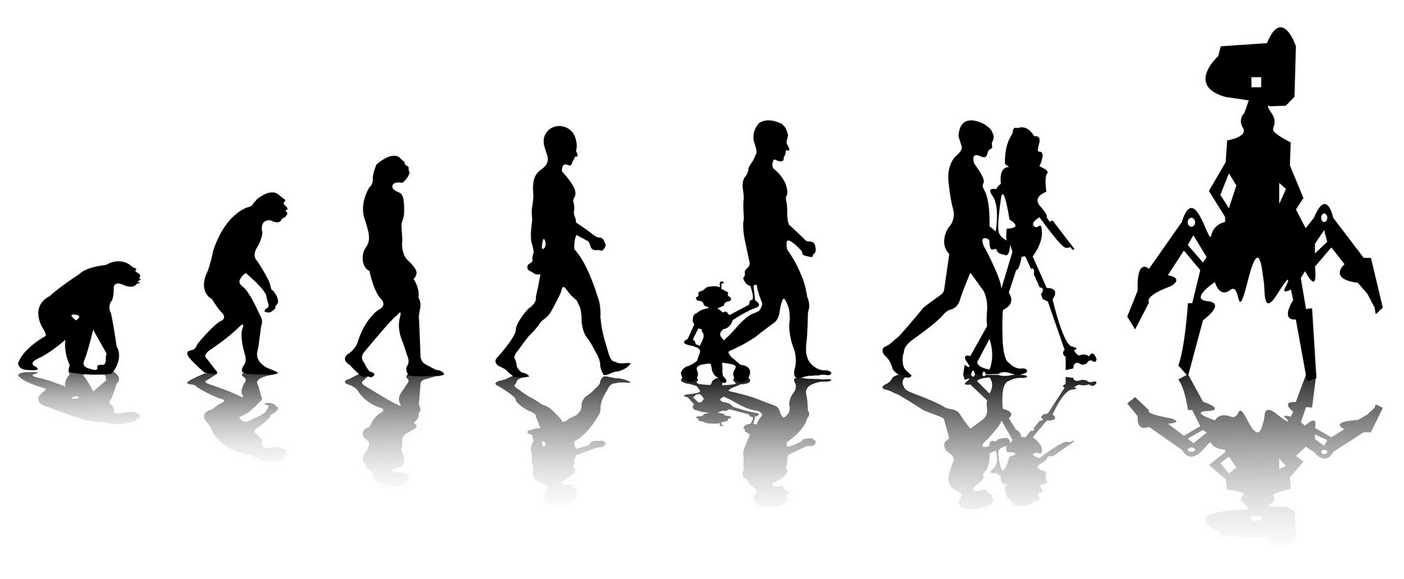
Expanding on Darwin’s Theory of Evolution

From a segment of a Radio Lab podcast, the episode focused on interaction and relationship on individuals or communities that grew fond with robots and computers. In other words, these various individual tend to later on describe these technological devices to be more humans than machines. For instance, the Radio Lab crew interviewed a man named, Robert Epstein, who didn’t realize he’d fallen in love with a virtual booth while dating it online. A contrast to how Theodore viewed Samantha. When Theodore first met his new operating system, he knew Samantha was just an artificial intelligence, but, he didn’t know how advance Samantha was to be capable of “adapting” to the human lifestyle where she slowly reprogrammed herself to become more human.

Citation:

“Talking to Machines.” Radio Labs. WNYC Radio, 31 May 2011. Web. 16 Apr. 2015.

HER. Dir. Spike Jonze. Perf. Joaquin Phoenix, Scarlett Johansson. Warner Bros. Pictures, 2014. DVD.


JavaScript Exercise

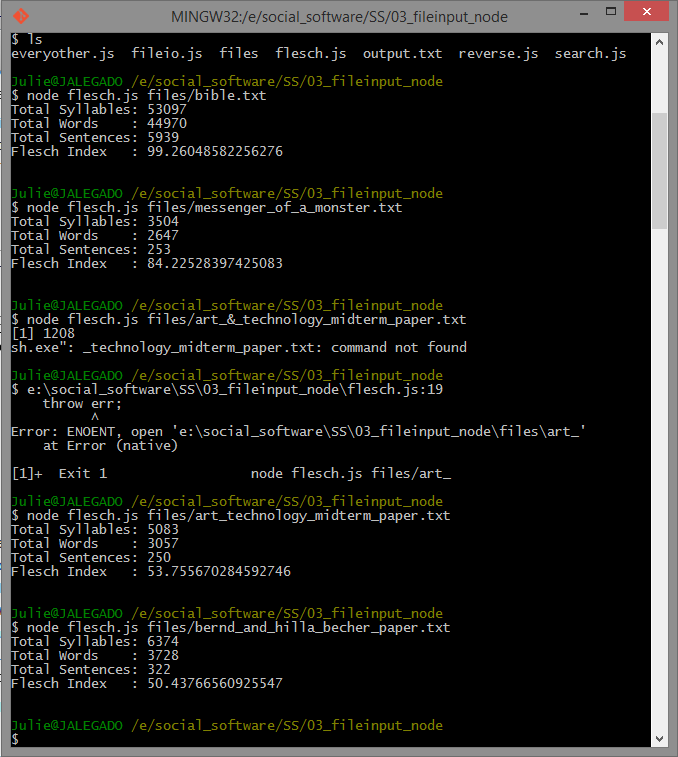
For this brief Javascript exercise, I played around with several pieces of text by calculating the Flesch-Kincaid reading level. For instance, the following texts are either written essays from different grade levels or comparisons of other literature based on popularity and the time period of when it was written. Overall, this short overview given out numeric results that indicated how readable the text is in a specific reading group; which ranges from at least eleven year old students to university graduates.

To start off, I have chosen my sister’s recent narrative in which she had to produce for her English class based on a given topic. I ended comparing it off with two essays I’ve written from my first year in college. Overall, I typed out all the needed data in my chosen terminal program; Git Bash, and plugged in the right command line to perform the task.

papers_flesch_index

Calculating Flesch-Kincaid reading level with school papers through Git Bash, node.js and flesch.js

As a result, I first started off calculating my sister’s narrative, “Memory of a Monster” and the test calculated it to be 84 in the Flesch Index. According to the scale, 84 is an easy readability level where at least an eleven-year-old student could manage to read. A contrast to the short narrative would be my two college essays, “Bernd And Hilla Becher” and “Art Technology Midterm Paper” which fallen into the same scale of 50-53. While going in depth with the numbers, the essays are fairly difficult and a high school senior is still capable to read them. Overall, these two papers were a few increments close to be difficult to read.

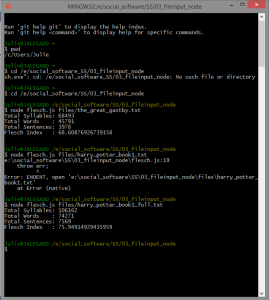
Lastly, for fun, I picked two well-known literatures and compared them of what their Flesch-Kincaid reading level would be. For example, “The Great Gastby” had at least a 68 Flesch index while the first book of the “Harry Potter” series was scaled to a 75. Both novels either scaled between being having a standard or fairly easy readability level.

books_flesch_index

Calculating Flesch-Kincaid reading level with famous literature through Git Bash, node.js and flesch.js

Furthermore, whenit came to literature and translating this particular experience on how words can benefit from searching specific information just by developing a program that does it for you. The effort on experimenting this concept was reflected by James Pennebaker during his TED talk on “The Secrets of Pronouns.” By going back to the idea of having this formula, which calculates your reading level just from the library of vocabulary a reader or writer, might know.


Social Media Bot Proposal

We communicate with one another more than ever before in other states, and countries at the touch of a few buttons with the use of either our phones or the web. Some of the inventions presented in the past through film and science fiction have become our reality.

The way people communicate with one another has changed as a result of this advancement in social media and technology, and while they have had positive effects on our society, I couldn’t help but look at all the negative effects they’ve had as well.

Thus, when it came to brainstorming ideas for this project I found myself going back to this idea of bringing attention to the negative aspects of social media. For instance, I’ve begun to notice how smart phones have completely taken over the way we communicate and because of this I believe they’ve destroyed the traditional ways of communication in replacing, ‘face to face’ with ‘screen to screen’, and have caused people to become reluctant to actually using their phone as a phone.VintagePhone

Among the various theories depicting social media as a negative force in our society I’d like to focus on how long individuals spend on social media and because of the increased amount of time people spend on social media, relationships have changed drastically (as I’ve mentioned before).

So the bot I intend to create for this exercise would be to remind people of how much time they spend on different social media platforms like Facebook, Tumblr, or even Instagram.

paperclip

When I thought more about this idea, I wanted my bot to not be pleasant in its reminder to the user of how long they’ve been online. That’s when I remembered the friendly Microsoft Word ‘Paperclip’. This Paperclip would always appear at the lower right hand side of the screen and spit useless information and reminders on how to do certain tasks within the software.

1f14a92a254ba600605af74cfa99b6f2

I’d like for my bot to be so annoying in its reminders that it causes the user to quit using the social media platform they’re using and stick with the amount of time away from it. That being said, I want this bot to have a programmed set of time that is normal for someone to be on (let’s just say Facebook) and after the user goes past that time I’d want the bot to pop up like a notification and remind the user that they need to log off. If they go past about ten minutes I’d want to see if its possible if I could program my bot to close the application (or just the tab window).

On the concept of time management and thinking about the name/mascot of my bot, the first thing that came to mind was the ‘white rabbit’ from Alice in Wonderland. This character is always time conscious so I think the character would fit perfectly with the idea I’m trying to portray with my bot.

giphytumblr_lob03yCwXq1qakh43o1_500

 Therefore, the name of the bot will be titled ‘White Rabbit’.

notiCRY ~ What I contributed

For this project I would say we all worked well together. We all initially started testing the sensor and tried to figure out how we could get the alert to work by the sensors being placed in salt water. While it started as a group effort, we slowly gained individual roles in the process.
I worked mainly with filming the video for our prosthetic, directing the shots as well as actually filming some of the scenes, however Alissa and I both took turns doing this. We worked through our thought process of how we wanted the video to look. Alissa and I also worked on putting the actual prosthetic together, (hat and glasses). We sewed the pieces together and attached the Arduino and wires to the hat. We were in charge of the video as well.  Alissa and I were mainly in charge of the aesthetic components of the project while Andrew worked with the backbone programming.
The outline behind our project is as follows: 
Project Brief and Design Rationale for “notiCRY”

Alissa Milano – Emily J Locke – Andrew Kaplan

Project Brief:

Intro
We want to create an emotional/social prosthetic that senses when the user is crying or distressed.  Once activated, the device will contact one of the users friends to let them know.
Ideas/Themes
  • Privacy
  • Defy common gender norms, sociological blocks, and assumptions of emotions
  • Peoples ability or inability to ask for help/show vulnerability
  • Digital devices having control over how humans handle their emotions
Intention:
  • Question how much our devices should be involved in our emotions.
  • Is it healthy? Does it invade our privacy?
  • Question gendered assumptions of emotions/crying
Target:
  • Everyone.  
  • People who have trouble asking for help.
  • People who have trouble crying.
Relation to Social Software
  • Breaching social norms and demonstrating other uses for ‘common’ things.
  • Alternate uses and future possibilities for common devices/technology
Design Rationale:
Coding:
View the code HERE
This project was coded using a scripting language called “Python”. In order to interact with the Arduino board, some steps had to be taken. A protocol called “Firmatta” used by the computer to communicate with the Arduino board had to be flashed to the device memory via the Arduino IDE. Next, a Python library called “BreakfastSerial” had to be installed. BreakfastSerial is built on top of pyFirmatta, thus abstracting away some of the more complex aspects of the Arduino board making it easier to use. The code interacts with a third-party API library called “Twilio” which is used to send text messages to a registered phone. 
We chose to code this way for two reasons;  We are much more proficient programmers in Python, and this is something we would find useful in everyday life. Python is a very powerful language to use, that is extremely easy to write in. Many thanks to the developer “Swift” for coding a Python library for Arduino! Other alternatives that were considered were: “Sendgrid”, “Lithouse”, “Temboo”, “IFTTT”, and using the Arduino IDE with Processing. The method we used was tricky to set up, but very easy to use and implement. 
Physical Design:
The basic schematic is shown below, with a few minor changes. Instead of a button, we use two moisture sensors, when they sense moisture the circuit is completed. This schematic also excludes the LED that is connected to the board. The moment the circuit is completed, a condition is satisfied in the code that begins sending a predefined message to a registered number.
In theory, it would be nice to have a fully wireless device, however the required part was upwards of 100$ which was out of our budget. For now, our board must be connected via serial with a computer to send messages to the phone. The board, and moisture sensors are located within our hat and glasses contraption. Two moisture sensors are located just beneath the eye, if either sensor detects moisture, the circuit is completed and the message is sent. 
We are trying to target all audiences, so we attempted to make our design as androgynous as possible. Time will tell if we were successful!
video:
[vimeo 125712504 w=500 h=281]

My Role in Project Brain Stream

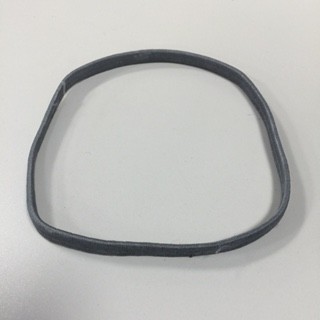
In the creation of project Brain Stream, I’ve had my hands in many things. I’ve contributed to the idea for the overall project in tweaking the ‘thought to tweet’ concept, and worked on the prototype to be used for the video with sketches and gathering materials that would work for the device. Eventually the rest of the group decided that a ‘simple’ look for the device was best and settled on the headband I spraypainted silver (was originally white).

IMG_5574

This is a photo of the final prototype I produced.


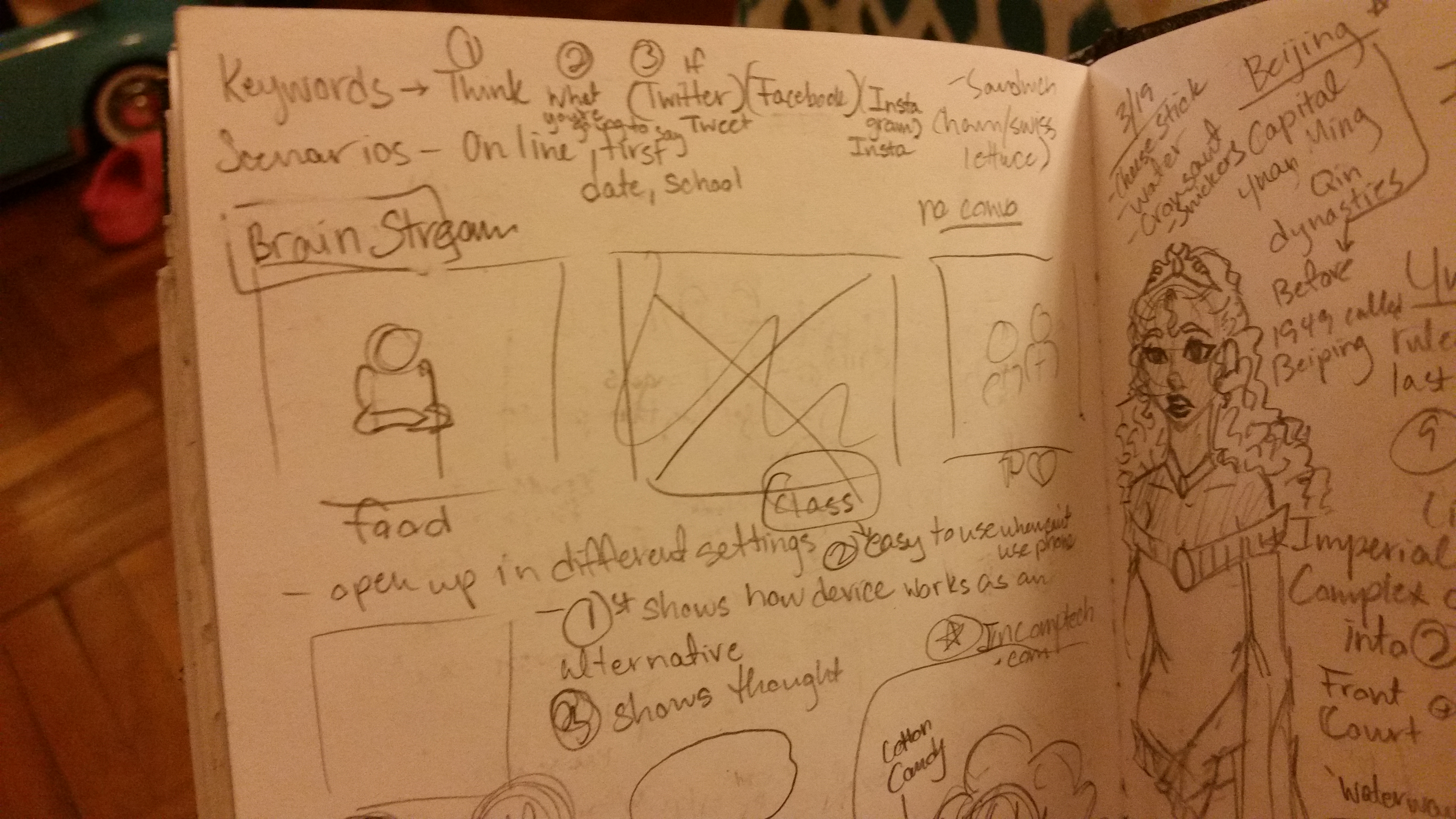
I had a part in creating the storyboard as well and giving input on how to go forward in shooting scenes for the promotional video for Brain Stream. In addition, I’ve also been present as an actress for various scenes of the video.

20150330_182218

This was the storyboard I drafted while we were deciding on what scenes to include in the promo video.


The rest of my group met about twice on campus separate from class time and although I could not be there as a result of my commute and living off campus, I made sure that I was updated on what was discussed and pulled my weight in full.

Lastly, I wrote the summary that assessed our project and its meaning, and thoroughly went through the influences that affected the origin of Brain Stream.

https://www.courses.tegabrain.com/SS15/?p=871

I also mentioned how this device could be used in the near future in benefitting individuals with disabilities and aiding them in social graces, as well as discussing in depth the process of how Brain Stream came to be.

Screenshot 2015-03-26 at 1.21.58 AM

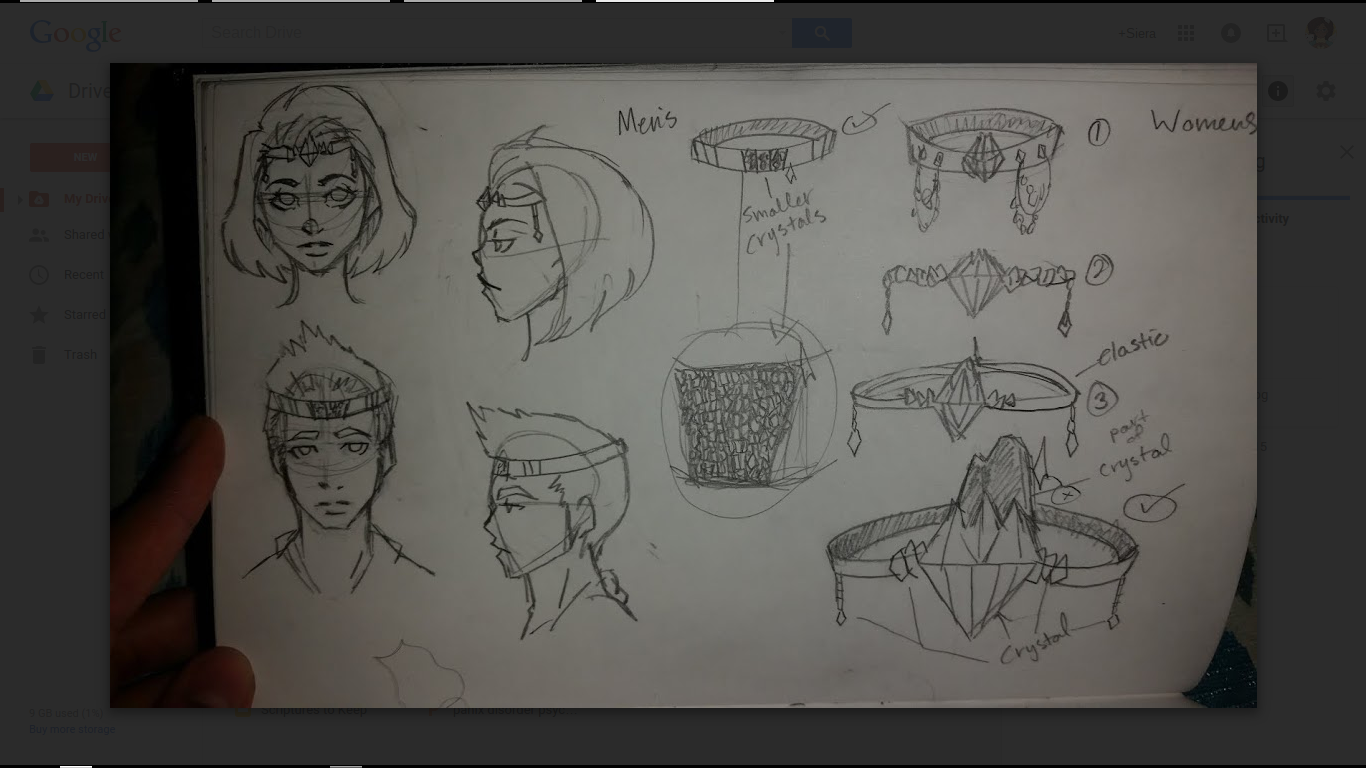
These are more recent sketches I produced of a future Brain Stream device for men and women.


#Week 9 Update

This week we were able to settle on everything we needed to do. In the workshop last class Alex, Siera, and Julie filmed the video. I worked with Professor Tega on making an in class demo with processing that used the Twitter API and Google talk to text API. We then met earlier this week to edit the video. Alex and I did most of the editing work for the video. We were able to use my H4 Zoom recorder to capture the narration of the video. The main shots were edited in final cut pro. Alex then transferred it to After Effects to add the tweets being shown in the video.
While editing the video we thought of our logo which ultimately ended up being a brain with the wifi signal. We felt that this was appropriate to demon-straight our prosthesis being able to bring your thoughts to social media.
Overall we were able to get the vision we wanted for our project out of the video and a working demo to demon-straight the concept.

Our concept headband for the video:
IMG_5574

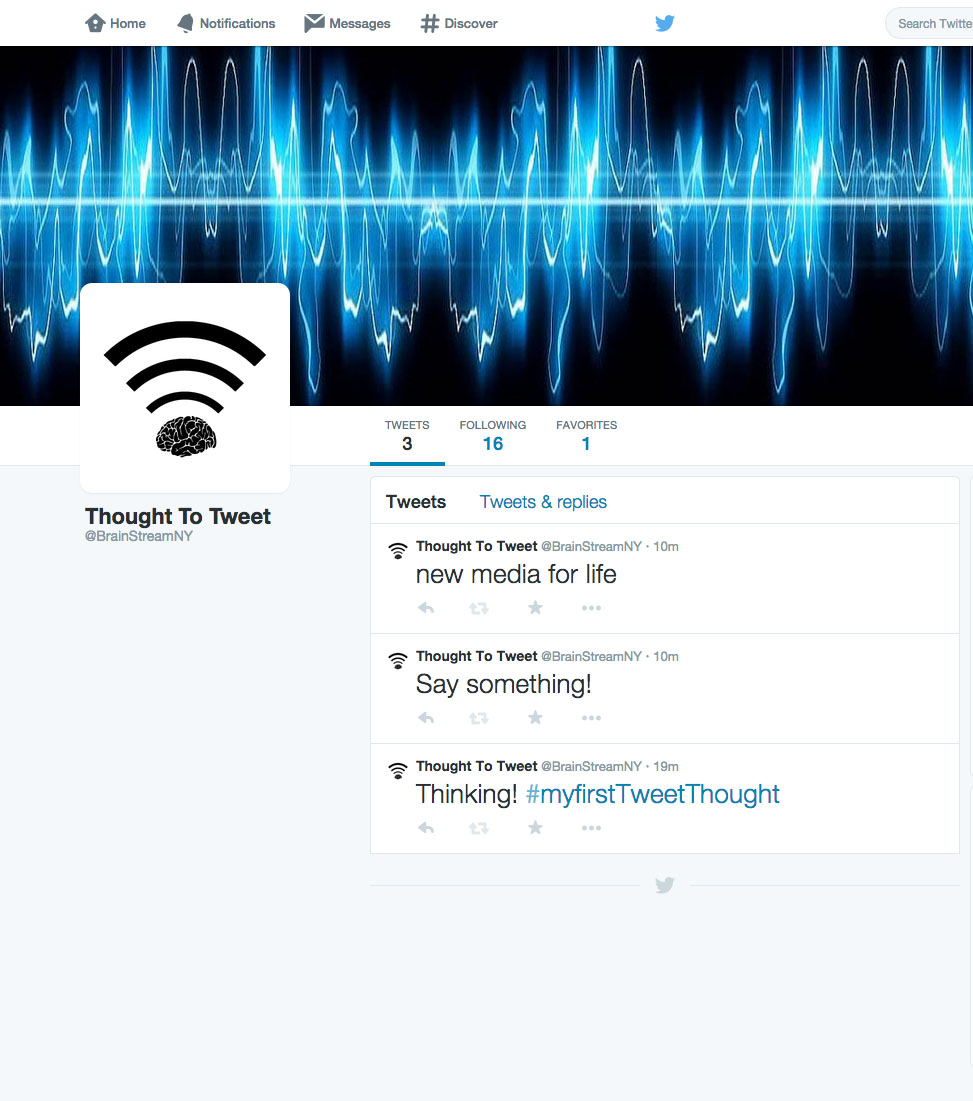
brain-stream-twitter-preview
The Brain Stream Twitter Account: https://twitter.com/brainstreamNY

Here’s our video:
[vimeo 123347282 w=500 h=281]

BrainStream from Alex Zahn on Vimeo.

Here’s the Talk to tweet program:

TRM – Dani Llamas, Erica Vitucci, Ivana Lukic, Zach Britt

For our social prosthetic, we decided to create a wearable that displays Terms and Conditions using an LCD screen connected to an Arduino. The idea spawned from the abundance of these terms that we must view to join social media websites. We had two initial focuses:


  1. “Using the wearable display to show how crazy it is to expect us to read the entire terms and conditions before accepting.  Also show off how creepy/extensive the actual terms of some services are today.


  1. Using the wearable as a “futurist” concept.  This way the terms and conditions are part of social contract between two people in day to day interaction.  So in order to have a conversation or get to know a person you need to accept their terms and conditions.  Its like if you were required in real life to request someone to be your friend and they responded yes or no right there.  We could also play with breaching, were some people have odd requirements in their contracts, like you can’t say certain words to them or it restricts your body language.”


We were unsure at first if we should use real terms from social media websites such as Facebook or Twitter, or to create our own terms that could vary from person to person. We also considered jumbling existing terms to create a sort of composite. We ended up using the second idea, to make it seem like a more personalized experience.


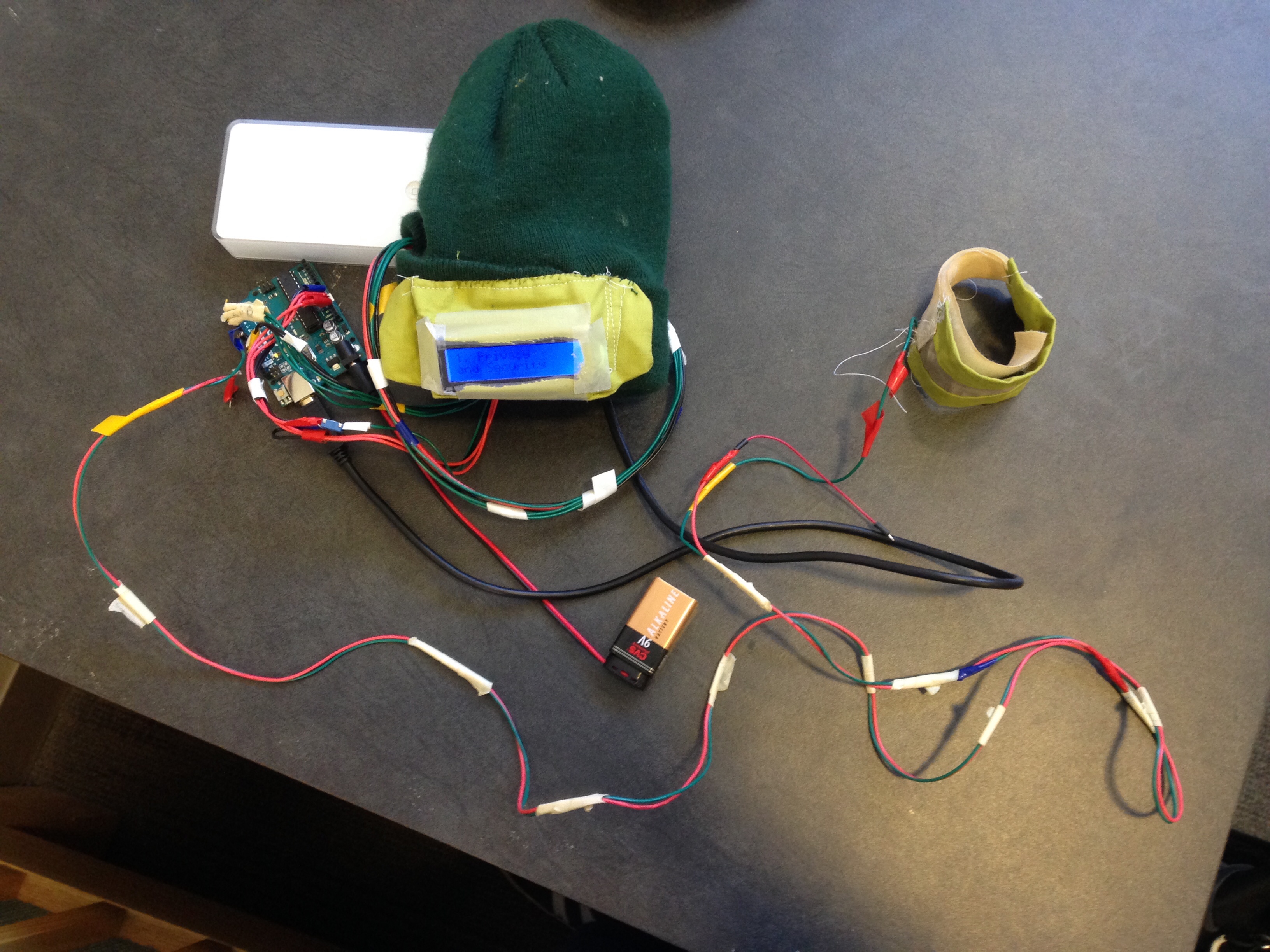
For the wearable itself, we first thought of making a headband or a shirt patch with the screen attached. This evolved into an actual hat, with the inclusion of a hand type accessory to “accept” the terms. This turned from a wristband to a hand-band with conductive fabric sending a sensor to the arduino to turn off the screen.


FullSizeRender


We then drafted the terms and conditions, using the Facebook terms as a reference. Here is an example of the terms we ended up with:


  1. Privacy and Safety
  • You are not allowed to disclose or sell any personal information about this user to any other persons or organizations.
  • You are not allowed to share any inflammatory, malicious, misleading or any offensive information with this user.
  • You are not allowed to use any methods of bullying or intimidation towards this user.
  • You are not allowed to raise your voice over 30 dB while speaking with this user, as they are easily frightened.
  • You are not allowed to touch this user in any way without their clear permission.


  1. Disputes
  • In the case of a dispute, you are not allowed to ignore this user or avoid confrontation.
  • You are not allowed to say anything inherently mean, hurtful or something that may make this person cry.
  • You are required to apologize first, even if this user was in the wrong.


We documented the wearable in action with a video that can be viewed here:

notiCRY – Alissa Milano, Emily Locke, Andrew Kaplan

Project Brief and Design Rationale for “notiCRY”

Alissa Milano – Emily Locke – Andrew Kaplan

Project Brief:

Intro
We want to create an emotional/social prosthetic that senses when the user is crying or distressed.  Once activated, the device will contact one of the users friends to let them know.
Ideas/Themes
  • Privacy
  • Defy common gender norms, sociological blocks, and assumptions of emotions
  • Peoples ability or inability to ask for help/show vulnerability
  • Digital devices having control over how humans handle their emotions
Intention:
  • Question how much our devices should be involved in our emotions.
  • Is it healthy? Does it invade our privacy?
  • Question gendered assumptions of emotions/crying
Target:
  • Everyone.  
  • People who have trouble asking for help.
  • People who have trouble crying.
Relation to Social Software
  • Breaching social norms and demonstrating other uses for ‘common’ things.
  • Alternate uses and future possibilities for common devices/technology
Design Rationale:
Coding:
View the code HERE
This project was coded using a scripting language called “Python”. In order to interact with the Arduino board, some steps had to be taken. A protocol called “Firmatta” used by the computer to communicate with the Arduino board had to be flashed to the device memory via the Arduino IDE. Next, a Python library called “BreakfastSerial” had to be installed. BreakfastSerial is built on top of pyFirmatta, thus abstracting away some of the more complex aspects of the Arduino board making it easier to use. The code interacts with a third-party API library called “Twilio” which is used to send text messages to a registered phone. 
We chose to code this way for two reasons;  We are much more proficient programmers in Python, and this is something we would find useful in everyday life. Python is a very powerful language to use, that is extremely easy to write in. Many thanks to the developer “Swift” for coding a Python library for Arduino! Other alternatives that were considered were: “Sendgrid”, “Lithouse”, “Temboo”, “IFTTT”, and using the Arduino IDE with Processing. The method we used was tricky to set up, but very easy to use and implement. 
Physical Design:
The basic schematic is shown below, with a few minor changes. Instead of a button, we use two moisture sensors, when they sense moisture the circuit is completed. This schematic also excludes the LED that is connected to the board. The moment the circuit is completed, a condition is satisfied in the code that begins sending a predefined message to a registered number.
In theory, it would be nice to have a fully wireless device, however the required part was upwards of 100$ which was out of our budget. For now, our board must be connected via serial with a computer to send messages to the phone. The board, and moisture sensors are located within our hat and glasses contraption. Two moisture sensors are located just beneath the eye, if either sensor detects moisture, the circuit is completed and the message is sent. 
We are trying to target all audiences, so we attempted to make our design as androgynous as possible. Time will tell if we were successful!

Assessment 2 – Project ‘Brain Stream’

In the development of this device we each took into account and thought in depth about the various ways in which humans interact with machines, and use them as extensions of ourselves to communicate within the virtual world. In society many avenues are taken within the virtual to satisfy different feelings such as loneliness, and even heart ache. Looking back to last weeks assignment with the Radiolab podcast titled ‘Talking to Machines’, we referred to many of the key points made in the transmission involving for instance, the way individuals become so infatuated with machines because of this need for companionship and the fact that people who are emotionally imbalanced turn to the realm of social media in the virtual. Thus the theory of social applications such as Facebook, Instagram, and Twitter are becoming ‘interactive diaries’ for these individuals as was mentioned in the podcast.

Now more than ever, individuals have turned to social media to catalogue and record every waking moment of their lives whether it be through photos on Instagram, status updates on Facebook, and tweets on Twitter. In turn through this constant practice people have become completely attached to social media.

In the beginning, our plan with this device was to create something that allows people to recognize just how attached they’ve become to social media as an entity. We began generating ideas and concepts on how to develop an easier way to send out messages verbally without the use of a keyboard. We developed this idea further by speculating how the user of our device would be able to send thoughts into a social network without using their computer, tablet, or smartphone. The main example of the expectations we had for our device was to be able to develop and send ‘tweets’ with our very thoughts. In this we speculated that the user would grow annoyed with the device out of the realization of how many times they would have to say ‘tweet’ or ‘facebook’ in order to properly send out their updates. Of course this device started to become a lot more fictional in the discussions we had and as our ideas clashed and built upon one another, project ‘Brain Stream’ was formed.

 In developing a prototype we considered how this device would fit discreetly on the human form, and developed designs for different wearable items such as a hat, t-shirt, watch, and a necklace. Eventually we decided upon a head piece for the prototype to shy away from the sci-fi theme we were touching upon in order to make our device appear more realistic. I had many designs for how the prototype would look and developed something flashy in attempt to build off of a humorous approach we were thinking of when creating the promo video for the product. However, the group suggested that the prototype appear to be something realistic yet hidden from the eye. The headband I chose seemed to be the perfect example of this, being that it looked modern enough to not be considered as our device thus making it harder to identify in situations where someone might want to ‘tweet’ something to their page but can’t because of the environment (ex: the middle of class, job meeting, bathroom, etc.).

Building off of the fictional aspect of our device, I had proposed a few ideas to the group involving how those with disabilities can benefit from ‘Brain Stream’ and ideas that could take our device beyond our present time period and belonging to the technology of a more futuristic world. For example, I developed a theory for individuals that were blind or mute who would use our device to be able to be able to communicate with others using their thoughts and projecting them onto a screen. Another idea I had that applies to my primary one, was for the individuals that are a bit socially awkward, and for those not able to speak clearly or associate with others. The last idea I had for the future of our device was that it will advance to a point where more than one person wearing the headpiece will be able to communicate with one another through only their thoughts, and will allow others in their vicinity access to the thoughts kept in their mind. Sort of like telekinesis, however it will only be when one dons the ‘Brain Stream’ that they will have this ability.

 Screenshot 2015-03-26 at 1.21.58 AM – Prototype Sketches

In closing, final thoughts we had for the prototype was for it to be in different colors after the original silver model into shades that complement the skin color of the individual wearing it. Therefore making it even more impossible to notice when someone is using it.

In regards to using the Twitter API, the group decided on using it to display a physical demonstration of what our device would run with speech as the substitute for thoughts.


– S.E.


Week 9 Assignment Summary

For this week, I mainly worked on fixing up my group’s Twitter for our prototype. We eventually narrowed down our list of potential names and we picked “Brain Stream.” Down below is a preview of my group’s prototype Twitter:

brain-stream-twitter-preview

I designed the logo on Illustrator with the help of group members generating the visual concept of our Twitter profile photo. I took their idea of using a brain symbol and wifi icon, and put them together. This concept was meant to illustrate a brain sending out “thought waves” instead. Lastly, I decided to upload an image of brain waves for the header photo in order to maintain constancy with our concept.

As for the rest of group, Anthony managed to get the Google Talk to Text API working on Processing and it’s officially sending out tweets to our prototype’s Twitter. Alex wrote a short transcript for the small narration of our video and as well providing her voice for narration. And lastly, Siera helped write up the overview of our assignment that discussed about our prototype and process.