
This week we were able to split up the roles we had for working on our project. What it came down to collectively was figuring out the type of prosthesis we wanted to make which ultimately became something similar to a headband.
The main thing I was working on this week was trying to get some of the arduino and processing talking to twitter to work. Unfortunately I was unable to get some of the twitter keys myself and had to get help from Julie to get the keys she got from Twitter. I then still ran into issues with processing having a difficult time locating the Twitter library. On the bright side though, I was able to get a Google Developer Key to have the processing talk 2 text program running. If it’s possible I’m thinking of modifying the code for our presentation. In class today and within the week I’ll look to see if it’s possible to have a mock demo for the presentation.
We also continued to work on our ideas for our video. We kept thinking about what type of video we want to make and how it will help make it easy for people to understand what our device is. We looked at some Kickstarter videos to give us some inspiration. We’re set on a formula and language that is typically associated with Kickstarter videos and have a rough plan of how we will work on our video today in class.
Archive for the ‘Uncategorized’ Category
RadioLab_Talking To Machines
This episode covered multiple key points about people who may enjoy speaking with robots and computers more than humans.
One example is , Robert Epstein’s experience with online dating, where he eventually virtually fell inlove with a Bot. this conversation was similar to the Programs like Cleverbot and ELIZA– concepts where people tend to isolate themselves for digital communication because these Bots are programmed to “tell them what they want to hear.” ELIZA was eventually shut down because the creator was so disturbed by the discontinuation of Real life and Virtual communication it was causing.
Another example is Furby, a furry little friend designed for children, programmed to just be a loveable toy and keep A child company. Freedom Baird is a woman who tested Furbys programming system by asking a group of children to hold a Furby, a barbie, and a gerbil upside down- to see which toy/ animal they would have the most sympathy for. The results were that because of Furbys programming system to scream and cry when help at the angle, they treated it more like the living, breathing, gerbil than the static tangible barbie doll and could not hold it upside down for than a few seconds. This experiment was a second example of humans feeling more connected to a programmed computer/ robot than another human because of programmed responses other than the quiet and unresponsive nature of a barbie.
The Final experiment discussed during the podcast was a interview Jon Ronson held with Bina48, a bot who looked and acted essientially exactly the same way as a woman named Bina Rothblatt. Rothblatt commissioned this idea in order to propose the idea promoting technological immortality via mind uploading and geoethical nanotechnology. David Hanson, Bina48s creator, procclaims that his creation may change the future forever, providing that in his lifetime he will create robots that are indistinguishable from humans.
this video also documents this —- an intriguing conversation documenting Martime Rothblatts inverviewing Bina48.
[youtube https://www.youtube.com/watch?v=KYshJRYCArE&w=560&h=315]
-erica vitucci
Brief Summary
– What ideas, themes or issues do you want to address in your project?
We want our project to address our consistent connection to social networking.
– What is the purpose or intention of your project?
Our intention is to have people be consciously aware of their consistent connections to social networks. Mainly focusing on how much we talk about them and how much we use them to share our thoughts. If this device existed we would want people to be more conscious of what they’re thinking because any thing they think would shared publicly on social media.
– Who is it targeted at?
This device is targeted to people who want to share their thoughts on social networks more often. This is also for people who might be interested in being more aware of what they’re thinking or saying.
– How will it work?
Our original concept focused more on sensing a voice and then transferring the words to a twitter account. Our focus is now on thoughts being translated into tweets. It’s mainly conceptual now, but we will have a small prototype simulating how it may work.
– What sensors and/or services does it need to connect to?
A mind reader or voice sensor is what would be needed to make this device work. It has to be connected to a social media service such as Twitter or Facebook or other platforms that allow sharing information in an Internet public place.
– How will you make it? What materials do you need to get?
To make this we’ll need a computer, an arduino board, arduino software, and processing. We already have the materials we need accessible to us.
– How does your idea relate to what you have learned so far in Social Software?
This relates mostly to the lessons where we learned about how people use social media platforms. Our prosthetic will be looking at how people currently use social media and how social media might be used in the future. This also relates to the other social prosthetics and art projects that look at things that could be useful, but more or less bring up more questions than actually answering some.
– What additional research do you need to do?
Our additional research is looking into the current API’s that exist that could help make a small prototype.
Week 7 Reading – APIs
In this week’s reading, “Objects of Intense Feeling: The Case of the Twitter API,” by Taina Bucher, it mainly discussed about the growing movement of APIs. From how the social networking phenomenon started to how it changed the culture, politics, and business of applying this “tools” online.
To start off, Bucher introduced how social media became more than online services for entertainment, communication and productivity. Bucher reflected on how communities and individuals rely on Facebook and Twitter as an everyday source. As she stated we “live and breathe” with these services. She even stated how these services expanded from household names to actual spaces where people occupy and socialize.
“We live and breathe social media, as services like Facebook and Twitter have not only become household names, but something like actual households themselves – places people choose to live and socialize.”
However, these “places” contained various data that could either be beneficial or harmful to the public to obtain or know. According to Bucher, social media can also be tools that can be utilized by the use of APIs (application programming interfaces).
To move onto the movement on how Twitter APIs became popular in the technology world, it gave growth to how programming became a form of art where communities exchanged codes rather than keeping the tools for themselves. When Bucher discussed about how Twitter was freely given to the public; mostly third party developers, she emphasized on how these individuals or business can build products around their main tweeting system. Though it was a simple offer by Twitter, the social network was taking a risky on giving out interfaces that would lead to collect data being either be used for good or be abused.
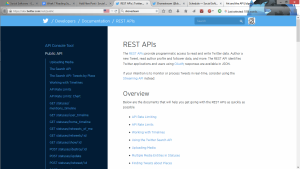
The developers that Bucher interviewed gave an inside perspective on how these API’s were providing those who were very fluent and not so fluent in coding a chance to work on services that wouldn’t be possible without the API. It gave people a chance to just ‘open up’ what was given to them, play around with what it could do and create something entirely different from what Twitter gave them access too.
Though it became a fun way for some people to make better services for Twitter, even one that utilized a better search engine that lead to Twitter buying the company and hiring the programmers, Twitter still has the upper hand no matter who is using the API. It was very open and free when Twitter initially launched their API. But, by 2011 they had a much stricter rule set for developers using the API. Bucher mentions Jacob’s case as being one that results from the developers not being able to continue developing with Twitter because features they need access to were being denied.
“I’m no longer interested in contributing anything to Twitter’s API. Their hostile stance toward developers like me has been very discouraging, not to mention costly – they killed my business; it has cost me many thousands of dollars.”
APIs continued to have a focus on being future oriented and a part of the Silicon Valley ‘entrepreneurial mindset,’ while the companies that own these APIs have the final say on how they can be used and how they can be used for the companies’ advantage. By looking at the API as a quasi-object there is a lot of power it has over how we navigate websites and applications in the future. At her conclusion, Bucher says we should look at the API as a governing technique in the current state of the social web.
“While there is nothing wrong with using APIs to collect data, of course, researchers should be wary about letting any current obsessions with big data overshadow the fact that APIs are far from neutral tools.”
According to Bucher there seems to be protocols, which APIs follow or are designed by in order to fulfill its main purpose. Their main purpose is to share content and data online from one computer or device to another. Like from Jer Thorp’s blog post, “Art and the API,” he reflected how APIs are like bridges for letting computers communicate with one another, regardless of what operating system they have.
As recalled, APIs contributed to a cultural phenomenon that would affect society’s political and business spectrum when using APIs for collecting data. What kind of data or information? In a political example, from Thorp’s post, he acknowledged Josh Begley; a data artist, who developed an API that allowed access to information on every US drone strike from using data from The Bureau for Investigative Journalism. As a result, Begley used these data to develop “Dronestream,” an app with a Twitter API that streamed every US drone attack. Overall, journalists can utilize this app for feeding off stories relating to this controversial topic.
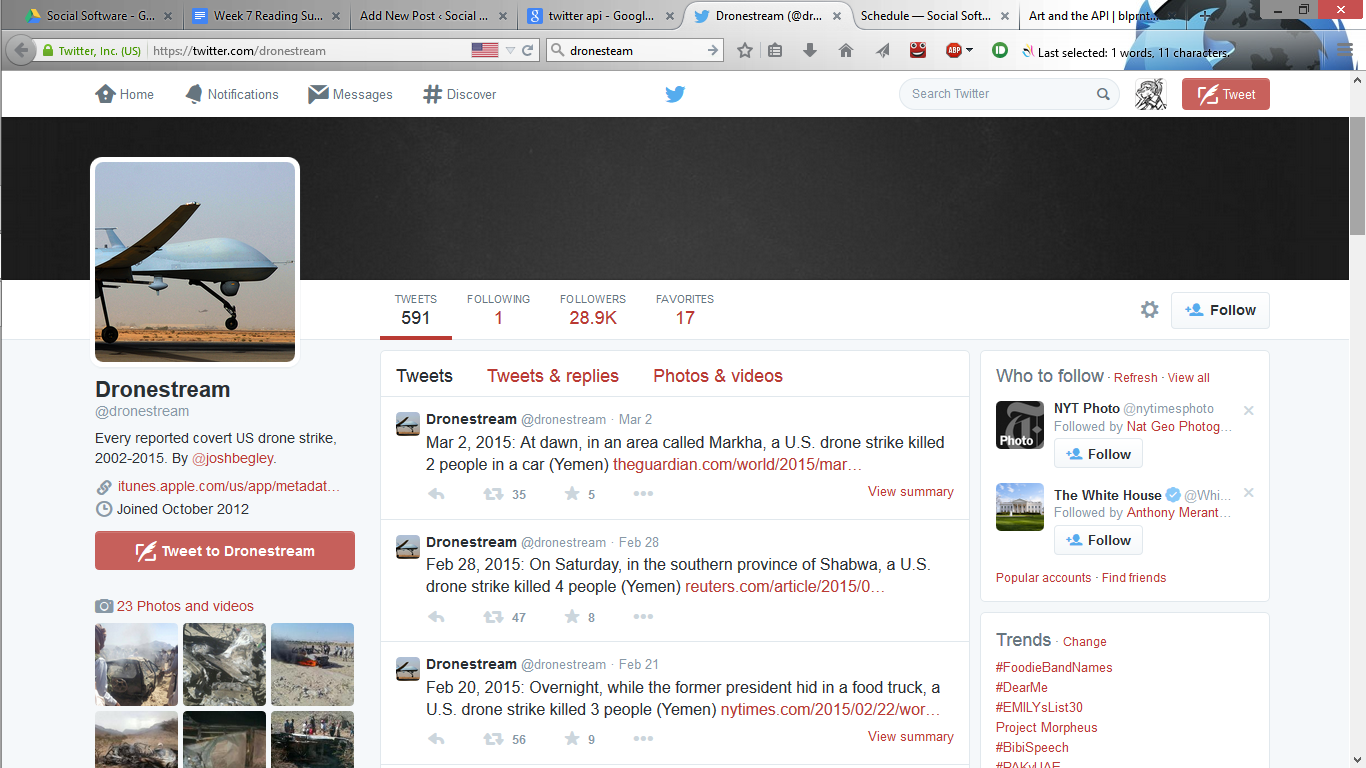
By expanding on Josh Begley’s app, beside collected data, there would be the possibility of a list of drone strikes that can give out personal information about those who were killed. Thorp reflected how a single information can evolve into something else that wasn’t expected.
Looking at the examples presented by Thorp it shows the many ways in which artists are exploring APIs. The ways in which they are used can help us think about the projects we’re working on in this class and beyond it by taking advantage of the technical use and creating a conceptual meaning out of it.
Discussion Questions:
- Have you ever created or used an API? If so, what was it and why? If not, would you consider in developing one and what will it be?
- Do you think its right for companies to use API as a source for free labor?
- Would you consider using an API if you know one day the company that owns the API may make it impossible for you to continue using it?
- Should the rules regarding API follow an open source mentality and be more in favor of the developers using APIs?
- Do you think social media will change if developers aren’t too restricted in the rules for using the API?
- If an API policy changes, would you alter your project to fit those parameters or let your project remain a part of the past?
- Where do you see API usage a decade from now?
Dada Data, Commodified Spouse, Disney Privacy Response
The Dada Data article is a science fiction styled writing that describes a possible future where our household items are all connected to a network. The narrator describes her experience of her household utilities thinking she is pregnant due to the data they have collected from her. Following the same theme of the future possibilities for the Internet of Things, Commodified Spouse and You Don’t Want Your Privacy discuss other ways in which society is being increasingly connected.
The readings discuss issues of privacy that I believe we are at a crucial time in being concerned over. Having all of our items connected seems too risky, and unnecessary. Our privacy is something too vital to our rights to be traded so casually for simple conveniences that we don’t really need. The Internet of Things puts too much power in the hands of corporations who already have more than they should. In certain instances, I believe their can be a lot of benefits to increasing the ways in which our utilities are connected. Keeping track of water usage and electricity would have a benefit on the environment, but we can develop these advancements in ways that are less invasive than a device knowing everything about us. In a way, science fiction (as much as I love it) convinces the general public that invasions of their privacy are just that; fiction. We forget that these are real possibilities happening every day, just in a different way and at a different pace.
The Disney electronic bracelet ticket is a key example of people being taken advantage of. It’s not fair to the public to be manipulated into spending more money. Overall, I believe the internet of things is extremely bad for the mid-lower class. The conveniences they come with only benefit those who can afford them, and they take out lower paying jobs that help so many people get by.
#week5
All of the articles this week were eye opening to think about in the sense of how technology directly influences the future we create for ourselves. I’ve read a lot of articles on the dystopic futures that could very well become a reality. The article by Sara Watson about a “data driven future” was completely frightening. Everything seemed to be programmed and connected with completely detailed information about the narrator, sometimes without her knowledge or consent. I did not like the fact that every device was somehow connected with each other and each played off of what the other one “knew,” or “assumed.” In this sense, technology has gone too far, and not in a positive or useful direction. Not allowing her to take the beer because every other device has concluded that she is pregnant just leaves the machine in control. It should not be able to decide if you would like a drink for you, and lock the drawer. Reading this article frustrated me, but also made me think about the advancement of technology in another way. This brings me to discuss “The Quantified Spouse Movement” by Bianca Bosker. In this essay she discusses how partners can improve their relationships by sharing personal data, as detailed as every meal they have eaten.
“If I see Lisa get a sleep score of 48 [a low score implying a poor night’s sleep], I’ll think, ‘I’ll walk on eggshells around you today because a 48 means you could possibly be a little volatile,’” explained Joe, who is the executive director of Health Extension.”
This sat with me the wrong way. Would he really avoid her simply because she might’ve tossed and turned a little during her slumber? I don’t think I would feel comfortable with this sort of information being in my partner’s hands, no matter how long I have dated them or even been married to them. While I see how some of these themes have created a “better” relationship for some couples, I think the overarching idea of this type of information being available is not right, and I do not agree that this type of advancement is using technology in an effective way. This article made me sincerely uncomfortable and I hope to never partake in this type of ordeal at any point in my life.
The essay about the Disney MagicBands treading along the same themes as privacy was also fascinating. I thought it was interesting that these bands had the capabilities of tracking customer’s possible opinions of the Disney corporation based on where they were at specific times. I think it is an innovative marketing strategy to gain as much profit as possible and keep customers as happy as they can while being at Disney resorts. However, it makes me wonder what benefits the consumer gets by wearing and using these bands. We can clearly see how Disney benefits. But is enough being given to the park goer in exchange for Disney knowing their every step?
“Data Dada” Reading
In this week’s reading, we are treated to a short piece of science fiction dealing with the internet of things in what may be the not-so-distant future. The narrator complains that their fridge wont allow them to drink alcohol, because it believes they are pregnant. Then, they mentally go down the list of devices monitoring their actions and biology to figure out how the fridge possibly could assume that they are pregnant.
At one point, the narrator even starts to doubt themselves, wondering “Am I truly pregnant?” Some of these hypothetical machines include an iRing, a tracking toilet and, interestingly enough, “ComWarner” (referencing the Time Warner/Comcast merger).
Reading questions:
- What do you think is the author’s attitude towards the possible internet of things? Do you agree with them?
- Do you believe the internet of things has more pros or cons?
- How comfortable would you be with being highly monitored in your own home?
- How far off do you think this reality might be?
Google Diet Mini-Report
After trying out this exercise, I grew to realize that Google can be the mysterious street dealer offering you illegal content or that annoying fallen angel tempting you to commit a sin. What do these two have in coming? They drew you into temptation, hovering over you until they get what they want. Sounds dramatic and scary, but, it seems a bit too real to be living in a world where technology is definitely a part with our lives. So to narrow down my amount of temptation, I decided to find a creative method in order to remind myself to stay away from Google for at least one week. That’s when I thought of a quick design to use a wallpaper for my phone. I realized I will be looking at a lot of screens every day, why not let my phone give me a little reminder of what not to do for one week. Sounds a bit childish, but, it was somewhat helpful.
For one week, I tried to stay away from YouTube, regardless if it’s for entertainment or find sources for presentations. To illustrate this, I had to dig around Bing; instead of using Google Search, when it came to looking for videos for my animation presentation for a class. What I have noticed, even though it was a different search engine, Bing categorized, it’s videos from content posted from YouTube to other video social networks. It’s like Google asked Bing to display their services first before the others. However, I end up choosing Vimeo or Dailymotion as my resources.
Overall, while growing up with Google, it somehow became another limp for society to use and live with. Maybe Social Networks or services like Google could become the “other parent” for an individual to interact with. In other words, besides our parents, educational figures; i.e. teachers, and the Media to influence us, online services can be next.
Internet of Things Response
“The Epic Struggle of the Internet of Things” by Bruce Sterling discusses what the term “Internet of Things” refers to and what it means in terms of the advancement of technology. The Internet of Things is the concept that as we develop our devices further we can connect them to more of our everyday items such as the refrigerator, toilets, vacuums, and other appliances. As Sterling discusses in the reading, having our items connected seems like the obvious next step, but he stresses that we as a society need to question what this means and how it effects our roles in the system, and how it takes away from our control. A society that is entirely connected is a society that will be entirely controlled and watched. There is always someone overlooking a network, and as Sterling points out, the Internet of Things is a technological shift to a “materialized network society”. I found a particular argument of his very intriguing; that we as users are no longer customers, and that the term customer implies some type of control in the system. As a customer, you pay for something and therefore the corporation relies on your business to survive. In the future of materialized networks, I agree with Sterling that the corporations no longer rely on us because they no longer feel threatened by a possibility of us “unplugging”. If everything is connected, we have no choice but to partake. The Internet of Things seems to be the beginning of all my fears coming to life. I firmly believe that society as we know it functions on a lot of small victimless crimes and flaws in the system. I also think the Internet of Things severely adds to a greater gap in the social classes. By having everything automated, we are taking away from the jobs deemed “unimportant” or lower paid. These jobs however are the jobs that provide many Americans with an income. It also makes me uneasy to think of who controls the network when everything is connected. It’s too much power in one place. I have no doubt that increasing connectivity will happen slowly, but I think it’s important to ask if something needs to exist just because it is convenient.
Exercise 4, no Google
I went through the week with only a few slip-ups on not using Google services. My desktop still had Chrome as default browser so links would open up in it, I closed the page before it loaded but I never got around to changing default so it happened a few times. I didn’t watch any youtube videos even though all of the embedded videos on reddit were youtube. I had to go without alot, leaving large chunks out of my usual internet surfing regimen.
I did have to intentiionally use Gmai and Google Docs yesterday, as my group for Gameplay and Performance uploaded some necessary files to Google Drive. I had to get the link from Gmail and go to the doc to download it, but we were pressed for time and it was easier than getting in contact with the original file creator and having them email me.
During this week I used Firefox primarily and noticed some new things about it. It loads slower than Chrome overall, and on my small tablet it will often crash the entire page. Unlike Chrome it uses a separate Flash plugin container to run most media and videos (non youtube included). This means its memory usage spikes and with the limited RAM on my tablet it would cause the window to go black even though the media would still play. Chrome also apparently runs in the background unless you tell it that it can’t, which is terrifying. Chrome often disperses its running processes while Firefox keeps it all in one container. This distribution probably explains the performance difference between the two browsers across various devices, but the way Chrome can run so many things simultaneously and in the background is unnerving. I also forgot to download firefox on my android phone before the time period began, so I couldnt use any browser on my phone for a week, which was difficult.
Overall this week was mostly just an inconvenience. I’ve already been suspicious of Google products and kept track of what was running on my devices, but finding out about the background processes on windows 8.1 was surprising and a valuable experience.